Meet the animal
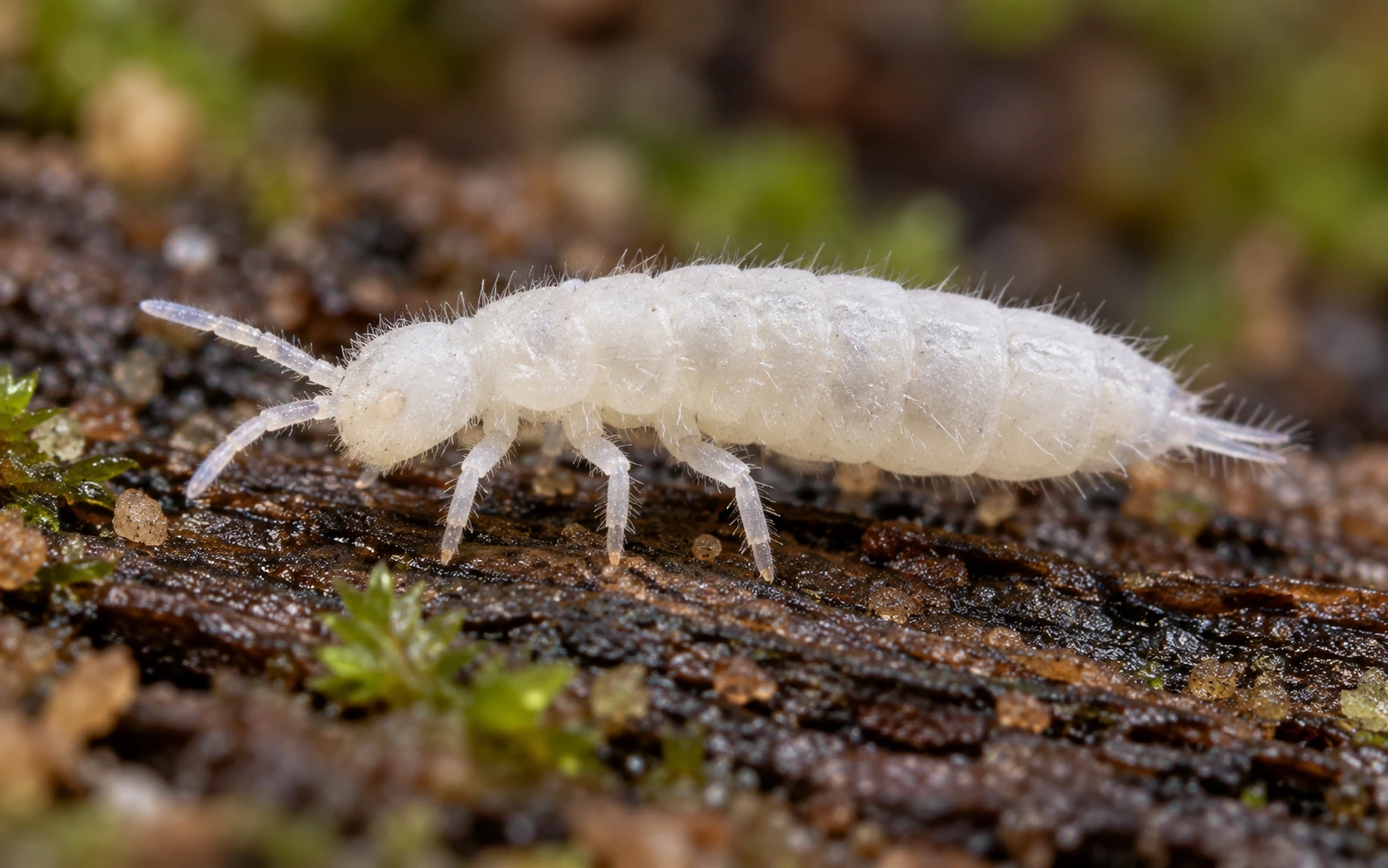
Folsomia candida is a springtail, not a small woodlouse. Several pale springtails share trade names, so retain the supplier’s scientific identification. It is widely used in soil testing; that does not establish compatibility with every warm vivarium.
Before you choose one
Maintain a continuing colony rather than expecting a one-off cleaning additive. This species can reproduce without males. No single pet lifespan or maturity timetable is established here. Keep labelled backup cultures and a plan for contained transfers.
Set up its home
The Canadian laboratory method uses covered vessels with moist plaster-and-charcoal substrate. It is a reproducible culture method, not a universal display-enclosure standard. Provide air exchange, retain moisture and contain the tiny animals without standing surface water.
Temperature and safe heating
The laboratory protocol uses air around 20 ± 2°C. That is a documented condition rather than a proven optimum for every habitat. Measure your culture and keep it away from direct sun and heaters that rapidly dry the surface.
Daylight, shade and UV
Use good observation light and a day-night rhythm without overheating the vessel. Soil shelter remains available. The reviewed protocol does not establish a species-specific reptile UV requirement.
Water, moisture and airflow
Check substrate moisture directly. A humid reading above a dry surface does not restore water the animals need. Keep the culture moist without flooding, and inspect more closely during warm weather or after a transfer.
Food and nutrition
Dry yeast is an established laboratory food, offered sparingly. Check that it is consumed before adding more; excess feed can support competing moulds or pests. Display-enclosure food availability varies. A declining culture needs a moisture and contamination check, not automatically a larger portion.
Behaviour and handling
Use magnification to inspect the colony without repeatedly disturbing it. Transfer carefully and keep cultures labelled. These animals are suited to culture observation rather than individual handling.
Health and life stages
A sudden decline, extensive fouling or changed reproduction needs a review of substrate, food, temperature and contamination. Seek experienced culture advice rather than applying pesticides or medicines. Keep tools separate between new, healthy and declining cultures.
Buying and keeping records
Verify scientific identity and current import requirements before ordering overseas. Prevent escapes during transfers and keep unwanted cultures or substrate out of gardens and natural waters. Only add the culture to another enclosure after checking its conditions and compatibility.
Your care routine
Prepare suitable vessels, small food portions, labels and backups. Inspect moisture and consumption regularly, refresh degraded material as needed and avoid chemical residues. Continue normal waste removal and drainage checks in a bioactive enclosure; springtails cannot cure infection or handle unlimited waste.
YOUR CHECKLIST
0 of 8 ticked
White springtail — Folsomia candida
Care hub: wildformexotics.co.uk/animals/white-springtail/
Ticks are kept only while this page is open. Print or download a copy before leaving. Completing the checklist does not establish that an animal is well or an installation is safe.
Use these reminders alongside the full guide. Adjust feeding and maintenance to your animal’s condition and measured enclosure conditions.
Sources
- Folsomia candida: a standard soil arthropod (Michelle T. Fountain and Steve P. Hopkin / Annual Review of Entomology (2005))
- Biological test method: springtail survival and reproduction, chapter 2 (Environment and Climate Change Canada)
- Import of pet invertebrates, amphibians and reptiles: IIN (GOV.UK / APHA and Defra)
- Guidance on section 14 of the Wildlife and Countryside Act (GOV.UK / Defra)
- Import or export endangered species: check if you need a CITES permit (GOV.UK / APHA and Defra)
Equipment checklist
Equipment examples for White springtail, grouped by care need. Read the checks before choosing. Shop links are Amazon affiliate links. Items without a verified Amazon match have no shop link.
Plan the whole setup: These examples cover only part of the setup. Meet every care need and test the finished enclosure before arrival. Suitable equipment you already own may meet the need; optional tools are labelled.
Check each item for your animal’s size and life stage, safe access, compatible controls and measured conditions. The list does not certify an installation.
Contained habitat
Essential care need
Secure ventilation and gaps smaller than the animal or nymph
Plan first: Check escape points and whether the animal needs height, floor area or substrate depth.
Also plan for: Prepare a covered, ventilated culture vessel that retains tiny springtails and moisture. No standard perforated enclosure is selected as a complete culture vessel.
Moisture and monitoring
Essential care need
A species-specific damp refuge or drinking access with airflow
Plan first: Check the places your animal uses and how they dry between wettings. A single humidity reading cannot describe the whole enclosure.
Exo Terra Digital Thermometer
Model: PT2472
Measure air temperature at animal height. Take independent warm and cool readings where the care plan needs a gradient.
Fit check: The remote probe measures air at one location. Keep it away from direct lamp heat, secure it safely and keep the display outside. Use separate probes for warm and cool areas where needed. Minimum/maximum readings help track changes; this device does not measure surfaces or control heating. Use a water-rated thermometer for submerged readings.
Food and maintenance
Essential care need
Clean continuing food supply and a way to remove spoilage
Plan first: Select tools and food for the exact species and life stage; do not substitute generic reptile supplements.
Also plan for: Dry yeast is an established laboratory food, offered sparingly.
Fine culture medium
Essential care need
A continuously moist but aerated medium in a fine-gap vessel
Plan first: Laboratory plaster/charcoal methods are evidence of culturing, not a universal vivarium recipe.
Also plan for: The source-linked plaster/charcoal method requires a prepared culture medium; no retail substrate is selected as a complete substitute.