Meet the animal
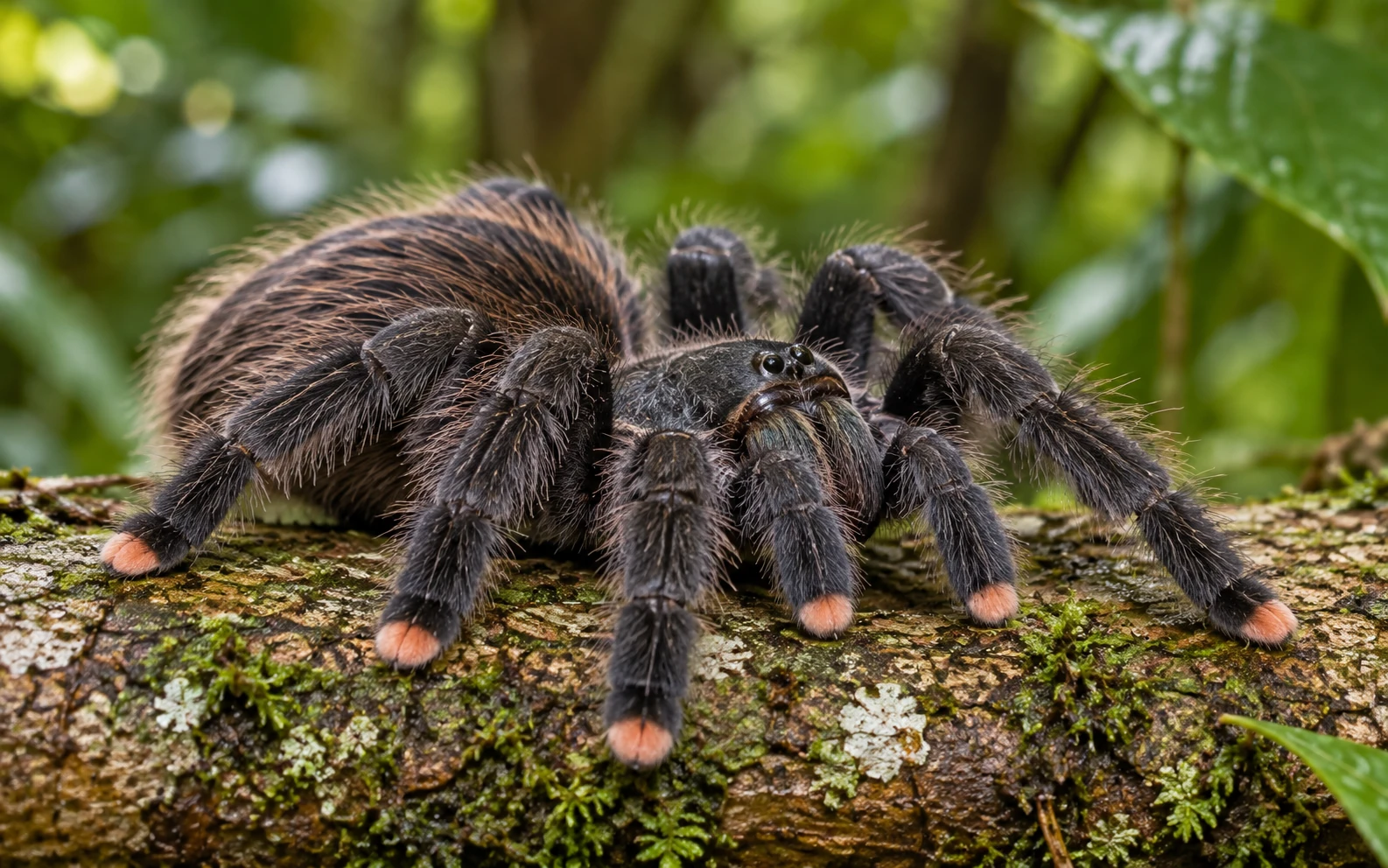
Avicularia avicularia is an arboreal tarantula from northern South America and Trinidad and Tobago. Pinktoe is used for several related spiders, so toe colour alone cannot confirm identity. Ask for the scientific name and provenance.
Before you choose one
Keep one spider and ask how its sex and maturity were established. Male and female lifespans can differ greatly, especially after maturity. Reliable care is mainly informed by experienced keepers; no precise lifespan or experimentally supported minimum box size can be promised here.
Set up its home
Use secure vertical housing with cork, stable branches and foliage for web anchors. Provide ventilation across the enclosure and safe access for water and cleaning. Keep sharp, hard objects out of fall zones. Scale gaps, prey access and transfers to the spider’s current size.
Temperature and safe heating
Keeper guidance describes roughly 21–27°C. Measure the enclosure and favour suitable room conditions over an exposed hot lamp or drying heat mat. Keep it out of direct sun. Small containers and spiderlings need closer checks because conditions can change quickly.
Daylight, shade and UV
The guidance used here supports ordinary room light with a regular day-night cycle. Preserve a shaded web retreat. There is no established beneficial UV dose for this species; a spider remaining inside its shelter is not a reason to dismantle it for viewing.
Water, moisture and airflow
Provide a clean shallow water dish, cross-ventilation and limited damp substrate areas. Do not saturate or seal the enclosure to meet a generic tarantula humidity number. Check spiderlings more often and inspect substrate directly. Cotton wool is not a substitute for accessible drinking water.
Food and nutrition
Offer cultured prey scaled to the spider. Keeper starting intervals of roughly 7–10 days for juveniles and two or three weeks for adults need adjustment to condition and moult stage. Remove biting prey and leftovers. After a moult, wait for the body and fangs to harden before feeding.
Behaviour and handling
Avoid routine handling: this spider can move or jump unexpectedly, and falls can injure it. Rehearse transfers with a catch container. Contact hairs can irritate and venom is not harmless. A spider on its back may be moulting; leave it undisturbed and do not turn it over.
Health and life stages
Wounds, leaking fluid, repeated grip failure or a persistent abnormal curled posture outside moulting need invertebrate-veterinary advice. The keeper phrase “sudden avic death” is not a diagnosis. Ask about a female’s mating history, as an egg sac could create a large separate-care obligation.
Buying and keeping records
Confirm identity and documented captive origin before purchase. Check current requirements before moving a spider across borders. Never release unwanted spiders or offspring. Keep used tools and substrate away from your face, eyes and food preparation areas.
Your care routine
Prepare safe servicing access and size-appropriate prey before arrival. Check water, airflow, escape gaps and substrate moisture. Remove waste and food remains while preserving useful webbing. Avoid the combination of over-misting, sealed housing and warm stagnant air.
YOUR CHECKLIST
0 of 7 ticked
Pinktoe tarantula — Avicularia avicularia
Care hub: wildformexotics.co.uk/animals/tarantulas-animal-11/
Ticks are kept only while this page is open. Print or download a copy before leaving. Completing the checklist does not establish that an animal is well or an installation is safe.
Use these reminders alongside the full guide. Adjust feeding and maintenance to your animal’s condition and measured enclosure conditions.
Sources
- Avicularia avicularia taxon details (World Spider Catalog / Natural History Museum Bern)
- Avicularia avicularia care (Richard Stewart / The Tarantula Collective)
- Tarantula care (2023) (Royal Veterinary College)
- Tarantula care (December 2024) (Royal Veterinary College)
- My spider is laying on its back (British Tarantula Society)
- Basic guide to keeping tarantulas (British Tarantula Society)
- Import of pet invertebrates, amphibians and reptiles: IIN (GOV.UK / APHA and Defra)
- Guidance on section 14 of the Wildlife and Countryside Act (GOV.UK / Defra)
- Import or export endangered species: check if you need a CITES permit (GOV.UK / APHA and Defra)
Equipment checklist
Equipment examples for Pinktoe tarantula, grouped by care need. Read the checks before choosing. Shop links are Amazon affiliate links. Items without a verified Amazon match have no shop link.
Plan the whole setup: These examples cover only part of the setup. Meet every care need and test the finished enclosure before arrival. Suitable equipment you already own may meet the need; optional tools are labelled.
Check each item for your animal’s size and life stage, safe access, compatible controls and measured conditions. The list does not certify an installation.
Contained habitat
Essential care need
Secure ventilation and gaps smaller than the animal or nymph
Plan first: Check escape points and whether the animal needs height, floor area or substrate depth.
Moisture and monitoring
Essential care need
A species-specific damp refuge or drinking access with airflow
Plan first: Check the places your animal uses and how they dry between wettings. A single humidity reading cannot describe the whole enclosure.
Exo Terra Water Dish Small
Model: PT2801
Provide accessible drinking water in a small, clean dish.
Fit check: PT2801 measures 5.5 × 6.5 × 3 cm externally. Check the usable basin, stability, safe water depth and easy entry and exit for your animal. Outside measurements do not establish a soaking fit. Clean and refresh water at least daily and whenever soiled. This is a small drinking dish, not an adult snake, dragon, frog or tortoise basin. Tiny spiderlings may need a smaller receptacle.
Exo Terra Digital Thermometer
Model: PT2472
Measure air temperature at animal height. Take independent warm and cool readings where the care plan needs a gradient.
Fit check: The remote probe measures air at one location. Keep it away from direct lamp heat, secure it safely and keep the display outside. Use separate probes for warm and cool areas where needed. Minimum/maximum readings help track changes; this device does not measure surfaces or control heating. Use a water-rated thermometer for submerged readings.
Exo Terra Digital Hygrometer
Model: PT2477
Optional air-humidity monitor
Track air humidity at an occupied position, alongside checks of ventilation and substrate moisture.
Fit check: Place the remote humidity sensor inside the enclosure, away from direct heat. The reading describes air at that point, so record its position and check other areas where needed. Inspect the substrate and damp retreats directly, and keep ventilation clear. A humidity reading cannot show whether an animal has drinking water.
Food and maintenance
Essential care need
Clean continuing food supply and a way to remove spoilage
Plan first: Select tools and food for the exact species and life stage; do not substitute generic reptile supplements.
Also plan for: Select appropriately sized cultured prey against this tarantula’s feeding guidance; the optional tool is not food. No supplement programme is selected here. Offer cultured prey scaled to the spider.
Retreat and safe transfer
Essential care need
Cork or hides appropriate to arboreal or terrestrial habit, plus a catch cup
Plan first: Prevent falls and protect webs; handling for display is optional and discouraged.
Alternative equipment
Zoo Med Natural Cork Round — select actual dimensions
Three natural small cork rounds; lengths, openings and shapes vary. One natural medium cork round; lengths, openings and shapes vary.
Choose actual dimensions and openings for this individual, support securely and avoid trapping or fall hazards. This is one component, not the complete set of retreats, broad resting surfaces or a grippable moult ceiling.
Select and, where appropriate, cut an actual piece to fit the animal and enclosure. Secure it without trapping gaps and keep hard pieces outside tarantula fall zones. Cork is a refuge or climbing component, not food substrate or a complete moulting ceiling.
Use only if the actual delivered opening and length fit the animal and leave its required usable enclosure space. Secure the piece and avoid hard fall zones. This option is not an automatic upgrade for a small spider enclosure.
Also plan for: Prepare a suitably sized catch container for necessary transfers; the retreat does not serve as a catch cup.