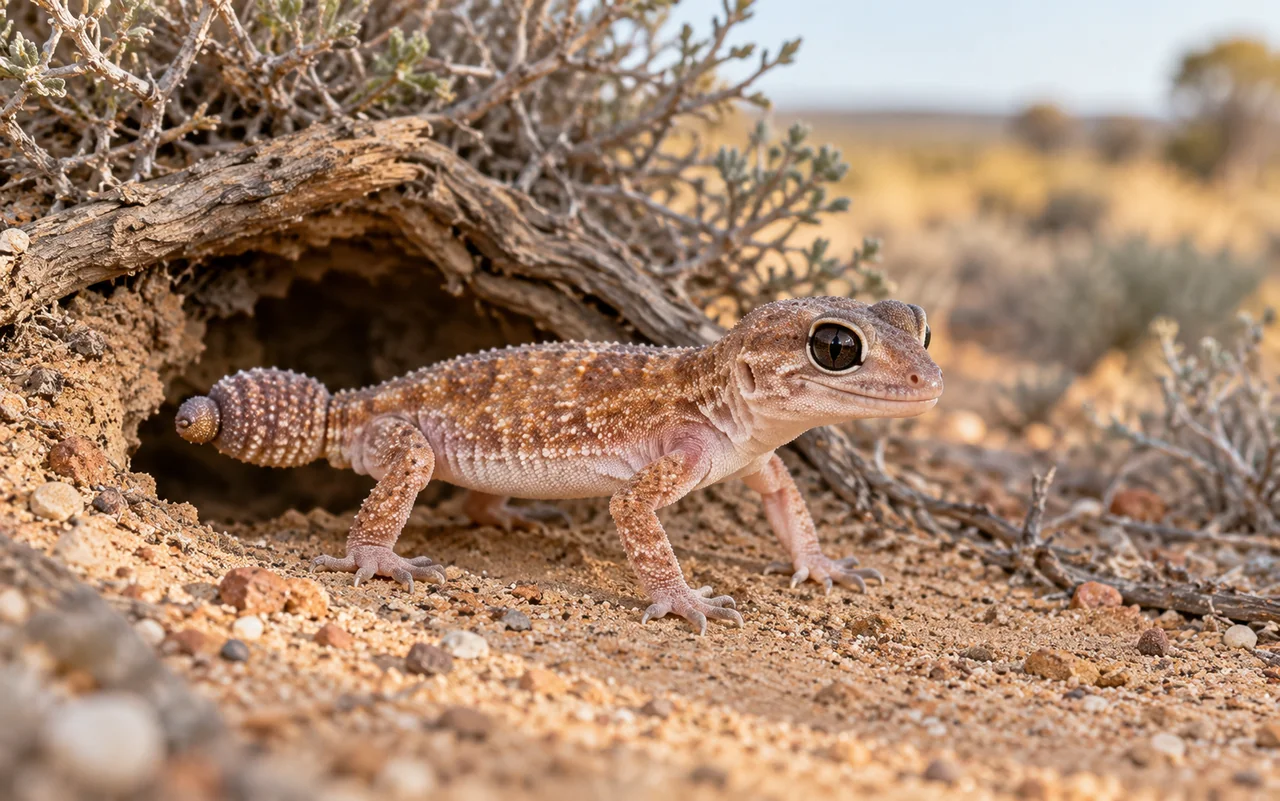
Meet the animal
This profile concerns Nephrurus levis. Do not substitute another knob-tail species or assume historical subspecies names are current identities.
Confirm the current taxonomic identity and locality of the animal.
Before you choose one
Plan a burrowing observation gecko and obtain the established food, moisture and temperature routine from the breeder.
Arrange dependable holiday care and keep money available for food, replacement equipment and appropriate veterinary help. Test the habitat before the animal arrives.
Set up its home
Wildform proposes 90 × 45 × 45 cm for an adult, allowing a real gradient, several shelters and diggable sand-based substrate. The proposal is not the older manufacturer’s 30 cm enclosure example.
Measure usable internal space after substrate, guards and furnishings. Check ventilation, cable holes and access against the smallest occupant. Fix heavy furnishings independently of loose substrate.
Historical tiny housing is not the adult plan described here.
Equipment for this care need
Temperature and safe heating
The Italian Gekko Association account describes a local warm area near 32–33°C and a cooler area near 25–26°C, with a dark overnight drop. The older manufacturer sheet gives broader air ranges. Neither settles every burrow measurement or locality; preserve a cooler, locally damp burrow and agree the exact night plan rather than heating all the sand to the warm figure.
Record the warm and cool locations, overnight minimum and daytime maximum. Air, surface and substrate readings are different measurements. Any added heater needs compatible thermostatic control and safe separation from the animal; assess summer cooling as well as winter heating.
Agree the local climate and dark overnight plan for that animal.
Equipment for this care need
Daylight, shade and UV
Provide gentle daytime light and complete shelter. The older sheet’s blue night-light suggestion is not adopted; retain darkness overnight. Low-level UVB needs individual assessment.
Keep the night dark and provide retreat from daytime light. Lamp percentage, electrical wattage and a product name cannot establish the exposure reaching an animal. Check the finished installation after changes to mesh, branches or lamp position.
Agree measured UV exposure; do not adopt historical night-lighting advice.
Equipment for this care need
SPECIFICATION TO MEET
Daylight, shelter and assessed UV provision
Daylight, shelter and assessed UV provision
Set the exact-species exposure plan before selecting a lamp; no one bulb is certified for this whole group. Keep a dark night.
Water, moisture and airflow
Maintain a locally damp digging refuge and dry alternatives, plus safe drinking access. Arid habitat does not mean removing all water.
Inspect the occupied refuge and substrate as well as the air reading. Adjust water provision and ventilation together, and clean contaminated drinking surfaces. A single humidity number cannot describe every microclimate.
Equipment for this care need
SPECIFICATION TO MEET
Accessible drinking provision
Accessible drinking provision
Size the usable basin and safe entry/exit for the actual animal. A small named reptile dish is not automatically a soaking basin.
Food and nutrition
Offer varied, appropriately sized cultured insects with a reviewed calcium/vitamin plan linked to UV provision.
Record what is actually eaten and follow changes in growth and body condition. Food size, life stage and the full diet matter. Supplement products require an individual plan; do not combine calcium, vitamin D and multivitamins by guesswork.
Behaviour and handling
Avoid routine handling and never lift by the distinctive tail. Allow undisturbed burrowing and refuge use.
Make necessary maintenance predictable and allow voluntary retreat. Prepare a secure transfer container before essential moves. Observation should not repeatedly interrupt feeding, rest or moulting.
Health and life stages
Watch body condition, toes and successful sheds; persistent retained skin or appetite loss needs a reptile vet.
Keep dated observations of appetite, activity and condition. A sudden decline, injury, abnormal breathing or repeated failed moults needs appropriate professional assessment. This guide does not provide a diagnosis or medicine dose.
Buying and keeping records
Keep exact taxon and captive-bred origin records; do not infer legal origin from the animal’s presence in trade.
Ask for a dated source record, scientific identity, life stage and established care history. Keep new arrivals and their equipment separate while an appropriate quarantine plan is agreed. Check current official rules for the exact animal, route and transaction before importing or buying; this page does not establish legal clearance. Never release animals or viable eggs outdoors.
Your care routine
Check the dry and moist refuges, water and actual occupied temperatures. Inspect substrate stability and record food intake and shedding. Keep a dated record of measurements and observations, and revisit the full advice when conditions or life stage change.
YOUR CHECKLIST
0 of 7 ticked
Smooth knob-tailed gecko — Nephrurus levis
Ticks stay on this page while it is open. Completing a list does not certify welfare or an installation.
Equipment checklist
Check usable dimensions, compatibility and measured conditions for the individual setup. A product listing does not complete a setup or guarantee price or stock.
Plan the whole setup: Named items are conditional examples. Meet every care need and test the finished habitat before arrival. No price, availability or installation approval is claimed.
CONDITIONAL EXAMPLE
Secure species-appropriate enclosure
Exo Terra Pro Paludarium 90 × 45 × 90 cm
Check usable floor after sand depth and hides; provide a damp burrow refuge and assess vent gaps and screen safety. Measure the finished usable floor and height after substrate and furnishings against this guide. Check doors, vents and cable gaps for the actual animal and life stage. Secure the lid, test airflow and temperature, and keep lamps inaccessible. For terrestrial layouts retain the land floor; close and secure any drain rather than adding a water pool.
Specification: PT4414; nominal external 90 × 45 × 90 cm; front-opening glass, closable bottom drain and lockable stainless-steel mesh top.
CONDITIONAL EXAMPLE
Independent temperature measurement
Exo Terra Digital Thermometer
Measure occupied warm/cool air or refuge locations and day/night extremes. This is a measuring probe, not a thermostat; protect wiring and follow the probe’s moisture rating.
Specification: Remote air probe and minimum/maximum memory; place away from direct lamp radiation.
CONDITIONAL EXAMPLE
Air humidity monitoring
Exo Terra Digital Hygrometer
Use representative air readings alongside actual substrate/refuge checks. Protect the sensor from direct spray; one reading does not prove the moisture gradient.
Specification: Remote humidity probe; readings describe air at the probe, not substrate moisture.
CONDITIONAL EXAMPLE
Compatible control for added heat
HabiStat Digital Dimming Thermostat Day/Night + Timer
Conditional on a suitable heater and its instructions. The HTDD has a 0–50°C setting range and 600 W maximum load. Confirm dimming compatibility and sensor position; the timer output is not another thermostatically controlled heat channel. Add guards. No cooling function is implied.
Specification: 600 W maximum, no minimum load; setting range 0–50°C. Socket II is timed; this model does not actively cool.
OPTIONAL TOOL
Surface-temperature spot checks
Zoo Med ReptiTemp Digital Infrared Thermometer
Optional cross-check of accessible surfaces. Account for emissivity and measurement area; it cannot replace occupied-air readings.
Specification: Measures surfaces, not air. Check distance/spot size and reflective-surface limitations.
OPTIONAL TOOL
Measure installed UV exposure
Solarmeter Model 6.5R UV Index Meter
An optional measuring tool, or arrange a competent measured installation check. Read at the animal’s accessible back/head height beneath the actual mesh and retain complete shade.
Specification: UV Index meter; take readings at accessible back height with screen and guards installed.
SPECIFICATION TO MEET
Daylight, shelter and assessed UV provision
Daylight, shelter and assessed UV provision
Set the exact-species exposure plan before selecting a lamp; no one bulb is certified for this whole group. Keep a dark night.
SPECIFICATION TO MEET
Accessible drinking provision
Accessible drinking provision
Size the usable basin and safe entry/exit for the actual animal. A small named reptile dish is not automatically a soaking basin.
Equipment notes: Set up its home
CONDITIONAL EXAMPLE
Secure species-appropriate enclosure
Exo Terra Pro Paludarium 90 × 45 × 90 cm
Check usable floor after sand depth and hides; provide a damp burrow refuge and assess vent gaps and screen safety. Measure the finished usable floor and height after substrate and furnishings against this guide. Check doors, vents and cable gaps for the actual animal and life stage. Secure the lid, test airflow and temperature, and keep lamps inaccessible. For terrestrial layouts retain the land floor; close and secure any drain rather than adding a water pool.
Specification: PT4414; nominal external 90 × 45 × 90 cm; front-opening glass, closable bottom drain and lockable stainless-steel mesh top.
Equipment notes: Temperature and safe heating
CONDITIONAL EXAMPLE
Independent temperature measurement
Exo Terra Digital Thermometer
Measure occupied warm/cool air or refuge locations and day/night extremes. This is a measuring probe, not a thermostat; protect wiring and follow the probe’s moisture rating.
Specification: Remote air probe and minimum/maximum memory; place away from direct lamp radiation.
CONDITIONAL EXAMPLE
Compatible control for added heat
HabiStat Digital Dimming Thermostat Day/Night + Timer
Conditional on a suitable heater and its instructions. The HTDD has a 0–50°C setting range and 600 W maximum load. Confirm dimming compatibility and sensor position; the timer output is not another thermostatically controlled heat channel. Add guards. No cooling function is implied.
Specification: 600 W maximum, no minimum load; setting range 0–50°C. Socket II is timed; this model does not actively cool.
OPTIONAL TOOL
Surface-temperature spot checks
Zoo Med ReptiTemp Digital Infrared Thermometer
Optional cross-check of accessible surfaces. Account for emissivity and measurement area; it cannot replace occupied-air readings.
Specification: Measures surfaces, not air. Check distance/spot size and reflective-surface limitations.
Equipment notes: Daylight, shade and UV
OPTIONAL TOOL
Measure installed UV exposure
Solarmeter Model 6.5R UV Index Meter
An optional measuring tool, or arrange a competent measured installation check. Read at the animal’s accessible back/head height beneath the actual mesh and retain complete shade.
Specification: UV Index meter; take readings at accessible back height with screen and guards installed.
Equipment notes: Water, moisture and airflow
CONDITIONAL EXAMPLE
Air humidity monitoring
Exo Terra Digital Hygrometer
Use representative air readings alongside actual substrate/refuge checks. Protect the sensor from direct spray; one reading does not prove the moisture gradient.
Specification: Remote humidity probe; readings describe air at the probe, not substrate moisture.