Meet the animal
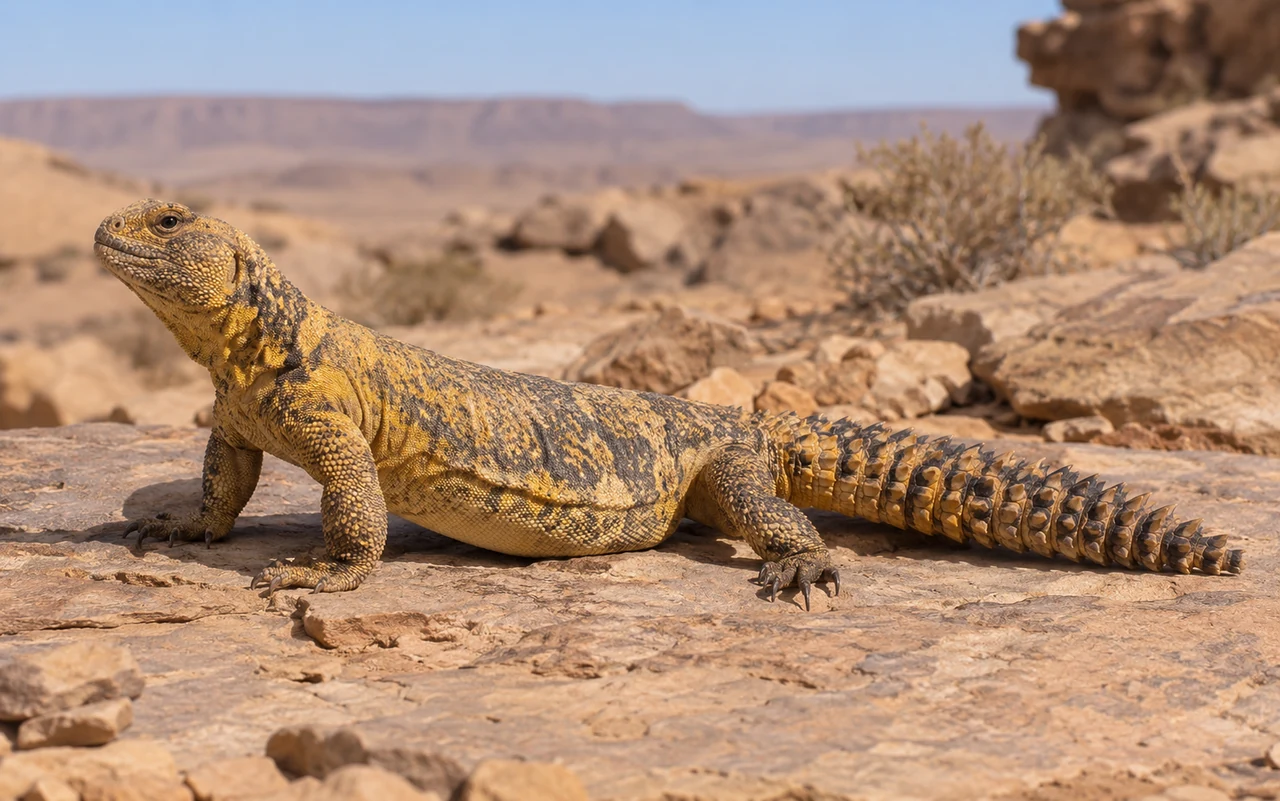
Uromastyx geyri is a Saharan spiny-tailed lizard, with yellow and orange adult colour forms. It is distinct from the much larger Egyptian uromastyx. Much available care guidance covers the genus, so exact species review remains important.
Before you choose one
Plan substantial housing, controlled high local heat, measured UV and fresh safe greens. Keep one animal and arrange a reptile vet. Confirm documented captive origin and that your room and enclosure can maintain cooler retreats in summer.
Set up its home
The proposed adult layout is 150 × 60 × 60 cm. Add broad basking surfaces, cool retreats and secure burrow-like shelters. Provide substantial digging material, around 10 cm or more where the build allows. Support rocks independently so digging cannot undermine them.
Temperature and safe heating
Genus guidance proposes a basking surface around 49–55°C with a much cooler area around 29°C. These are not whole-enclosure air settings. Have the exact U. geyri plan reviewed and use compatible control, guarded fittings and independent measurements. Follow controller limits; do not request settings the equipment cannot provide.
Daylight, shade and UV
Provide bright daytime light, a dark night and UVB with complete shaded retreats. The genus guide proposes basking UVI around 4.5–6, subject to species review. Measure at back height and follow lamp clearance. A percentage on the tube does not certify exposure.
Water, moisture and airflow
The exposed environment can be relatively dry, often described around 20–30% humidity in genus guidance. Burrow-like refuges need less drying conditions. Assess hydration through diet, condition and water access; do not withhold water by rule or bake every refuge dry.
Food and nutrition
Base the diet on varied suitable leafy greens and correctly identified safe weeds, with a reviewed calcium programme. Routine insect or animal-protein feeding is not adopted for this plant-eating lizard. Fruit and seeds do not replace fibrous greens. Avoid contaminated collected plants.
Behaviour and handling
Allow basking, digging and retreating. Do not pull the spiny tail or force the animal from a burrow. Check season, security and gradients when hiding changes, rather than changing everything or introducing a companion.
Health and life stages
Persistent refusal, weight loss, burns, mouth or respiratory changes or abnormal urates need a reptile vet. A bright warm enclosure does not rule out dehydration or poor nutrition. Avoid forced cooling, force-feeding or adding protein as automatic responses.
Buying and keeping records
Choose documented captive-bred U. geyri with exact identification and origin records. Check current CITES and transaction requirements. Keep equipment instructions with care records and arrange holiday cover that understands the difference between hot surfaces and surrounding air.
Your care routine
Test full-body basking, cool refuges and measured UV before arrival. Each day, check water access, greens and controls. Inspect rock support, digging areas and probes. Leave a labelled measurement and plant-feeding plan for holiday care.
YOUR CHECKLIST
0 of 6 ticked
Saharan uromastyx — Uromastyx geyri
Care hub: wildformexotics.co.uk/animals/saharan-uromastyx/
Ticks are kept only while this page is open. Print or download a copy before leaving. Completing the checklist does not establish that an animal is well or an installation is safe.
Use these reminders alongside the full guide. Adjust feeding and maintenance to your animal’s condition and measured enclosure conditions.
Sources
- Uromastyx (genus) care sheet (ReptiFiles)
- Uromastyx care guidance (Maryland Avian and Exotics)
- Reptile management and husbandry (Merck Veterinary Manual)
- UV-Tool: selecting appropriate UV lighting for reptiles and amphibians (2016) (Baines and colleagues, Journal of Zoo and Aquarium Research)
- Saharan uromastyx: Uromastyx geyri UK listing (Exotic-Pets.co.uk)
- CITES import and export guidance (APHA / GOV.UK)
- Guidance on section 14 of the Wildlife and Countryside Act (GOV.UK / Defra)
- Import of pet invertebrates, amphibians and reptiles: IIN (GOV.UK / APHA and Defra)
Equipment checklist
Equipment examples for Saharan uromastyx, grouped by care need. Read the checks before choosing. Shop links are Amazon affiliate links. Items without a verified Amazon match have no shop link.
Plan the whole setup: These examples cover only part of the setup. Meet every care need and test the finished enclosure before arrival. Suitable equipment you already own may meet the need; optional tools are labelled.
Check each item for your animal’s size and life stage, safe access, compatible controls and measured conditions. The list does not certify an installation.
Adult enclosure, substrate and shelter
Read the care guidance for this need
Alternative equipment
Repti-Life 72 × 24 × 24 inch vivarium — black
Amazon-selected 72 × 24 × 24 inch black flat-pack; 18 mm MFC, 4 mm toughened glass, six vents. External/nominal sizing, not certified usable space.
Secure doors, cables and vents; check the smallest life stage and actual usable space. External dimensions are not usable internal space. Check actual individual size, access, secure gaps, load support, furnishing clearance and any substrate depth before choosing this example.
This is an 18 mm melamine-faced chipboard enclosure with glass doors. Check the delivered internal length, depth and height against the care requirement after substrate, guards and furnishings; the inch label is external/nominal and is not proof of usable dimensions. Fit a suitable lock, protect board edges and keep water in watertight containers. Do not use unprotected board for a wet substrate build. Choose larger housing if any usable dimension or full-body extension fails.
Also plan for: Add the substrate, hides, cover and secure supports described in the care guide. The enclosure alone does not provide them.
Temperature and safe heating
Read the care guidance for this need
Exo Terra Digital Thermometer
Model: PT2472
Records minimum and maximum air temperatures near a shelter your animal uses, to help you check the temperature plan.
Fit check: The remote probe measures air at one location. Keep it away from direct lamp heat, secure it safely and keep the display outside. Use separate probes for warm and cool areas where needed. Minimum/maximum readings help track changes; this device does not measure surfaces or control heating. Use a water-rated thermometer for submerged readings.
Zoo Med ReptiTemp Digital Infrared Thermometer
Model: RT-1
Checks basking and other occupied surface temperatures separately from air readings.
Fit check: Use this for surface temperatures, with air probes for air readings. Follow the distance and spot-size instructions, and account for reflective surfaces. It cannot measure internal body temperature.
Also plan for: Select a compatible heating/controller/probe arrangement rated for the actual control plan; do not request a setting beyond the device's range.
Lighting, shade and UV
Read the care guidance for this need
Existing lighting may already provide a suitable day-night cycle. If you need extra lighting, use a switch or timer confirmed as compatible with its exact load, including any UVB ballast.
Arcadia ProT5 Dragon 14% UV-B Kit 39 W
Model: RARTP39D
A UVB fitting to assess against the individual exposure plan, with complete shade available.
Fit check: RARTP39D is a 39 W, 870 mm UK 220–240 V fitting. Keep it away from water and spray; IP20 is not waterproof. Follow the manufacturer’s minimum animal clearance of 250 mm. This is a safety limit, not a recommended mounting height or UVI target. Check the complete fitting length, guards and reachable animal positions. Measure UV Index through the installed screen at each reachable height, with full shade available. Use a separately verified lighting circuit, never a heater’s dimming outlet.
Solarmeter Model 6.5R UV Index Meter
Model: 6.5R
Use your own meter or arrange an exposure check
Measures UV Index at the animal’s reachable back height, with the screen and guards fitted.
Fit check: Use a 6.5 or 6.5R UV Index meter, rather than a UVB irradiance meter. Measure all reachable positions and shaded retreats through the fitted screen and guards. You can borrow a suitable meter or arrange a competent exposure check instead of buying one. Confirm UK supply if buying.
Water, humidity and ventilation
Read the care guidance for this need
Exo Terra Digital Hygrometer
Model: PT2477
Tracks the air humidity cycle near an occupied area.
Fit check: Place the remote humidity sensor inside the enclosure, away from direct heat. The reading describes air at that point, so record its position and check other areas where needed. Inspect the substrate and damp retreats directly, and keep ventilation clear. A humidity reading cannot show whether an animal has drinking water.
Also plan for: Provide the drinking water, damp retreats or safe water area described in the care guide. A sprayer and humidity gauge cannot provide these on their own.
Feeding and nutrition
Read the care guidance for this need
Also plan for: Base the diet on varied suitable leafy greens and correctly identified safe weeds, with a reviewed calcium programme.
Equipment notes: Set up its home
Alternative equipment
Repti-Life 72 × 24 × 24 inch vivarium — black
Amazon-selected 72 × 24 × 24 inch black flat-pack; 18 mm MFC, 4 mm toughened glass, six vents. External/nominal sizing, not certified usable space.
Secure doors, cables and vents; check the smallest life stage and actual usable space. External dimensions are not usable internal space. Check actual individual size, access, secure gaps, load support, furnishing clearance and any substrate depth before choosing this example.
This is an 18 mm melamine-faced chipboard enclosure with glass doors. Check the delivered internal length, depth and height against the care requirement after substrate, guards and furnishings; the inch label is external/nominal and is not proof of usable dimensions. Fit a suitable lock, protect board edges and keep water in watertight containers. Do not use unprotected board for a wet substrate build. Choose larger housing if any usable dimension or full-body extension fails.
Equipment notes: Temperature and safe heating
EQUIPMENT TO CONSIDER
Exo Terra Digital Thermometer
Model PT2472 · Remote air probe and minimum/maximum memory; place away from direct lamp radiation. Check the supplier’s current price and availability, and confirm that the item suits your installation.
Records minimum and maximum air temperatures near a shelter your animal uses, to help you check the temperature plan.
Check before choosing: The remote probe measures air at one location. Keep it away from direct lamp heat, secure it safely and keep the display outside. Use separate probes for warm and cool areas where needed. Minimum/maximum readings help track changes; this device does not measure surfaces or control heating. Use a water-rated thermometer for submerged readings.
EQUIPMENT TO CONSIDER
Zoo Med ReptiTemp Digital Infrared Thermometer
Model RT-1 · Measures surfaces, not air. Check distance/spot size and reflective-surface limitations. Check the supplier’s current price and availability, and confirm that the item suits your installation.
Checks basking and other occupied surface temperatures separately from air readings.
Check before choosing: Use this for surface temperatures, with air probes for air readings. Follow the distance and spot-size instructions, and account for reflective surfaces. It cannot measure internal body temperature.
Equipment notes: Daylight, shade and UV
EQUIPMENT TO CONSIDER
Arcadia ProT5 Dragon 14% UV-B Kit 39 W
Model RARTP39D · 870 mm fitting for a large enclosure; measure exposure, retain clearance and full shade. Check the supplier’s current price and availability, and confirm that the item suits your installation.
A UVB fitting to assess against the individual exposure plan, with complete shade available.
Check before choosing: RARTP39D is a 39 W, 870 mm UK 220–240 V fitting. Keep it away from water and spray; IP20 is not waterproof. Follow the manufacturer’s minimum animal clearance of 250 mm. This is a safety limit, not a recommended mounting height or UVI target. Check the complete fitting length, guards and reachable animal positions. Measure UV Index through the installed screen at each reachable height, with full shade available. Use a separately verified lighting circuit, never a heater’s dimming outlet.
EQUIPMENT TO CONSIDER
Solarmeter Model 6.5R UV Index Meter
Use your own meter or arrange an exposure check
Model 6.5R · UV Index meter; take readings at accessible back height with screen and guards installed. Check the supplier’s current price and availability, and confirm that the item suits your installation.
Measures UV Index at the animal’s reachable back height, with the screen and guards fitted.
Check before choosing: Use a 6.5 or 6.5R UV Index meter, rather than a UVB irradiance meter. Measure all reachable positions and shaded retreats through the fitted screen and guards. You can borrow a suitable meter or arrange a competent exposure check instead of buying one. Confirm UK supply if buying.
Equipment notes: Water, moisture and airflow
EQUIPMENT TO CONSIDER
Exo Terra Digital Hygrometer
Model PT2477 · Remote humidity probe; readings describe air at the probe, not substrate moisture. Check the supplier’s current price and availability, and confirm that the item suits your installation.
Tracks the air humidity cycle near an occupied area.
Check before choosing: Place the remote humidity sensor inside the enclosure, away from direct heat. The reading describes air at that point, so record its position and check other areas where needed. Inspect the substrate and damp retreats directly, and keep ventilation clear. A humidity reading cannot show whether an animal has drinking water.