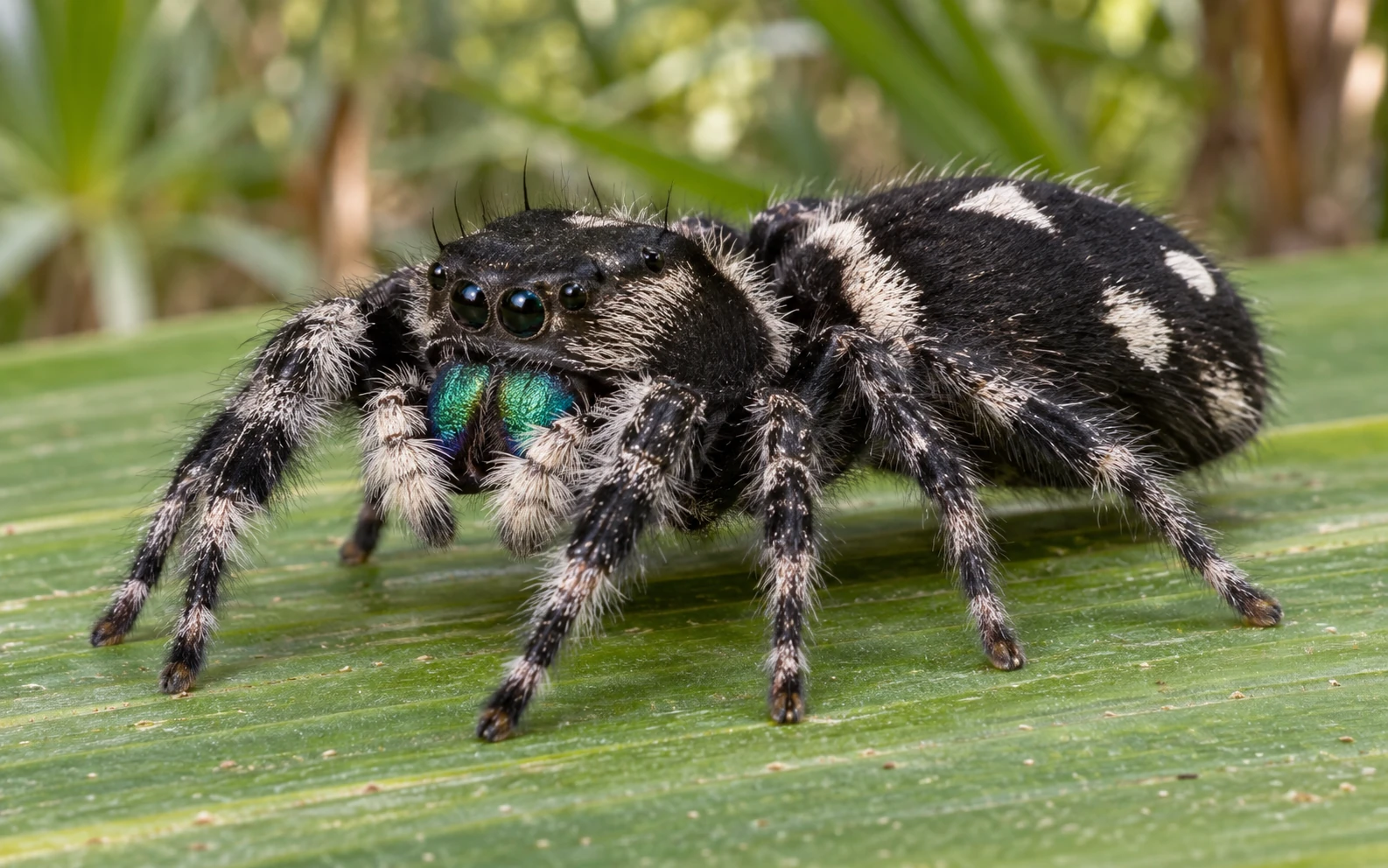
Meet the animal
Phidippus regius is a jumping spider from the south-eastern United States and parts of the Caribbean. Published adult measurements are roughly 6–22 mm in body length, depending on sex and individual; that is not leg span. Colour or metallic-looking mouthparts alone cannot reliably identify or sex every juvenile.
Before you choose one
Ask for hatch or moult history and the animal’s stage before purchase. Keeper lifespan estimates often span one to three years, but a mature animal of unknown age may have much less time remaining. You will need reliable live prey and someone who can care for a tiny spider without disturbing its silk retreat.
Set up its home
Keep one spider in a secure, ventilated vertical enclosure with connected climbing surfaces and sheltered silk anchors. Choose access that does not tear open a retreat near the top. Tiny juveniles need especially fine escape gaps and prey they can find; an adult enclosure specification does not automatically fit them.
Temperature and safe heating
Keeper guidance often describes about 20–24°C, but an exact species optimum has not been established here. Measure enclosure conditions before adding heat. A small container in direct sun can overheat quickly, so place it away from sunny windows and uncontrolled heaters.
Daylight, shade and UV
This is a daytime visual hunter. Provide useful daytime illumination and darkness overnight, with shaded resting places. The evidence reviewed does not establish a species-specific UVB target. Do not add a strong reptile basking lamp to improve the view of your spider.
Water, moisture and airflow
Offer small drinking droplets while keeping airflow and allowing drying between wettings. Do not flood the silk retreat or leave large trapped drops around spiderlings. Keeper humidity percentages are not proven requirements; usable droplets and a well-ventilated refuge matter more than sealing the container to reach one number.
Food and nutrition
Use cultured prey the spider can capture safely, from tiny fruit flies for small juveniles to suitable larger insects as it grows. Observe capture success and abdomen condition rather than using one timetable for every stage. Remove biting prey. A spider sealing itself inside silk may be preparing to moult; do not open the retreat or force food.
Behaviour and handling
Silk is used for resting, moulting, egg protection and safety lines. Preserve sound retreats during cleaning. Handling is optional and creates escape or fall risks; for essential transfers, use a catch container or voluntary movement onto support. Keep any contact low and away from other pets, open windows and hazards.
Health and life stages
Allow the new body to harden after moulting before feeding again. Repeated falls, grip failure, injuries or progressive loss of condition need experienced invertebrate advice. Do not peel away old cuticle. Mature males may feed and behave differently from juveniles, so assess the animal’s stage as well as its appetite.
Buying and keeping records
Prefer documented captive-bred stock with a scientific identification and developmental history. Ask about mating history if buying a mature female: she may produce several egg sacs after purchase. Plan for contained offspring and specialist prey. Check current import requirements and never release a spider or egg sac outdoors.
Your care routine
Prepare stage-appropriate prey and secure housing before arrival. Check droplets, ventilation and escape gaps during routine care. Remove waste without damaging retreats, and record meals and moults. When the spider closes itself away for a moult, give it peace rather than repeatedly checking inside.
YOUR CHECKLIST
0 of 8 ticked
Regal jumping spider — Phidippus regius
Care hub: wildformexotics.co.uk/animals/regal-jumping-spider-animal-5/
Ticks are kept only while this page is open. Print or download a copy before leaving. Completing the checklist does not establish that an animal is well or an installation is safe.
Use these reminders alongside the full guide. Adjust feeding and maintenance to your animal’s condition and measured enclosure conditions.
Sources
- Regal jumping spider, Phidippus regius (G. B. Edwards / University of Florida IFAS)
- Handbook 2019: keeping spiders (British Arachnological Society)
- Phidippus regius care (Richard Stewart / The Tarantula Collective)
- Import of pet invertebrates, amphibians and reptiles: IIN (GOV.UK / APHA and Defra)
- Guidance on section 14 of the Wildlife and Countryside Act (GOV.UK / Defra)
- Import or export endangered species: check if you need a CITES permit (GOV.UK / APHA and Defra)
Equipment checklist
Equipment examples for Regal jumping spider, grouped by care need. Read the checks before choosing. Shop links are Amazon affiliate links. Items without a verified Amazon match have no shop link.
Plan the whole setup: These examples cover only part of the setup. Meet every care need and test the finished enclosure before arrival. Suitable equipment you already own may meet the need; optional tools are labelled.
Check each item for your animal’s size and life stage, safe access, compatible controls and measured conditions. The list does not certify an installation.
Contained habitat
Essential care need
Secure ventilation and gaps smaller than the animal or nymph
Plan first: Check escape points and whether the animal needs height, floor area or substrate depth.
Moisture and monitoring
Essential care need
A species-specific damp refuge or drinking access with airflow
Plan first: Check the places your animal uses and how they dry between wettings. A single humidity reading cannot describe the whole enclosure.
Alternative equipment
Exo Terra Mini Mister — 0.5 L
PT2489; 0.5 L hand spray bottle. The Amazon title uses 16 US fluid ounces; this is not the conflicting 1.5/2 L pressure sprayer.
Use an existing suitable fine sprayer if you have one. Follow the individual wet-dry cycle; do not spray the animal, soak every surface or substitute misting for drinking water.
A manual misting tool only where the individual care plan calls for it. Use clean water, keep the bottle hygienic and free of chemicals, and do not spray directly at the animal. Check substrate/refuge moisture and drying/airflow rather than misting to a universal schedule.
Exo Terra Digital Thermometer
Model: PT2472
Measure air temperature at animal height. Take independent warm and cool readings where the care plan needs a gradient.
Fit check: The remote probe measures air at one location. Keep it away from direct lamp heat, secure it safely and keep the display outside. Use separate probes for warm and cool areas where needed. Minimum/maximum readings help track changes; this device does not measure surfaces or control heating. Use a water-rated thermometer for submerged readings.
Food and maintenance
Essential care need
Clean continuing food supply and a way to remove spoilage
Plan first: Select tools and food for the exact species and life stage; do not substitute generic reptile supplements.
Also plan for: Use cultured prey the spider can capture safely, from tiny fruit flies for small juveniles to suitable larger insects as it grows.
Retreat and safe transfer
Essential care need
Cork or hides appropriate to arboreal or terrestrial habit, plus a catch cup
Plan first: Prevent falls and protect webs; handling for display is optional and discouraged.
Alternative equipment
Zoo Med Natural Cork Round — select actual dimensions
Three natural small cork rounds; lengths, openings and shapes vary. One natural medium cork round; lengths, openings and shapes vary.
Choose actual dimensions and openings for this individual, support securely and avoid trapping or fall hazards. This is one component, not the complete set of retreats, broad resting surfaces or a grippable moult ceiling.
Select and, where appropriate, cut an actual piece to fit the animal and enclosure. Secure it without trapping gaps and keep hard pieces outside tarantula fall zones. Cork is a refuge or climbing component, not food substrate or a complete moulting ceiling.
Use only if the actual delivered opening and length fit the animal and leave its required usable enclosure space. Secure the piece and avoid hard fall zones. This option is not an automatic upgrade for a small spider enclosure.
Also plan for: Prepare a suitably sized catch container for necessary transfers; the retreat does not serve as a catch cup.