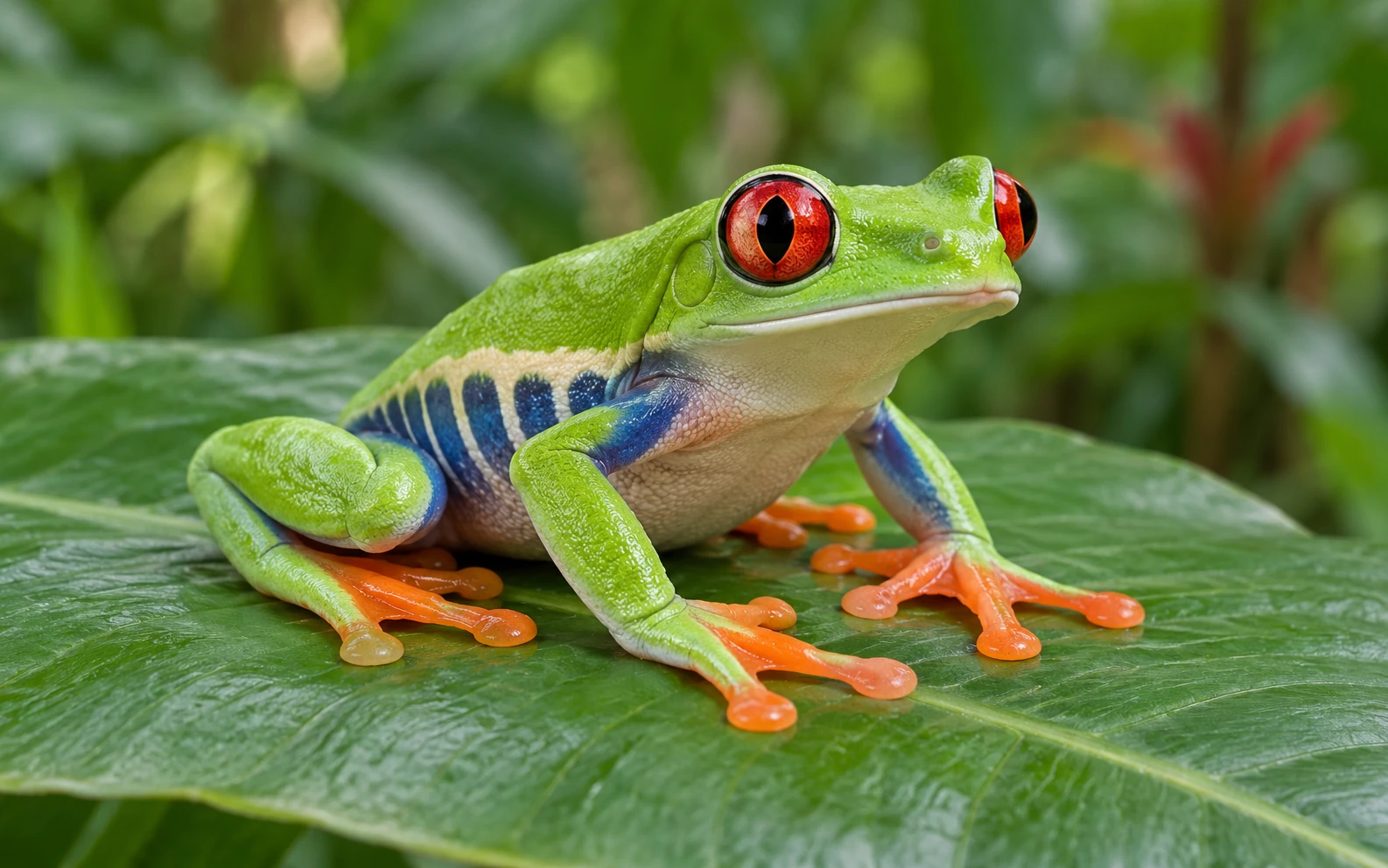
Meet the animal
Agalychnis callidryas is the Central American red-eyed tree frog, distinct from the similarly named Australian frog. Older names include Hyla and Phyllomedusa callidryas. It rests concealed on leaves and hunts at night; bright colours do not mean it benefits from a sparse exposed display.
Before you choose one
Plan several years of care, with some published estimates approaching a decade. Arrange small live insects and an amphibian vet. A first setup for one frog makes feeding and condition easier to track; group keeping needs separate quarantine and individual monitoring.
Set up its home
For one adult, use at least about 45 × 45 × 60 cm, following the larger veterinary recommendation. Add stable branches and broad leaves at several heights, including concealed rests. Keep a secure ventilated lid and shallow easy-exit water dish. For juveniles, check smaller escape gaps and make food easy to reach.
Temperature and safe heating
The veterinary daytime ranges overlap around 24–26°C, a cautious starting band rather than a proven optimum. Keep cooler retreats and a modest night drop. Control extra heat and measure air where frogs rest. Avoid hot, drying basking arrangements.
Daylight, shade and UV
Provide around 10–12 hours of daytime light, darkness overnight and low UV access with opaque shade. The clinical sources do not establish a measured species-specific UVI target. Have the fitted lamp, screen and reachable positions assessed rather than copying another frog’s percentage or distance.
Water, moisture and airflow
Clinical sources describe 60–80% humidity alongside airflow, drainage and drying of exposed surfaces. Use treated water for chlorine and chloramine, refreshing the shallow dish daily. A mature planted floor needs drainage; quarantine paper makes waste easier to see. Avoid sharp or swallowable pieces at feeding points.
Food and nutrition
Offer varied small gut-loaded insects when the frog is active. Juveniles generally feed daily; adults often start every two or three days. Adjust to condition and actual intake, with a coordinated calcium and vitamin plan. Remove biting leftovers and prevent smaller frogs competing with larger ones.
Behaviour and handling
Keep contact to essential transfers using clean powder-free gloves moistened with conditioned water. Preserve leafy retreats and avoid repeated bright-light disturbance at night. A hidden frog still needs intake and condition checks, but should not be repeatedly exposed for viewing.
Health and life stages
Swelling, abnormal skin, weakness, wasting or persistent appetite decline need an amphibian vet. Agree quarantine and screening before mixing animals. Eggs are laid above water in nature and tadpoles have separate aquatic needs; seek specialist help if eggs appear rather than trying to induce breeding.
Buying and keeping records
Confirm identity and documented captive origin, especially where only a common name is supplied. Check current CITES and import requirements before international movement. Keep records with a rehomed animal and never release frogs, eggs or enclosure organisms.
Your care routine
Prepare concealed rests, clean water and measured conditions before arrival. Each day, check the frog and water dish. Remove waste and prey, inspect drainage and clean water equipment. Track each frog’s food and condition rather than using one group appetite record.
YOUR CHECKLIST
0 of 6 ticked
Red-eyed tree frog — Agalychnis callidryas
Care hub: wildformexotics.co.uk/animals/red-eyed-tree-frog/
Ticks are kept only while this page is open. Print or download a copy before leaving. Completing the checklist does not establish that an animal is well or an installation is safe.
Use these reminders alongside the full guide. Adjust feeding and maintenance to your animal’s condition and measured enclosure conditions.
Sources
- Agalychnis callidryas (Darrel R. Frost / American Museum of Natural History)
- Red Eyed Tree Frog Care (Erica Mede CVT / Chicago Exotics Animal Hospital)
- Red-eyed tree frog care (Arizona Exotics / Colorado Exotic Animal Hospital)
- Impact of Plant Cover on Fitness and Behavioural Traits of Captive Red-Eyed Tree Frogs (Agalychnis callidryas) (Michaels, Antwis and Preziosi (2014))
- Egg clutch dehydration induces early hatching in red-eyed treefrogs, Agalychnis callidryas (María José Salica, James R. Vonesh and Karen M. Warkentin / PeerJ (2017))
- Import or export endangered species: check if you need a CITES permit (GOV.UK / APHA and Defra)
- Importing non-native animals (GOV.UK / APHA and Defra)
- Guidance on section 14 of the Wildlife and Countryside Act (GOV.UK / Defra)
- Import of pet invertebrates, amphibians and reptiles: IIN (GOV.UK / APHA and Defra)
Equipment checklist
Equipment examples for Red-eyed tree frog, grouped by care need. Read the checks before choosing. Shop links are Amazon affiliate links. Items without a verified Amazon match have no shop link.
Plan the whole setup: These examples cover only part of the setup. Meet every care need and test the finished enclosure before arrival. Suitable equipment you already own may meet the need; optional tools are labelled.
Check each item for your animal’s size and life stage, safe access, compatible controls and measured conditions. The list does not certify an installation.
Tall ventilated enclosure
Essential care need
Vertical usable space with secure doors and gaps
Plan first: Plan for adult size and any group; test airflow and confirm frogs cannot reach hot fittings.
Alternative equipment
Exo Terra Pro Paludarium 90 × 45 × 90 cm
PT4414; nominal external 90 × 45 × 90 cm; front-opening glass, closable bottom drain and lockable stainless-steel mesh top.
External dimensions are not usable internal space. Check actual individual size, access, secure gaps, load support, furnishing clearance and any substrate depth before choosing this example.
Measure the finished usable floor and height after substrate and furnishings against this guide. Check doors, vents and cable gaps for the actual animal and life stage. Secure the lid, test airflow and temperature, and keep lamps inaccessible. For terrestrial layouts retain the land floor; close and secure any drain rather than adding a water pool.
Perches and foliage
Essential care need
Stable broad leaves and multiple sheltered resting sites
Plan first: Secure branches, wash plant residues and retain open routes and shaded retreats.
Exo Terra Jungle Vines Large
Model: PT3086
Add a securely fixed climbing route.
Fit check: PT3086 is about 182 cm long and 1.5 cm across. Check that the animal can grip it, secure it against movement and avoid trapping gaps or unsafe falls. Add broad resting cover where needed. It cannot replace food stems or a secure ceiling grip for moulting.
Alternative equipment
Zoo Med Natural Cork Round — select actual dimensions
Three natural small cork rounds; lengths, openings and shapes vary. One natural medium cork round; lengths, openings and shapes vary.
Choose actual dimensions and openings for this individual, support securely and avoid trapping or fall hazards. This is one component, not the complete set of retreats, broad resting surfaces or a grippable moult ceiling.
Select and, where appropriate, cut an actual piece to fit the animal and enclosure. Secure it without trapping gaps and keep hard pieces outside tarantula fall zones. Cork is a refuge or climbing component, not food substrate or a complete moulting ceiling.
Use only if the actual delivered opening and length fit the animal and leave its required usable enclosure space. Secure the piece and avoid hard fall zones. This option is not an automatic upgrade for a small spider enclosure.
Measured climate
Essential care need
Independent day and night temperature and humidity readings
Plan first: Measure at frog height and allow airflow and drying; do not target one air reading alone.
Exo Terra Digital Thermometer
Model: PT2472
Measure air temperature at animal height. Take independent warm and cool readings where the care plan needs a gradient.
Fit check: The remote probe measures air at one location. Keep it away from direct lamp heat, secure it safely and keep the display outside. Use separate probes for warm and cool areas where needed. Minimum/maximum readings help track changes; this device does not measure surfaces or control heating. Use a water-rated thermometer for submerged readings.
Exo Terra Digital Hygrometer
Model: PT2477
Track air humidity at an occupied position, alongside checks of ventilation and substrate moisture.
Fit check: Place the remote humidity sensor inside the enclosure, away from direct heat. The reading describes air at that point, so record its position and check other areas where needed. Inspect the substrate and damp retreats directly, and keep ventilation clear. A humidity reading cannot show whether an animal has drinking water.
Also plan for: If the room needs supplemental heat, select and guard a suitable heater with thermostatic control. Measuring instruments do not provide heat.
Water and hygiene
Essential care need
Clean amphibian-safe drinking access and rinsed cleaning tools
Plan first: Change soiled water promptly and prevent disinfectant or soap residue contacting skin.
Exo Terra Water Dish Large
Model: PT2803
Provide a shallow water dish with enough usable space for the frog and an easy exit.
Fit check: PT2803 measures 22 × 17.8 × 5.5 cm externally. Check the usable basin, stability, safe water depth and easy entry and exit for your animal. Outside measurements do not establish a soaking fit. Clean and refresh water at least daily and whenever soiled.
Seachem Prime 100 ml
Treat replacement water for chlorine and chloramine before use.
Fit check: Use only when new water needs chlorine or chloramine treatment. Prepare suitable replacement water in a separate container at the current label dose, and confirm the amphibian plan with a vet. Conditioner cannot replace cycling, water tests, changes or a safe basin. Do not use emergency overdoses or treat it as medicine.
Live prey and supplements
Essential care need
Appropriately sized gut-loaded insects and stage-specific supplement plan
Plan first: Remove uneaten prey and monitor body condition rather than following a universal schedule.
Exo Terra Bamboo Tweezers Small 28 cm
Model: PT2076
Optional food-placement or maintenance tool
Place or remove small food items without gripping the animal.
Fit check: Use for placing food or removing leftovers, never for gripping the animal, forcing a bite or striking its mouth. Keep tools separate between quarantine groups. Choose food and supplements separately for the species.
Also plan for: Select manageable cultured prey and the frog’s calcium/vitamin programme against its feeding guidance and UV provision; the optional tool is not food. Do not combine differing supplement schedules.
Lighting and shade
Essential care need
Stable photoperiod and any supported low-level UV gradient
Plan first: Measure installed output at occupied branches and keep a complete shade route.
Existing lighting may already provide a suitable day-night cycle. If you need extra lighting, use a switch or timer confirmed as compatible with its exact load, including any UVB ballast.
Solarmeter Model 6.5R UV Index Meter
Model: 6.5R
Use your own meter or arrange an exposure check
Measure UV Index at the animal’s reachable basking and resting positions, with the fitted screen and guards in place.
Fit check: Use a 6.5 or 6.5R UV Index meter, rather than a UVB irradiance meter. Measure all reachable positions and shaded retreats through the fitted screen and guards. You can borrow a suitable meter or arrange a competent exposure check instead of buying one. Confirm UK supply if buying. The sources do not agree on a species-specific UVI target, so no lamp or fixed setting is selected here.
Also plan for: Choose the lighting system with an amphibian specialist. The sources do not agree on a UVI target, so no UVB lamp or fixed setting is selected here. A timer and UV meter cannot provide daylight or UVB themselves.