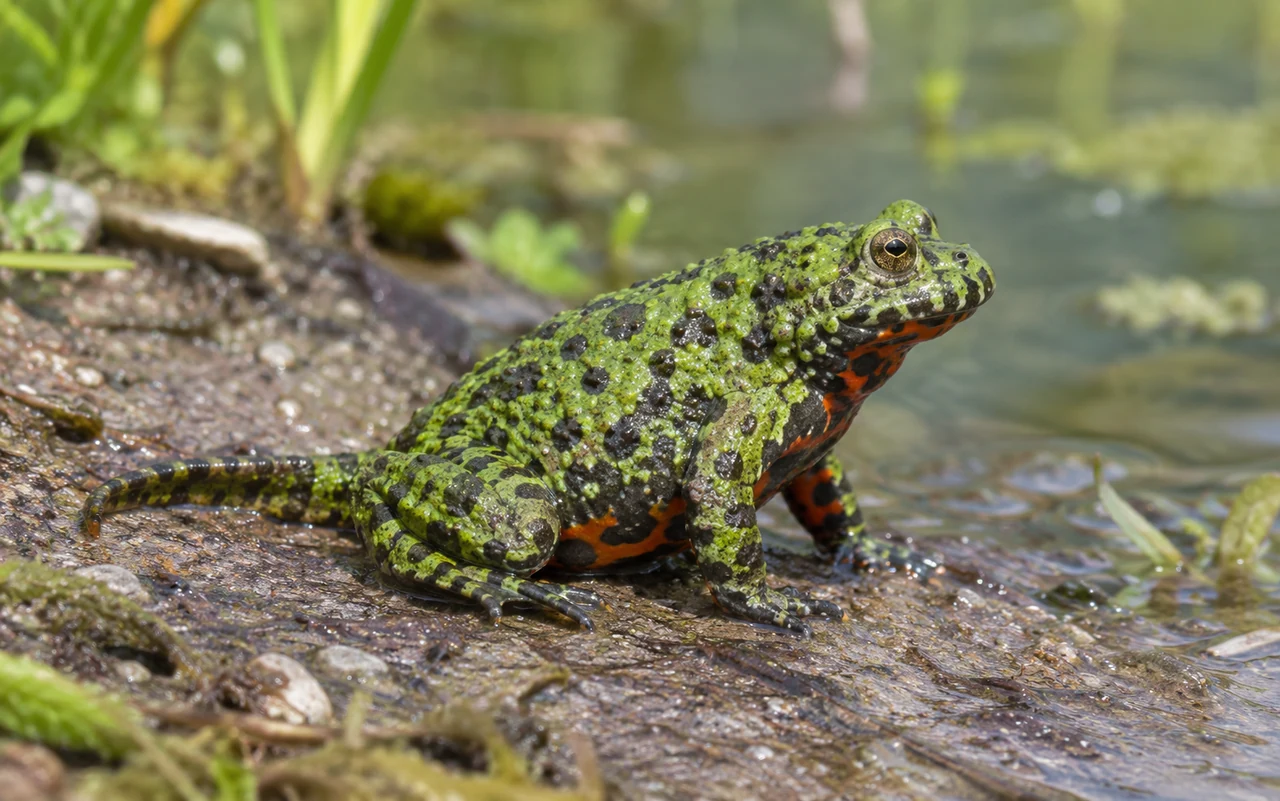
Meet the animal
Bombina orientalis is an East Asian toad with green or brown patterned upper surfaces and an orange-red belly. It is distinct from other Bombina. Defensive posture and skin secretion are not behaviours to provoke by turning the animal over.
Before you choose one
Arrange land-and-water housing, water treatment, insects and an amphibian vet. A small compatible group needs monitoring; group keeping is optional. Avoid mixed species, fish and markedly different-sized animals. A filter does not remove the need for water changes.
Set up its home
The proposed small-group layout is 60 × 45 × 45 cm. Provide substantial resting land and shallow water with easy exits. A starting depth around 5–10 cm needs adjustment to animal size and furnishings. Prevent trapping gaps, unstable slopes and swallowable loose stones.
Temperature and safe heating
The veterinary sheet describes daytime air around 24–26°C, a warmer area around 26–27°C and nights around 22°C. Other keeper guidance is cooler, so resolve the full climate plan individually. Avoid intense basking or heating the entire land-and-water area uniformly.
Daylight, shade and UV
Use gentle daytime light and darkness overnight with shaded land retreats. The sources do not establish an exact species UVI optimum. Review a measured low-output option and ensure lamp warmth does not overheat the water.
Water, moisture and airflow
Clean water and usable land matter alongside humidity. UK and veterinary humidity advice differs. Treat new mineralised water for chlorine and chloramine and replace fouled water promptly. Standing tap water overnight is not reliable chloramine removal.
Food and nutrition
Offer varied manageable cultured insects with a reviewed amphibian calcium and vitamin plan. Adults may start with measured meals a few times weekly; young animals need more frequent small food. A single food such as bloodworms is not assumed complete. Remove leftovers before they foul the water.
Behaviour and handling
Allow voluntary movement between land and water. Limit contact to essential transfers with clean appropriately moistened gloves. Avoid secretion contact with eyes and mouth and wash hands. Separate an animal that is persistently excluded, injured or losing condition.
Health and life stages
Reddening, wounds, swelling, abnormal buoyancy, weakness or persistent refusal need prompt amphibian-veterinary advice. Record food, condition and water maintenance. Avoid household chemical residues and unreviewed aquatic medicines in occupied housing.
Buying and keeping records
Choose documented captive-bred B. orientalis with identification and feeding records. Confirm current import requirements separately. Never release unwanted toads or offspring, and arrange care from someone who understands treated water and secretion precautions.
Your care routine
Before arrival, test land access, water exits and the reviewed climate plan. Each day, check animals, water and controls. Remove waste, record meals and inspect competition. Leave a clear water-change method for holiday cover; clear-looking water alone does not show it is suitable.
YOUR CHECKLIST
0 of 6 ticked
Oriental fire-bellied toad — Bombina orientalis
Care hub: wildformexotics.co.uk/animals/oriental-fire-bellied-toad/
Ticks are kept only while this page is open. Print or download a copy before leaving. Completing the checklist does not establish that an animal is well or an installation is safe.
Use these reminders alongside the full guide. Adjust feeding and maintenance to your animal’s condition and measured enclosure conditions.
Sources
- Fire-bellied toad care (Chicago Exotics, Erica Mede CVT)
- Oriental fire-bellied toad UK care overview (Monkfield Reptile)
- UV-Tool: selecting appropriate UV lighting for reptiles and amphibians (2016) (Baines and colleagues, Journal of Zoo and Aquarium Research)
- Environment and husbandry for amphibians (Merck Veterinary Manual)
- Introduction to amphibians: skin protection, handling and injuries (MSD Veterinary Manual)
- UK reptile species equipment list (Monkfield Reptile)
- CITES import and export guidance (APHA / GOV.UK)
- Guidance on section 14 of the Wildlife and Countryside Act (GOV.UK / Defra)
- Import of pet invertebrates, amphibians and reptiles: IIN (GOV.UK / APHA and Defra)
Equipment checklist
Equipment examples for Oriental fire-bellied toad, grouped by care need. Read the checks before choosing. Shop links are Amazon affiliate links. Items without a verified Amazon match have no shop link.
Plan the whole setup: These examples cover only part of the setup. Meet every care need and test the finished enclosure before arrival. Suitable equipment you already own may meet the need; optional tools are labelled.
Check each item for your animal’s size and life stage, safe access, compatible controls and measured conditions. The list does not certify an installation.
Adult enclosure, substrate and shelter
Read the care guidance for this need
Alternative equipment
Exo Terra Pro Terrarium 60 × 45 × 45 cm
PT4408; nominal external 60 × 45 × 45 cm; front-opening glass and lockable stainless-steel mesh top.
Secure doors, cables and vents; check the smallest life stage and actual usable space. External dimensions are not usable internal space. Check actual individual size, access, secure gaps, load support, furnishing clearance and any substrate depth before choosing this example.
Measure the finished usable floor and height after substrate and furnishings against this guide. Check doors, vents and cable gaps for the actual animal and life stage. Secure the lid, test airflow and temperature, and keep lamps inaccessible. For terrestrial layouts retain the land floor; close and secure any drain rather than adding a water pool.
Also plan for: Add the substrate, hides, cover and secure supports described in the care guide. The enclosure alone does not provide them.
Temperature and safe heating
Read the care guidance for this need
Exo Terra Digital Thermometer
Model: PT2472
Records minimum and maximum air temperatures near a shelter your animal uses, to help you check the temperature plan.
Fit check: The remote probe measures air at one location. Keep it away from direct lamp heat, secure it safely and keep the display outside. Use separate probes for warm and cool areas where needed. Minimum/maximum readings help track changes; this device does not measure surfaces or control heating. Use a water-rated thermometer for submerged readings.
Lighting, shade and UV
Read the care guidance for this need
Existing lighting may already provide a suitable day-night cycle. If you need extra lighting, use a switch or timer confirmed as compatible with its exact load, including any UVB ballast.
Solarmeter Model 6.5R UV Index Meter
Model: 6.5R
Use your own meter or arrange an exposure check
Measures UV Index at the animal’s reachable back height, with the screen and guards fitted.
Fit check: Use a 6.5 or 6.5R UV Index meter, rather than a UVB irradiance meter. Measure all reachable positions and shaded retreats through the fitted screen and guards. You can borrow a suitable meter or arrange a competent exposure check instead of buying one. Confirm UK supply if buying.
Also plan for: Agree a lighting and UV exposure plan for your animal before choosing a lamp. Keep a regular day-night cycle and accessible shade. No lamp model is selected here.
Water, humidity and ventilation
Read the care guidance for this need
Alternative equipment
Exo Terra Mini Mister — 0.5 L
PT2489; 0.5 L hand spray bottle. The Amazon title uses 16 US fluid ounces; this is not the conflicting 1.5/2 L pressure sprayer.
Adjust to the species: do not spray the animal directly, soak every surface or treat a mister as a substitute for drinking water. Use an existing suitable fine sprayer if you have one. Follow the individual wet-dry cycle; do not spray the animal, soak every surface or substitute misting for drinking water.
A manual misting tool only where the individual care plan calls for it. Use clean water, keep the bottle hygienic and free of chemicals, and do not spray directly at the animal. Check substrate/refuge moisture and drying/airflow rather than misting to a universal schedule.
Exo Terra Digital Hygrometer
Model: PT2477
Tracks the air humidity cycle near an occupied area.
Fit check: Place the remote humidity sensor inside the enclosure, away from direct heat. The reading describes air at that point, so record its position and check other areas where needed. Inspect the substrate and damp retreats directly, and keep ventilation clear. A humidity reading cannot show whether an animal has drinking water.
Seachem Prime 100 ml
Treats replacement mineralised water for chlorine and chloramine before appropriate use.
Fit check: Use only when new water needs chlorine or chloramine treatment. Prepare suitable replacement water in a separate container at the current label dose, and confirm the amphibian plan with a vet. Conditioner cannot replace cycling, water tests, changes or a safe basin. Do not use emergency overdoses or treat it as medicine.
Also plan for: Provide the drinking water, damp retreats or safe water area described in the care guide. A sprayer and humidity gauge cannot provide these on their own.
Feeding and nutrition
Read the care guidance for this need
Exo Terra Bamboo Tweezers Small 28 cm
Model: PT2076
Optional food-placement or maintenance tool
Places or removes food and spoiled leftovers while keeping fingers away from feeding responses.
Fit check: Use for placing food or removing leftovers, never for gripping the animal, forcing a bite or striking its mouth. Keep tools separate between quarantine groups. Choose food and supplements separately for the species.
Also plan for: Offer varied manageable cultured insects with a reviewed amphibian calcium and vitamin plan.
Equipment notes: Set up its home
Alternative equipment
Exo Terra Pro Terrarium 60 × 45 × 45 cm
PT4408; nominal external 60 × 45 × 45 cm; front-opening glass and lockable stainless-steel mesh top.
Secure doors, cables and vents; check the smallest life stage and actual usable space. External dimensions are not usable internal space. Check actual individual size, access, secure gaps, load support, furnishing clearance and any substrate depth before choosing this example.
Measure the finished usable floor and height after substrate and furnishings against this guide. Check doors, vents and cable gaps for the actual animal and life stage. Secure the lid, test airflow and temperature, and keep lamps inaccessible. For terrestrial layouts retain the land floor; close and secure any drain rather than adding a water pool.
Equipment notes: Temperature and safe heating
EQUIPMENT TO CONSIDER
Exo Terra Digital Thermometer
Model PT2472 · Remote air probe and minimum/maximum memory; place away from direct lamp radiation. Check the supplier’s current price and availability, and confirm that the item suits your installation.
Records minimum and maximum air temperatures near a shelter your animal uses, to help you check the temperature plan.
Check before choosing: The remote probe measures air at one location. Keep it away from direct lamp heat, secure it safely and keep the display outside. Use separate probes for warm and cool areas where needed. Minimum/maximum readings help track changes; this device does not measure surfaces or control heating. Use a water-rated thermometer for submerged readings.
Equipment notes: Daylight, shade and UV
EQUIPMENT TO CONSIDER
Solarmeter Model 6.5R UV Index Meter
Use your own meter or arrange an exposure check
Model 6.5R · UV Index meter; take readings at accessible back height with screen and guards installed. Check the supplier’s current price and availability, and confirm that the item suits your installation.
Measures UV Index at the animal’s reachable back height, with the screen and guards fitted.
Check before choosing: Use a 6.5 or 6.5R UV Index meter, rather than a UVB irradiance meter. Measure all reachable positions and shaded retreats through the fitted screen and guards. You can borrow a suitable meter or arrange a competent exposure check instead of buying one. Confirm UK supply if buying.
Equipment notes: Water, moisture and airflow
Alternative equipment
Exo Terra Mini Mister — 0.5 L
PT2489; 0.5 L hand spray bottle. The Amazon title uses 16 US fluid ounces; this is not the conflicting 1.5/2 L pressure sprayer.
Adjust to the species: do not spray the animal directly, soak every surface or treat a mister as a substitute for drinking water. Use an existing suitable fine sprayer if you have one. Follow the individual wet-dry cycle; do not spray the animal, soak every surface or substitute misting for drinking water.
A manual misting tool only where the individual care plan calls for it. Use clean water, keep the bottle hygienic and free of chemicals, and do not spray directly at the animal. Check substrate/refuge moisture and drying/airflow rather than misting to a universal schedule.
EQUIPMENT TO CONSIDER
Exo Terra Digital Hygrometer
Model PT2477 · Remote humidity probe; readings describe air at the probe, not substrate moisture. Check the supplier’s current price and availability, and confirm that the item suits your installation.
Tracks the air humidity cycle near an occupied area.
Check before choosing: Place the remote humidity sensor inside the enclosure, away from direct heat. The reading describes air at that point, so record its position and check other areas where needed. Inspect the substrate and damp retreats directly, and keep ventilation clear. A humidity reading cannot show whether an animal has drinking water.
EQUIPMENT TO CONSIDER
Seachem Prime 100 ml
Aquarium conditioner that treats chlorine/chloramine; use label dose in a separate container, never a replacement for water-quality testing. Check the supplier’s current price and availability, and confirm that the item suits your installation.
Treats replacement mineralised water for chlorine and chloramine before appropriate use.
Check before choosing: Use only when new water needs chlorine or chloramine treatment. Prepare suitable replacement water in a separate container at the current label dose, and confirm the amphibian plan with a vet. Conditioner cannot replace cycling, water tests, changes or a safe basin. Do not use emergency overdoses or treat it as medicine.
Equipment notes: Food and nutrition
EQUIPMENT TO CONSIDER
Exo Terra Bamboo Tweezers Small 28 cm
Optional food-placement or maintenance tool
Model PT2076 · For placing/removing food, not gripping animals; separate tools between quarantine groups. Check the supplier’s current price and availability, and confirm that the item suits your installation.
Places or removes food and spoiled leftovers while keeping fingers away from feeding responses.
Check before choosing: Use for placing food or removing leftovers, never for gripping the animal, forcing a bite or striking its mouth. Keep tools separate between quarantine groups. Choose food and supplements separately for the species.