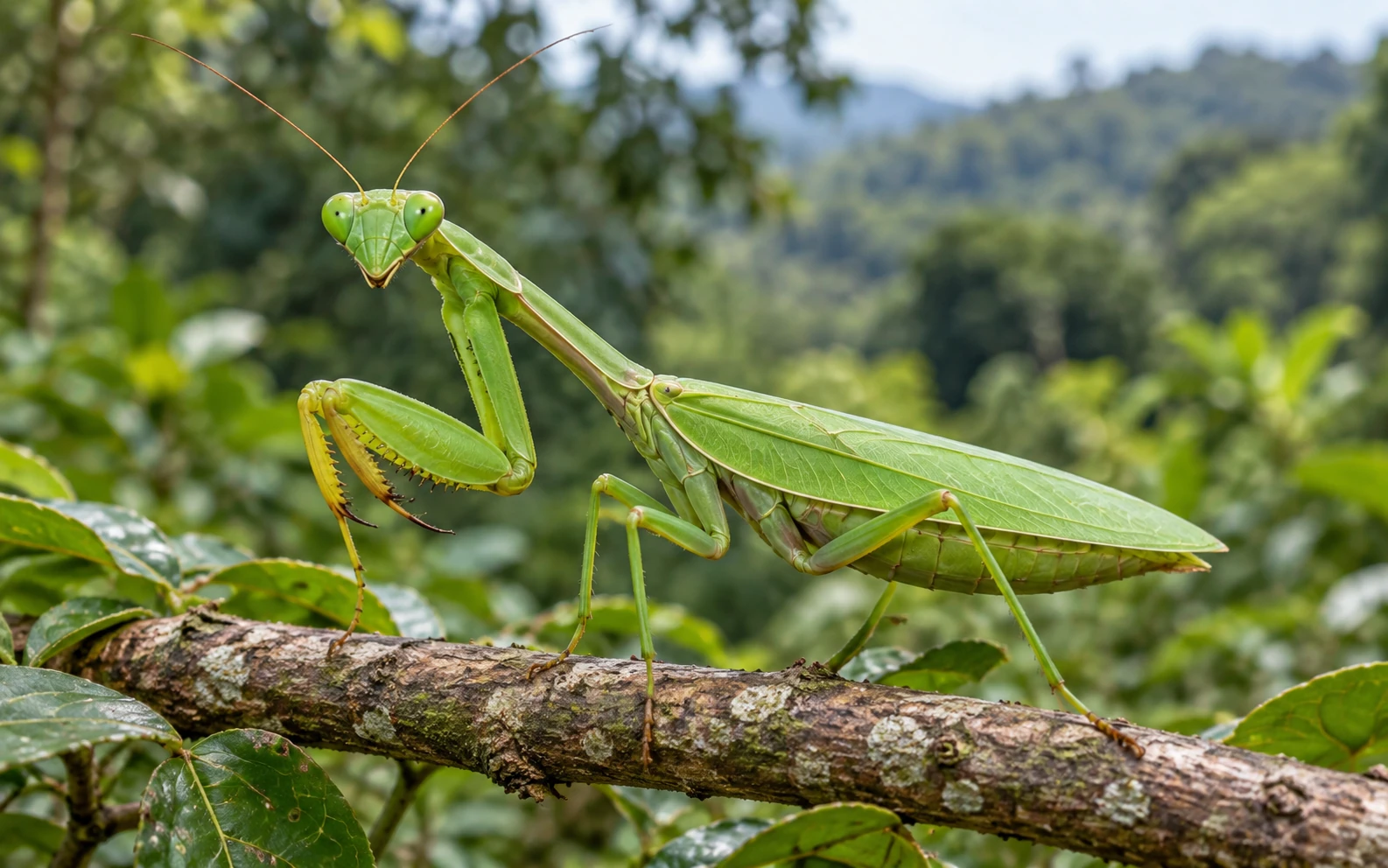
Meet the animal
This profile is for Hierodula membranacea. Giant Asian mantis is used for several Hierodula species, so confirm the scientific identification. Keeper accounts describe females around 8–9 cm, with smaller, slimmer males. Colour is not enough to identify or sex every animal.
Before you choose one
Keep one mantis and ask for its developmental stage and sexing evidence. A winged adult has finished growing through normal moults. Precise lifespan and maturity promises are not well supported here; a feeding and moult record is more useful than an unsupported birthday.
Set up its home
Provide secure ventilation, stable stems and overhead grip. AES recommends at least four body lengths of clear drop beneath the moult perch. Judge space after furnishing, rather than by the external height of a 30 cm box. Leave room for limbs and adult wings while keeping prey findable.
Temperature and safe heating
Species keeper advice describes about 20–24°C by day and nights no lower than around 17°C. These are practical recommendations, not independently established optima. Confirm the plan for your actual culture and measure the enclosure. Avoid direct sun and uncontrolled lamps.
Daylight, shade and UV
Use a normal day-night rhythm and sheltered cover. No species-specific UVB requirement has been established in this review. Observation lighting should not overheat the box or keep the animal continuously exposed.
Water, moisture and airflow
Keeper guidance gives 40–65% humidity, with drinking droplets, ventilation and drying between wettings. Do not apply a hotter or wetter regime simply because another species shares the trade name. Avoid large trapped droplets around small nymphs and permanently soaked bedding.
Food and nutrition
Small nymphs need small cultured prey such as fruit flies. Increase prey size gradually and observe capture and abdomen condition. Remove remains and biting insects when food is refused or a moult approaches. Do not force-feed; droplets are a separate drinking resource.
Behaviour and handling
Leave a hanging mantis and its enclosure still during a moult. Give the new body and wings time to harden before feeding. Use a supported voluntary transfer when needed and do not pull legs free from mesh. A quiet posture does not establish that prolonged handling is beneficial.
Health and life stages
Falls, visible injury, failed grip or failed moulting need experienced invertebrate advice. Do not peel off old cuticle. A female may produce an ootheca, or egg case; mating history matters. Pairing risks injury and cannibalism and is not part of routine pet care.
Buying and keeping records
Retain the scientific name, captive origin and moult history. Keep animals, egg cases and used substrate contained. Check current import rules before ordering abroad, and never release unwanted mantises or offspring outside.
Your care routine
Confirm identity and arrange stage-appropriate prey before arrival. Check grip, free hanging space, ventilation and droplets regularly. Remove waste without disturbing an approaching moult. Plan holiday care and contained management of any egg cases.
YOUR CHECKLIST
0 of 9 ticked
Giant Asian mantis — Hierodula membranacea
Care hub: wildformexotics.co.uk/animals/mantises-animal-13/
Ticks are kept only while this page is open. Print or download a copy before leaving. Completing the checklist does not establish that an animal is well or an installation is safe.
Use these reminders alongside the full guide. Adjust feeding and maintenance to your animal’s condition and measured enclosure conditions.
Sources
- Giant Asian mantis (Keeping Insects)
- Praying mantid caresheet (Amateur Entomologists' Society)
- Import of pet invertebrates, amphibians and reptiles: IIN (GOV.UK / APHA and Defra)
- Guidance on section 14 of the Wildlife and Countryside Act (GOV.UK / Defra)
- Import or export endangered species: check if you need a CITES permit (GOV.UK / APHA and Defra)
Equipment checklist
Equipment examples for Giant Asian mantis, grouped by care need. Read the checks before choosing. Shop links are Amazon affiliate links. Items without a verified Amazon match have no shop link.
Plan the whole setup: These examples cover only part of the setup. Meet every care need and test the finished enclosure before arrival. Suitable equipment you already own may meet the need; optional tools are labelled.
Check each item for your animal’s size and life stage, safe access, compatible controls and measured conditions. The list does not certify an installation.
Contained habitat
Essential care need
Secure ventilation and gaps smaller than the animal or nymph
Plan first: Check escape points and whether the animal needs height, floor area or substrate depth.
Alternative equipment
Exo Terra Pro Paludarium 45 × 45 × 90 cm
PT4406; nominal external 45 × 45 × 90 cm; front-opening glass, adjustable ventilation, lockable stainless-steel mesh top.
Measure free hanging clearance below the real moult perch and leave lateral unfolding space. No UVB lamp is selected: the existing species-specific lighting/UV source gap remains unresolved. External dimensions are not usable internal space. Check actual individual size, access, secure gaps, load support, furnishing clearance and any substrate depth before choosing this example. Measure at least four adult body lengths of unobstructed hanging space below the actual grip, after substrate and food stems; fit secure stage-appropriate roof grip.
Measure the finished usable floor and height after substrate and furnishings against this guide. Check doors, vents and cable gaps for the actual animal and life stage. Secure the lid, test airflow and temperature, and keep lamps inaccessible. For terrestrial layouts retain the land floor; close and secure any drain rather than adding a water pool. Provide secure stage-appropriate overhead grip and measure the unobstructed drop beneath it: at least four actual body lengths for mantises or three adult body lengths for stick/leaf insects. Include soil depth, food stems and protected water vessels in that measurement; choose a larger enclosure if it fails. Very small nymphs may need a separate fine-gap nursery and accessible prey.
Moisture and monitoring
Essential care need
A species-specific damp refuge or drinking access with airflow
Plan first: Check the places your animal uses and how they dry between wettings. A single humidity reading cannot describe the whole enclosure.
Alternative equipment
Exo Terra Mini Mister — 0.5 L
PT2489; 0.5 L hand spray bottle. The Amazon title uses 16 US fluid ounces; this is not the conflicting 1.5/2 L pressure sprayer.
Use an existing suitable fine sprayer if you have one. Follow the individual wet-dry cycle; do not spray the animal, soak every surface or substitute misting for drinking water.
A manual misting tool only where the individual care plan calls for it. Use clean water, keep the bottle hygienic and free of chemicals, and do not spray directly at the animal. Check substrate/refuge moisture and drying/airflow rather than misting to a universal schedule.
Exo Terra Digital Thermometer
Model: PT2472
Measure air temperature at animal height. Take independent warm and cool readings where the care plan needs a gradient.
Fit check: The remote probe measures air at one location. Keep it away from direct lamp heat, secure it safely and keep the display outside. Use separate probes for warm and cool areas where needed. Minimum/maximum readings help track changes; this device does not measure surfaces or control heating. Use a water-rated thermometer for submerged readings.
Food and maintenance
Essential care need
Clean continuing food supply and a way to remove spoilage
Plan first: Select tools and food for the exact species and life stage; do not substitute generic reptile supplements.
Also plan for: Small nymphs need small cultured prey such as fruit flies.
Moulting structure
Essential care need
Overhead grip and clear space below at least several body lengths
Plan first: Keep food plants and prey from blocking a hanging moult; screen any open water vessel.
Exo Terra Jungle Vines Large
Model: PT3086
Add climbing stems leading to a separately fitted grippable moult ceiling.
Fit check: PT3086 is about 182 cm long and 1.5 cm across. Check that the animal can grip it, secure it against movement and avoid trapping gaps or unsafe falls. Add broad resting cover where needed. It cannot replace food stems or a secure ceiling grip for moulting.
Also plan for: Fit a secure grippable overhead surface and measure the free drop below it. The climbing vine alone does not complete the moulting structure.
Live prey
Essential care need
Prey smaller than the nymph can safely overpower
Plan first: Remove leftovers, especially before moulting; avoid a fixed feeding schedule across stages.
Also plan for: These small flies are a young-stage option. Select suitably larger cultured prey for an adult.