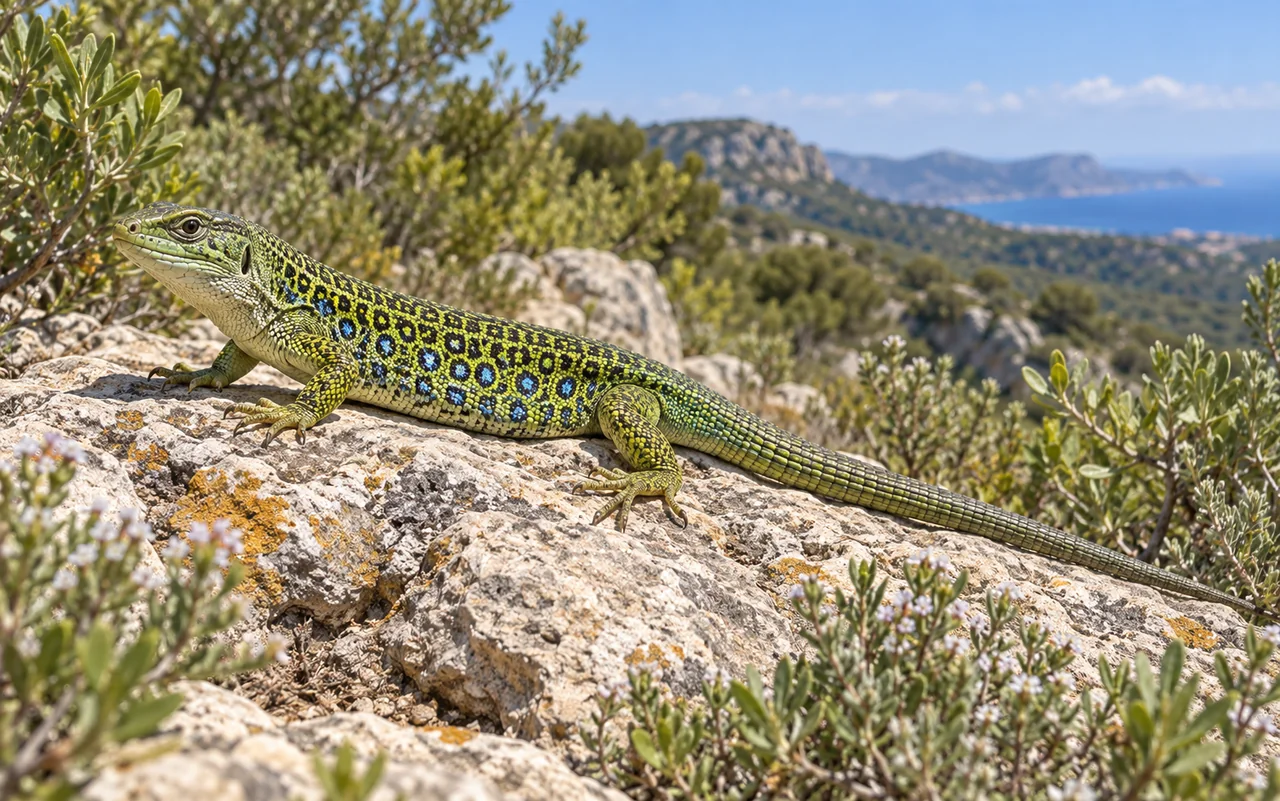
Meet the animal
Timon lepidus, formerly Lacerta lepida, is a Mediterranean lizard with characteristic blue flank spots in typical adults.
Before you choose one
Provide extensive running and retreat space; a colourful adult should not be bought for a compact display.
Arrange dependable holiday care and keep money available for food, replacement equipment and appropriate veterinary help. Test the habitat before the animal arrives.
Set up its home
Wildform proposes 180 × 90 × 90 cm or larger for one adult, with deep diggable areas, stable basking platforms and several screened retreat routes.
Measure usable internal space after substrate, guards and furnishings. Check ventilation, cable holes and access against the smallest occupant. Fix heavy furnishings independently of loose substrate.
Temperature and safe heating
The retrieved firsthand account calls for a substantial thermal gradient. Exact basking-surface, cool-refuge and night targets still require a current measured care plan; do not infer them from outdoor Mediterranean weather.
Record the warm and cool locations, overnight minimum and daytime maximum. Air, surface and substrate readings are different measurements. Any added heater needs compatible thermostatic control and safe separation from the animal; assess summer cooling as well as winter heating.
Agree exact-species temperature targets and measurement locations before setting up the enclosure.
Equipment for this care need
Daylight, shade and UV
Provide bright daytime illumination and a measured UVB gradient, while retaining opaque shelter at warm and cool positions.
Keep the night dark and provide retreat from daytime light. Lamp percentage, electrical wattage and a product name cannot establish the exposure reaching an animal. Check the finished installation after changes to mesh, branches or lamp position.
Agree measured UV exposure for the installation.
Equipment for this care need
Water, moisture and airflow
Keep drinking water and appropriate damp refuge/laying substrate while the main enclosure remains well ventilated. Mediterranean does not mean entirely dry.
Inspect the occupied refuge and substrate as well as the air reading. Adjust water provision and ventilation together, and clean contaminated drinking surfaces. A single humidity number cannot describe every microclimate.
Equipment for this care need
SPECIFICATION TO MEET
Accessible drinking provision
Accessible drinking provision
Size the usable basin and safe entry/exit for the actual animal. A small named reptile dish is not automatically a soaking basin.
Food and nutrition
Use varied suitable cultured invertebrates, with any supplementary foods and calcium/vitamin plan agreed for age and condition.
Record what is actually eaten and follow changes in growth and body condition. Food size, life stage and the full diet matter. Supplement products require an individual plan; do not combine calcium, vitamin D and multivitamins by guesswork.
Confirm the exact-species nutrition plan.
Behaviour and handling
Keep singly for this plan. Use cover and calm predictable maintenance; avoid chasing or holding the tail.
Make necessary maintenance predictable and allow voluntary retreat. Prepare a secure transfer container before essential moves. Observation should not repeatedly interrupt feeding, rest or moulting.
Health and life stages
Monitor body condition, shedding and female reproductive behaviour. Persistent straining, injury or feeding decline needs a reptile vet.
Keep dated observations of appetite, activity and condition. A sudden decline, injury, abnormal breathing or repeated failed moults needs appropriate professional assessment. This guide does not provide a diagnosis or medicine dose.
Agree the individual seasonal regime with an appropriate specialist.
Buying and keeping records
Seek documented captive-bred origin and check exact-species trade controls before acquisition.
Ask for a dated source record, scientific identity, life stage and established care history. Keep new arrivals and their equipment separate while an appropriate quarantine plan is agreed. Check current official rules for the exact animal, route and transaction before importing or buying; this page does not establish legal clearance. Never release animals or viable eggs outdoors.
Your care routine
Check water, refuge access and the measured climate gradient. Review usable running area, substrate depth and body condition. Keep a dated record of measurements and observations, and revisit the full advice when conditions or life stage change.
YOUR CHECKLIST
0 of 7 ticked
Jewelled lizard — Timon lepidus
Ticks stay on this page while it is open. Completing a list does not certify welfare or an installation.
Equipment checklist
Check usable dimensions, compatibility and measured conditions for the individual setup. A product listing does not complete a setup or guarantee price or stock.
Plan the whole setup: Named items are conditional examples. Meet every care need and test the finished habitat before arrival. No price, availability or installation approval is claimed.
CONDITIONAL EXAMPLE
Independent temperature measurement
Exo Terra Digital Thermometer
Measure occupied warm/cool air or refuge locations and day/night extremes. This is a measuring probe, not a thermostat; protect wiring and follow the probe’s moisture rating.
Specification: Remote air probe and minimum/maximum memory; place away from direct lamp radiation.
CONDITIONAL EXAMPLE
Air humidity monitoring
Exo Terra Digital Hygrometer
Use representative air readings alongside actual substrate/refuge checks. Protect the sensor from direct spray; one reading does not prove the moisture gradient.
Specification: Remote humidity probe; readings describe air at the probe, not substrate moisture.
CONDITIONAL EXAMPLE
Compatible control for added heat
HabiStat Digital Dimming Thermostat Day/Night + Timer
Conditional on a suitable heater and its instructions. The HTDD has a 0–50°C setting range and 600 W maximum load. Confirm dimming compatibility and sensor position; the timer output is not another thermostatically controlled heat channel. Add guards. No cooling function is implied.
Specification: 600 W maximum, no minimum load; setting range 0–50°C. Socket II is timed; this model does not actively cool.
OPTIONAL TOOL
Surface-temperature spot checks
Zoo Med ReptiTemp Digital Infrared Thermometer
Optional cross-check of accessible surfaces. Account for emissivity and measurement area; it cannot replace occupied-air readings.
Specification: Measures surfaces, not air. Check distance/spot size and reflective-surface limitations.
OPTIONAL TOOL
Measure installed UV exposure
Solarmeter Model 6.5R UV Index Meter
An optional measuring tool, or arrange a competent measured installation check. Read at the animal’s accessible back/head height beneath the actual mesh and retain complete shade.
Specification: UV Index meter; take readings at accessible back height with screen and guards installed.
CONDITIONAL EXAMPLE
UVB fitting example
Arcadia ProT5 Desert 12% UV-B Kit 39 W
A fitting example only after a species-specific exposure plan and measured installation. Its 870 mm length, current manufacturer clearance, actual reflector, mesh and reachable animal height must all fit. Percentage is not UVI.
Specification: 870 mm UK 220–240 V fitting. Retain at least the manufacturer’s 250 mm animal clearance, then measure exposure at every reachable back height against this profile’s plan. Percentage and clearance alone do not establish suitable UVI.
SPECIFICATION TO MEET
Accessible drinking provision
Accessible drinking provision
Size the usable basin and safe entry/exit for the actual animal. A small named reptile dish is not automatically a soaking basin.
Equipment notes: Temperature and safe heating
CONDITIONAL EXAMPLE
Independent temperature measurement
Exo Terra Digital Thermometer
Measure occupied warm/cool air or refuge locations and day/night extremes. This is a measuring probe, not a thermostat; protect wiring and follow the probe’s moisture rating.
Specification: Remote air probe and minimum/maximum memory; place away from direct lamp radiation.
CONDITIONAL EXAMPLE
Compatible control for added heat
HabiStat Digital Dimming Thermostat Day/Night + Timer
Conditional on a suitable heater and its instructions. The HTDD has a 0–50°C setting range and 600 W maximum load. Confirm dimming compatibility and sensor position; the timer output is not another thermostatically controlled heat channel. Add guards. No cooling function is implied.
Specification: 600 W maximum, no minimum load; setting range 0–50°C. Socket II is timed; this model does not actively cool.
OPTIONAL TOOL
Surface-temperature spot checks
Zoo Med ReptiTemp Digital Infrared Thermometer
Optional cross-check of accessible surfaces. Account for emissivity and measurement area; it cannot replace occupied-air readings.
Specification: Measures surfaces, not air. Check distance/spot size and reflective-surface limitations.
Equipment notes: Daylight, shade and UV
OPTIONAL TOOL
Measure installed UV exposure
Solarmeter Model 6.5R UV Index Meter
An optional measuring tool, or arrange a competent measured installation check. Read at the animal’s accessible back/head height beneath the actual mesh and retain complete shade.
Specification: UV Index meter; take readings at accessible back height with screen and guards installed.
CONDITIONAL EXAMPLE
UVB fitting example
Arcadia ProT5 Desert 12% UV-B Kit 39 W
A fitting example only after a species-specific exposure plan and measured installation. Its 870 mm length, current manufacturer clearance, actual reflector, mesh and reachable animal height must all fit. Percentage is not UVI.
Specification: 870 mm UK 220–240 V fitting. Retain at least the manufacturer’s 250 mm animal clearance, then measure exposure at every reachable back height against this profile’s plan. Percentage and clearance alone do not establish suitable UVI.
Equipment notes: Water, moisture and airflow
CONDITIONAL EXAMPLE
Air humidity monitoring
Exo Terra Digital Hygrometer
Use representative air readings alongside actual substrate/refuge checks. Protect the sensor from direct spray; one reading does not prove the moisture gradient.
Specification: Remote humidity probe; readings describe air at the probe, not substrate moisture.