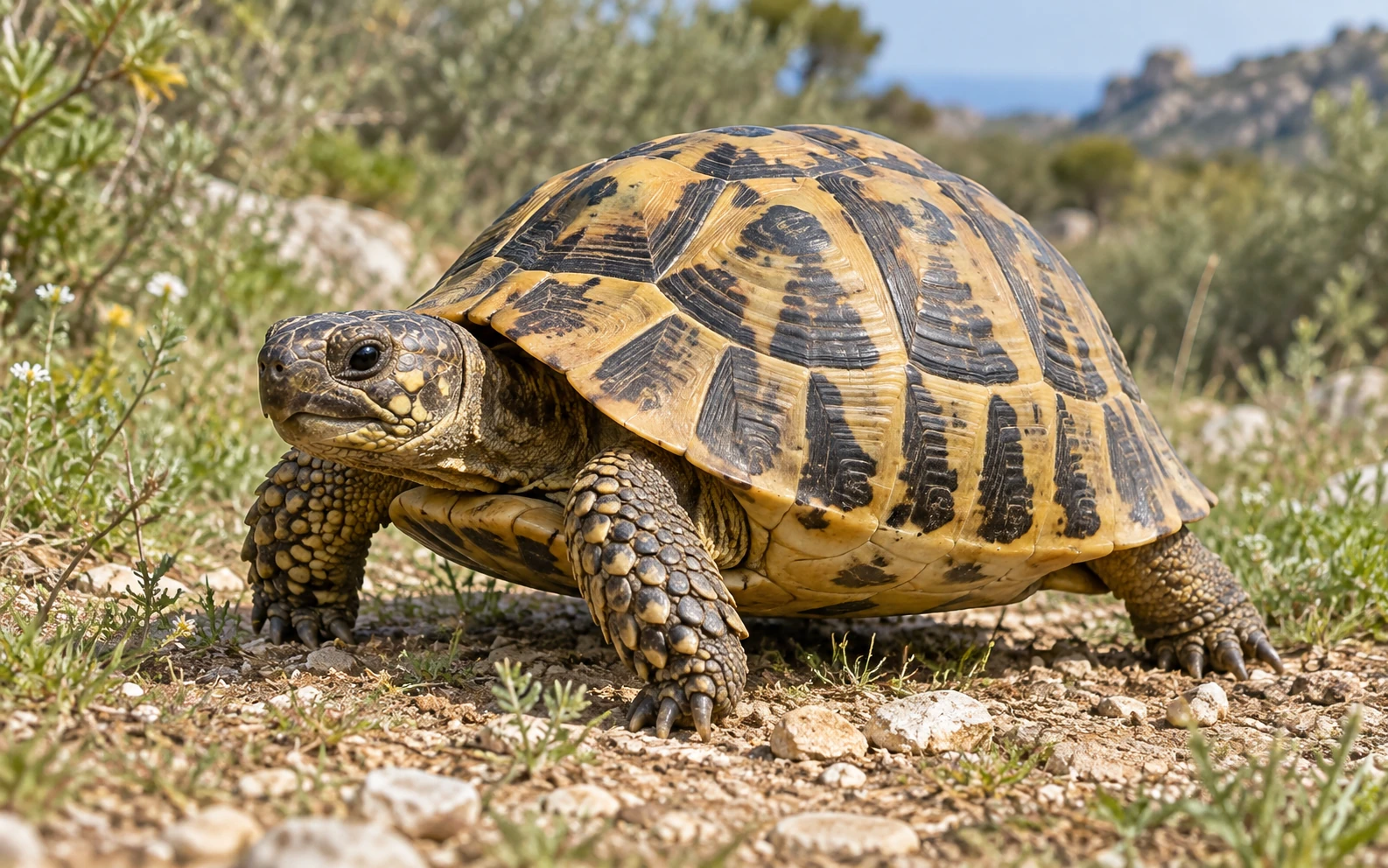
Meet the animal
Testudo hermanni is a Mediterranean tortoise. Eastern and western populations differ in size, so a photograph cannot reliably establish a pet’s subspecies or final dimensions. Its natural routine includes moving between open feeding and basking ground and sheltered vegetation.
Before you choose one
Plan for decades of care and a future keeper if needed. RSPCA guidance starts at 180 × 120 cm indoors, with welfare guidance describing around 10 square metres outdoors. Use these as starting sizes, then plan the shelter, ground, climate and other care your tortoise needs.
Set up its home
Provide secure boundaries, varied terrain, shade and a weatherproof warm retreat. Protect youngsters from predators and prevent access to ponds, toxic plants and garden chemicals. Use suitable soil deep enough for digging and covering. A small indoor table should not be assumed to provide lifetime housing.
Temperature and safe heating
Welfare and veterinary advice describes local basking around 35°C and cooler daytime areas around 20–25°C. Night advice differs, so have an active-season plan reviewed individually. Control indoor heat and check at shell height and on surfaces. Outdoor glass shelters can overheat even on mild days.
Daylight, shade and UV
Provide appropriate UVB and bright daytime light when useful unfiltered sunlight is unavailable. Ordinary window glass is not a reliable UVB route. The sources do not agree on one UVI target. Assess the fitted lamp at shell height, preserve shade and follow output checks rather than relying on visible light.
Water, moisture and airflow
Provide sheltered moisture without cold saturated ground and clean shallow drinking water with safe entry and exit. Young tortoises need particular hydration checks; a completely dry heated table can be unsuitable. Any advised bathing needs supervision and does not replace drinking access.
Food and nutrition
Base the diet on varied, correctly identified safe leafy plants and suitable high-fibre greens, with coordinated calcium and vitamins. Avoid pesticide-treated browse and fruit, meat or dog and cat food as staples. Feed on a clean surface and record growth and condition rather than judging health by shell appearance alone.
Behaviour and handling
Keep one tortoise to avoid competition and mating harassment. Support the whole body with both hands for necessary moves, staying close to the ground. Never tether it, drill the shell or apply oils to make it shine. Digging, browsing and sheltered exploration belong in its enclosure.
Health and life stages
Nasal discharge, swollen eyes, abnormal breathing, shell injury, weakness or persistent appetite loss need a tortoise vet. Females need private digging access; straining or weakness needs prompt help. Hibernation requires an individual health and weight plan. Do not assume seasonal slowing proves an animal is healthy enough to hibernate.
Buying and keeping records
Keep legal-origin and identification documents, including existing certificates. Article 10 commercial-use rules and import permits are different requirements. A GB captive-bred exemption must not be assumed to cover every animal or Northern Ireland. Ask APHA to confirm the current marking, specimen and transaction requirements before purchase or movement.
Your care routine
Prepare secure indoor and outdoor housing, safe browse, water and measured heat and UV. Agree a written winter plan before arrival. Remove waste and inspect fencing, shelters and substrate regularly. Recheck garden chemicals, predator access and weather whenever outdoor conditions change.
YOUR CHECKLIST
0 of 8 ticked
Hermann’s tortoise — Testudo hermanni
Care hub: wildformexotics.co.uk/animals/hermanns-tortoise/
Ticks are kept only while this page is open. Print or download a copy before leaving. Completing the checklist does not establish that an animal is well or an installation is safe.
Use these reminders alongside the full guide. Adjust feeding and maintenance to your animal’s condition and measured enclosure conditions.
Sources
- Testudo hermanni species account (2011) (IUCN/SSC Tortoise and Freshwater Turtle Specialist Group)
- Testudo hermanni: 2024 Red List assessment (IUCN)
- Spur-thighed, Hermann's, marginated and Horsfield's tortoises (RSPCA)
- Caresheet for Mediterranean Tortoises (British Chelonia Group)
- Mediterranean tortoise care (December 2024) (Royal Veterinary College)
- Hermann’s care sheet January 2014 (Tortoise Protection Group)
- Endangered species: certificates for commercial use (GOV.UK / APHA and Defra)
- The Control of Trade in Endangered Species (Amendment and Revocation) Regulations 2026 (UK legislation)
- Reforming domestic CITES implementation: government response (GOV.UK / Defra)
- Shark Fins Act 2023: explanatory notes, legal background (UK legislation / government explanatory notes)
- Import or export endangered species: check if you need a CITES permit (GOV.UK / APHA and Defra)
- Guidance on section 14 of the Wildlife and Countryside Act (GOV.UK / Defra)
- Import of pet invertebrates, amphibians and reptiles: IIN (GOV.UK / APHA and Defra)
Equipment checklist
Equipment examples for Hermann’s tortoise, grouped by care need. Read the checks before choosing. Shop links are Amazon affiliate links. Items without a verified Amazon match have no shop link.
Plan the whole setup: These examples cover only part of the setup. Meet every care need and test the finished enclosure before arrival. Suitable equipment you already own may meet the need; optional tools are labelled.
Check each item for your animal’s size and life stage, safe access, compatible controls and measured conditions. The list does not certify an installation.
Secure enclosure
Essential care need
Usable adult dimensions and escape-proof ventilation
Plan first: Verify inside measurements after décor and lamp guards; choose floor or climbing style for the species.
Also plan for: Plan the 180 × 120 cm indoor baseline and individual space needs in the care section. No small tortoise table or enclosure kit is selected as a complete adult home.
Temperature control and measurement
Essential care need
A thermostat for every heat source plus independent warm/cool readings
Plan first: Match dimming or on/off control to the heater, guard exposed lamps and put probes at animal level.
Exo Terra Digital Thermometer
Model: PT2472
Measure air temperature at animal height. Take independent warm and cool readings where the care plan needs a gradient.
Fit check: The remote probe measures air at one location. Keep it away from direct lamp heat, secure it safely and keep the display outside. Use separate probes for warm and cool areas where needed. Minimum/maximum readings help track changes; this device does not measure surfaces or control heating. Use a water-rated thermometer for submerged readings.
HabiStat Digital Dimming Thermostat Day/Night + Timer
Model: HTDD
Only for a compatible heater when extra heat is needed
Regulate a compatible heater using separate day and night settings. The thermostat does not produce heat.
Fit check: HTDD controls compatible heaters up to 600 W, with no minimum load and a 0–50°C setting range. Socket I regulates the heater; socket II switches a separately verified load on a timer without temperature control. Never connect UVB to the dimming heater socket; the 600 W rating does not confirm T5 ballast compatibility. Guard the heater, secure the probe as instructed without tape and keep electrics dry. Check warm and cool areas with independent thermometers. The controller cannot cool a hot enclosure.
Zoo Med ReptiTemp Digital Infrared Thermometer
Model: RT-1
Spot-check basking surfaces and other accessible surfaces; use an air probe for air temperature.
Fit check: Use this for surface temperatures, with air probes for air readings. Follow the distance and spot-size instructions, and account for reflective surfaces. It cannot measure internal body temperature.
Also plan for: Select the heat source, fitting and guard for this enclosure and room before buying the controller; no heater wattage is selected here.
Lighting and shade
Essential care need
A predictable day/night cycle and species-appropriate measured UV gradient
Plan first: Check the installed lamp, mesh, distance and animal-accessible basking position; preserve zero-UV shade.
Solarmeter Model 6.5R UV Index Meter
Model: 6.5R
Use your own meter or arrange an exposure check
Measure UV Index at the animal’s reachable basking and resting positions, with the fitted screen and guards in place.
Fit check: Use a 6.5 or 6.5R UV Index meter, rather than a UVB irradiance meter. Measure all reachable positions and shaded retreats through the fitted screen and guards. You can borrow a suitable meter or arrange a competent exposure check instead of buying one. Confirm UK supply if buying.
Also plan for: If a timer is needed, choose one confirmed as compatible with the actual lighting load, including the UVB ballast. A suitable existing timed socket may meet the need. Agree a lighting and UV exposure plan for your animal before choosing a lamp. Keep a regular day-night cycle and accessible shade. No lamp model is selected here.
Water and hygiene
Essential care need
Accessible clean water and species-safe cleaning tools
Plan first: Choose a stable bowl/ledge sized for the animal and clean it when fouled.
Also plan for: Choose a stable shallow drinking dish with easy entry and exit for the actual tortoise. The 5.5 × 6.5 cm small reptile dish is not selected for an adult.
Ground cover and hides
Essential care need
Secure warm/cool retreats and a substrate matched to age and health
Plan first: Avoid sharp material and collapse risks; use a separate clean humid hide when required.
Also plan for: Choose suitable digging material and an adult-sized stable shelter against the individual care plan. No small gecko cave is selected.
Secure outdoor run
Essential care need
Escape- and predator-resistant grazing space for suitable weather
Plan first: Provide sun, shade and shelter; check the local weather daily and keep an indoor alternative ready.
Also plan for: Design the complete adult indoor/outdoor accommodation: secure opaque boundaries, shelter, digging depth, predator protection, shade and climate provision. A building block is only a construction component.
Measured UV and seasonal plan
Essential care need
Installed UVB checked at shell height and a vet-directed seasonal plan
Plan first: A bulb label cannot confirm exposure; do not hibernate without identification and veterinary assessment.
Also plan for: Use the UV meter listed above for the installed system; the separate seasonal and hibernation plan needs a tortoise-experienced veterinarian.
Foraging food and water
Essential care need
Safe plant food and a stable shallow water dish
Plan first: Confirm every plant and supplement against tortoise-specific guidance.
Also plan for: Base the diet on varied, correctly identified safe leafy plants and suitable high-fibre greens, with coordinated calcium and vitamins.