Meet the animal
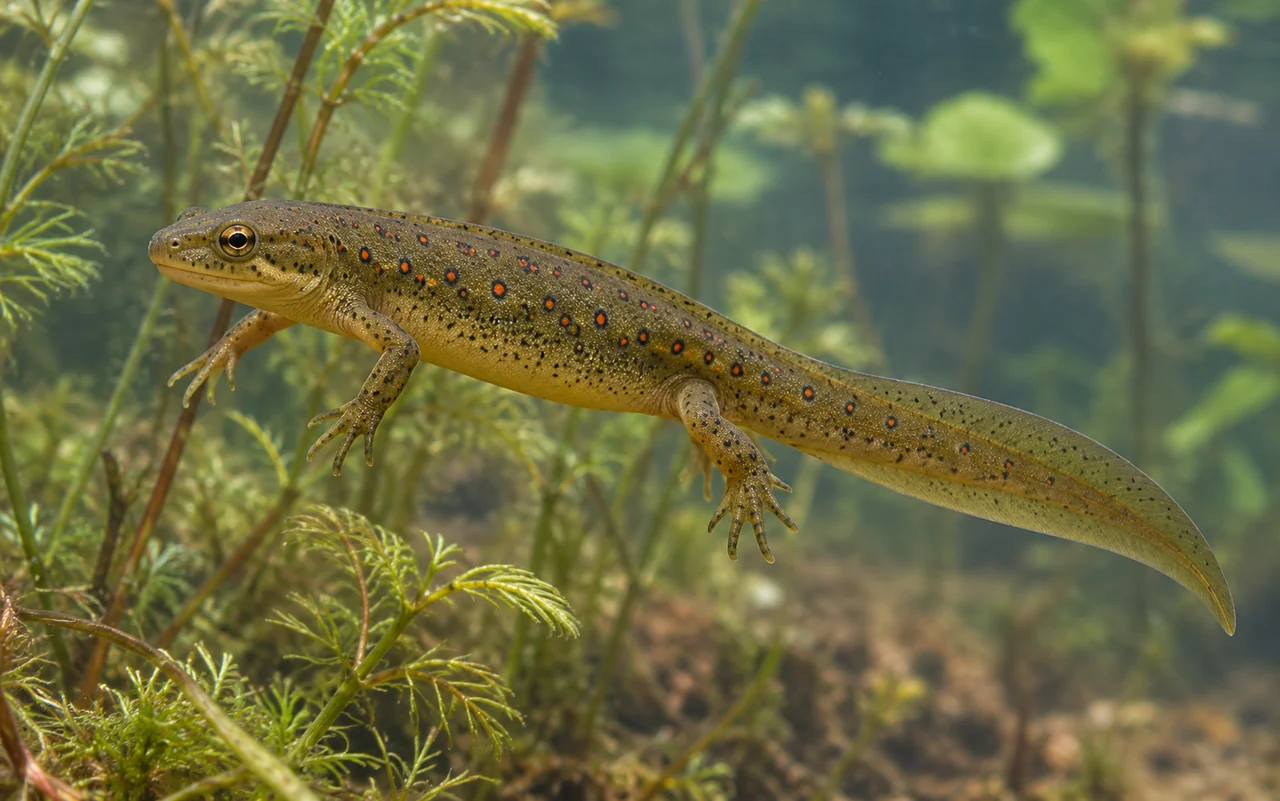
Notophthalmus viridescens can have aquatic larvae, terrestrial efts and aquatic adults. Some forms skip or modify stages; the illustration depicts an adult.
Confirm regional form and current life stage.
Before you choose one
Confirm the actual life stage and captive-bred source before deciding whether an aquarium is appropriate.
Arrange dependable holiday care and keep money available for food, replacement equipment and appropriate veterinary help. Test the habitat before the animal arrives.
Set up its home
For aquatic adults, Wildform proposes at least a 60 × 40 cm footprint with still-water planting and an accessible land rest. Efts need a secure damp woodland terrarium instead; an aquarium is not their default housing.
Measure usable internal space after substrate, guards and furnishings. Check ventilation, cable holes and access against the smallest occupant. Fix heavy furnishings independently of loose substrate.
Aquarium-only housing is not suitable for every life stage.
Equipment for this care need
SPECIFICATION TO MEET
Stage-appropriate aquarium or terrarium
Stage-appropriate aquarium or terrarium
For aquatic adults, Wildform proposes at least a 60 × 40 cm footprint with still-water planting and an accessible land rest. Efts need a secure damp woodland terrarium instead; an aquarium is not their default housing. No existing stock enclosure is selected as meeting the whole requirement.
Temperature and safe heating
The keeper account describes 18–23°C for active adults and a separate colder winter regime. Winter cooling is not prescribed here for new, juvenile or unassessed animals.
Record the warm and cool locations, overnight minimum and daytime maximum. Air, surface and substrate readings are different measurements. Any added heater needs compatible thermostatic control and safe separation from the animal; assess summer cooling as well as winter heating.
Equipment for this care need
Daylight, shade and UV
Provide gentle day/night lighting with substantial shade and concealment. Prevent lamps warming the water.
Keep the night dark and provide retreat from daytime light. Lamp percentage, electrical wattage and a product name cannot establish the exposure reaching an animal. Check the finished installation after changes to mesh, branches or lamp position.
Water, moisture and airflow
Aquatic adults need cycled, clean low-current water; efts need moist terrestrial refuges with ventilation. Both need secure lids and life-stage-safe exits.
Inspect the occupied refuge and substrate as well as the air reading. Adjust water provision and ventilation together, and clean contaminated drinking surfaces. A single humidity number cannot describe every microclimate.
Equipment for this care need
SPECIFICATION TO MEET
Low-flow filtration, secure land rest and cooling
Low-flow filtration, secure land rest and cooling
Choose an intake/current arrangement safe for the animal and stage, with tested biological capacity. Plan summer cooling separately; do not use an included aquarium heater by default. Eastern newt efts require terrestrial housing.
Food and nutrition
Use suitable small worms and other assessed invertebrates. Terrestrial efts need prey presented for terrestrial feeding; do not assume an adult pellet diet transfers.
Record what is actually eaten and follow changes in growth and body condition. Food size, life stage and the full diet matter. Supplement products require an individual plan; do not combine calcium, vitamin D and multivitamins by guesswork.
Check the animal’s individual feeding needs.
Behaviour and handling
Avoid handling and mixed-species housing. An adult repeatedly leaving water may signal a habitat or health problem rather than misbehaviour.
Make necessary maintenance predictable and allow voluntary retreat. Prepare a secure transfer container before essential moves. Observation should not repeatedly interrupt feeding, rest or moulting.
Health and life stages
Record weight/condition, skin and appetite and check water quality when behaviour changes.
Keep dated observations of appetite, activity and condition. A sudden decline, injury, abnormal breathing or repeated failed moults needs appropriate professional assessment. This guide does not provide a diagnosis or medicine dose.
Agree the individual seasonal regime.
Buying and keeping records
Retain species, form, stage and disease/source records and check current Caudata import conditions.
Ask for a dated source record, scientific identity, life stage and established care history. Keep new arrivals and their equipment separate while an appropriate quarantine plan is agreed. Check current official rules for the exact animal, route and transaction before importing or buying; this page does not establish legal clearance. Never release animals or viable eggs outdoors.
Your care routine
Check the correct life-stage habitat, temperature and actual food intake. Review developmental changes and maintain separate terrestrial/aquatic equipment as needed. Keep a dated record of measurements and observations, and revisit the full advice when conditions or life stage change.
YOUR CHECKLIST
0 of 7 ticked
Eastern newt — Notophthalmus viridescens
Ticks stay on this page while it is open. Completing a list does not certify welfare or an installation.
Equipment checklist
Check usable dimensions, compatibility and measured conditions for the individual setup. A product listing does not complete a setup or guarantee price or stock.
Plan the whole setup: Named items are conditional examples. Meet every care need and test the finished habitat before arrival. No price, availability or installation approval is claimed.
SPECIFICATION TO MEET
Stage-appropriate aquarium or terrarium
Stage-appropriate aquarium or terrarium
For aquatic adults, Wildform proposes at least a 60 × 40 cm footprint with still-water planting and an accessible land rest. Efts need a secure damp woodland terrarium instead; an aquarium is not their default housing. No existing stock enclosure is selected as meeting the whole requirement.
CONDITIONAL EXAMPLE
Independent water temperature readings
JBL Aquarium Thermometer Slim
Measure occupied water, cross-check readings and record summer maximum. This thermometer does not provide cooling.
Specification: 15 cm glass aquarium thermometer with suction holder, range 0–50°C. Fix securely where the reading represents the water the animal occupies, inspect for damage and cross-check uncertain readings. This measures temperature; it does not cool the aquarium. Confirm a UK supplier for this exact model.
CONDITIONAL EXAMPLE
Water-quality monitoring
API Freshwater Master Test Kit
Establish the biological cycle before aquatic animals arrive. Test ammonia and nitrite, follow nitrate trends and assess pH; hardness tests are separate.
Specification: Tests pH, high-range pH, ammonia, nitrite and nitrate. Follow reagent instructions and expiry dates; hardness tests are separate when required by the water plan.
CONDITIONAL EXAMPLE
Water conditioning
Seachem Prime 100 ml
Only where source water requires chlorine/chloramine treatment; follow the exact current label for the actual water volume. Conditioner does not cycle a filter.
Specification: Aquarium conditioner that treats chlorine/chloramine; use label dose in a separate container, never a replacement for water-quality testing.
SPECIFICATION TO MEET
Low-flow filtration, secure land rest and cooling
Low-flow filtration, secure land rest and cooling
Choose an intake/current arrangement safe for the animal and stage, with tested biological capacity. Plan summer cooling separately; do not use an included aquarium heater by default. Eastern newt efts require terrestrial housing.
SPECIFICATION TO MEET
Dedicated quarantine and cleaning tools
Dedicated quarantine and cleaning tools
Use separate nets/containers and an amphibian-appropriate hygiene plan. Confirm the exact source and current salamander movement rules.
Equipment notes: Temperature and safe heating
CONDITIONAL EXAMPLE
Independent water temperature readings
JBL Aquarium Thermometer Slim
Measure occupied water, cross-check readings and record summer maximum. This thermometer does not provide cooling.
Specification: 15 cm glass aquarium thermometer with suction holder, range 0–50°C. Fix securely where the reading represents the water the animal occupies, inspect for damage and cross-check uncertain readings. This measures temperature; it does not cool the aquarium. Confirm a UK supplier for this exact model.
Equipment notes: Water, moisture and airflow
CONDITIONAL EXAMPLE
Water-quality monitoring
API Freshwater Master Test Kit
Establish the biological cycle before aquatic animals arrive. Test ammonia and nitrite, follow nitrate trends and assess pH; hardness tests are separate.
Specification: Tests pH, high-range pH, ammonia, nitrite and nitrate. Follow reagent instructions and expiry dates; hardness tests are separate when required by the water plan.
CONDITIONAL EXAMPLE
Water conditioning
Seachem Prime 100 ml
Only where source water requires chlorine/chloramine treatment; follow the exact current label for the actual water volume. Conditioner does not cycle a filter.
Specification: Aquarium conditioner that treats chlorine/chloramine; use label dose in a separate container, never a replacement for water-quality testing.