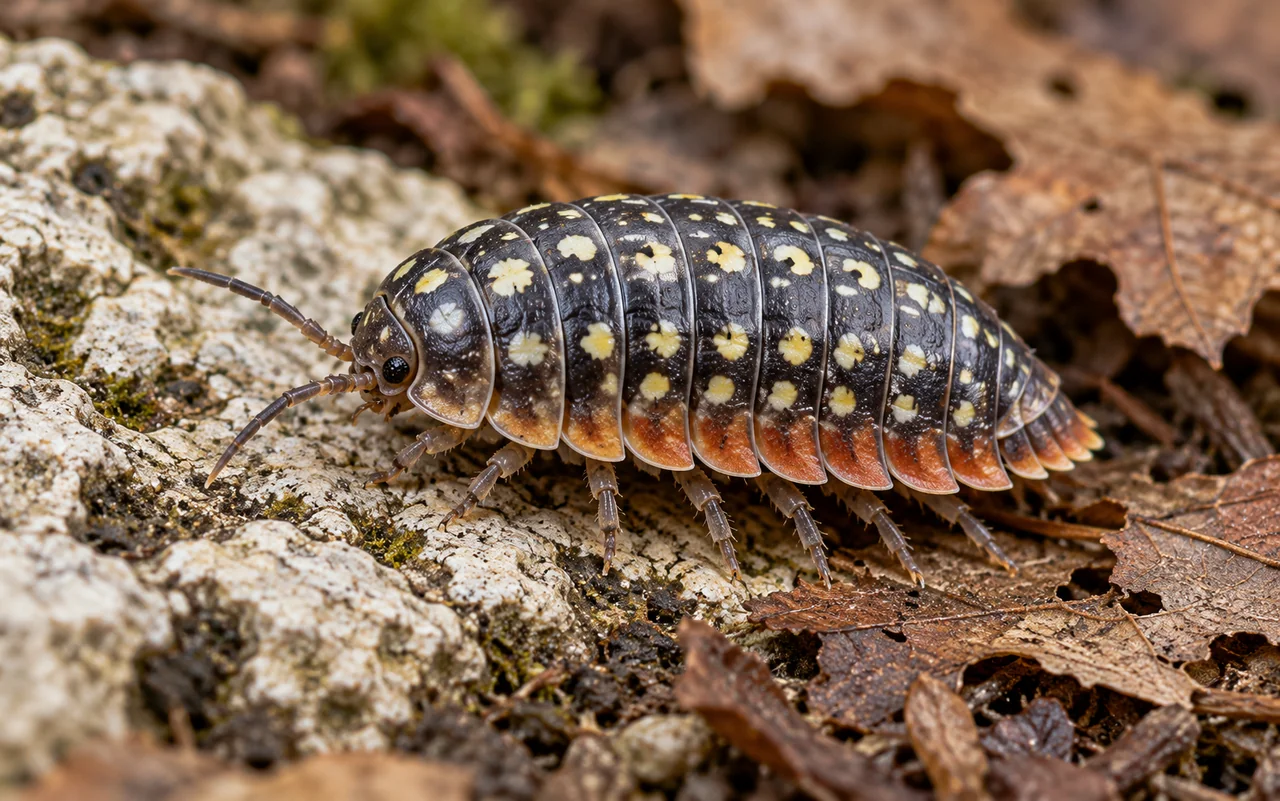
Meet the animal
Armadillidium klugii is a Balkan pill isopod. Trade morph names and changing spot colours do not by themselves prove locality.
Confirm line identity.
Before you choose one
Provide a complete separate culture before considering use in another animal’s habitat.
Arrange dependable holiday care and keep money available for food, replacement equipment and appropriate veterinary help. Test the habitat before the animal arrives.
Set up its home
Wildform proposes a secure ventilated 40 × 30 cm footprint for a starter colony, with generous leaf litter, bark and a genuinely moist refuge alongside a drier end.
Measure usable internal space after substrate, guards and furnishings. Check ventilation, cable holes and access against the smallest occupant. Fix heavy furnishings independently of loose substrate.
Do not assume compatibility as a cleanup crew in another animal’s enclosure.
Equipment for this care need
Temperature and safe heating
The keeper uses 22–26°C. Monitor the moist refuge and summer peaks; do not add an unregulated mat underneath.
Record the warm and cool locations, overnight minimum and daytime maximum. Air, surface and substrate readings are different measurements. Any added heater needs compatible thermostatic control and safe separation from the animal; assess summer cooling as well as winter heating.
Equipment for this care need
Daylight, shade and UV
Use a normal day/night rhythm with opaque shelter; no mandatory UVB target was established.
Keep the night dark and provide retreat from daytime light. Lamp percentage, electrical wattage and a product name cannot establish the exposure reaching an animal. Check the finished installation after changes to mesh, branches or lamp position.
Water, moisture and airflow
Maintain the wet-to-dry substrate choice rather than a sealed uniformly humid tub. Ventilation must not dry the refuge completely.
Inspect the occupied refuge and substrate as well as the air reading. Adjust water provision and ventilation together, and clean contaminated drinking surfaces. A single humidity number cannot describe every microclimate.
Adjust moisture and ventilation to the actual culture.
Equipment for this care need
Food and nutrition
Keep decayed hardwood leaves and suitable rotten wood continuously available, plus plain calcium and small assessed supplements.
Record what is actually eaten and follow changes in growth and body condition. Food size, life stage and the full diet matter. Supplement products require an individual plan; do not combine calcium, vitamin D and multivitamins by guesswork.
Equipment for this care need
Behaviour and handling
Avoid repeatedly rolling or exposing animals for viewing. Check population and young beneath a limited piece of cover.
Make necessary maintenance predictable and allow voluntary retreat. Prepare a secure transfer container before essential moves. Observation should not repeatedly interrupt feeding, rest or moulting.
Health and life stages
Repeated surface clustering or losses call for a review of moisture, ventilation, food and contamination.
Keep dated observations of appetite, activity and condition. A sudden decline, injury, abnormal breathing or repeated failed moults needs appropriate professional assessment. This guide does not provide a diagnosis or medicine dose.
Buying and keeping records
Keep morph and source records without presenting a trade name as geographic certification.
Ask for a dated source record, scientific identity, life stage and established care history. Keep new arrivals and their equipment separate while an appropriate quarantine plan is agreed. Check current official rules for the exact animal, route and transaction before importing or buying; this page does not establish legal clearance. Never release animals or viable eggs outdoors.
Your care routine
Check the moist refuge and remove spoiled supplements. Replenish leaves/calcium and review colony density. Keep a dated record of measurements and observations, and revisit the full advice when conditions or life stage change.
YOUR CHECKLIST
0 of 7 ticked
Clown isopod — Armadillidium klugii
Ticks stay on this page while it is open. Completing a list does not certify welfare or an installation.
Equipment checklist
Check usable dimensions, compatibility and measured conditions for the individual setup. A product listing does not complete a setup or guarantee price or stock.
Plan the whole setup: Named items are conditional examples. Meet every care need and test the finished habitat before arrival. No price, availability or installation approval is claimed.
CONDITIONAL EXAMPLE
Independent temperature measurement
Exo Terra Digital Thermometer
Measure occupied warm/cool air or refuge locations and day/night extremes. This is a measuring probe, not a thermostat; protect wiring and follow the probe’s moisture rating.
Specification: Remote air probe and minimum/maximum memory; place away from direct lamp radiation.
CONDITIONAL EXAMPLE
Air humidity monitoring
Exo Terra Digital Hygrometer
Use representative air readings alongside actual substrate/refuge checks. Protect the sensor from direct spray; one reading does not prove the moisture gradient.
Specification: Remote humidity probe; readings describe air at the probe, not substrate moisture.
CONDITIONAL EXAMPLE
Secure refuge or climbing grip
Zoo Med Natural Cork Round — select actual dimensions
Select natural dimensions for the occupant, secure pieces and avoid trapping gaps. Keep hard décor out of tarantula fall zones; cork is not food substrate or a moulting ceiling. Select and, where appropriate, cut an actual piece to fit the animal and enclosure. Secure it without trapping gaps and keep hard pieces outside tarantula fall zones. Cork is a refuge or climbing component, not food substrate or a complete moulting ceiling. Use only if the actual delivered opening and length fit the animal and leave its required usable enclosure space. Secure the piece and avoid hard fall zones. This option is not an automatic upgrade for a small spider enclosure.
Specification: Three natural small cork rounds; lengths, openings and shapes vary. One natural medium cork round; lengths, openings and shapes vary.
CONDITIONAL EXAMPLE
Plain calcium source
Zoo Med Turtle Bone — two-pack
A supplemental calcium option after assessing the whole substrate and diet. It does not replace decayed leaves and wood. A plain supplemental calcium component for the listed detritivore plan. Check the delivered label and remove any packaging or holder. It does not replace decayed leaves, decomposed wood or a complete species-appropriate food substrate.
Specification: TB-1; two natural cuttlebones, not a 100 g pack. Manufacturer lists cuttlebone as the sole ingredient.
Equipment notes: Set up its home
CONDITIONAL EXAMPLE
Secure refuge or climbing grip
Zoo Med Natural Cork Round — select actual dimensions
Select natural dimensions for the occupant, secure pieces and avoid trapping gaps. Keep hard décor out of tarantula fall zones; cork is not food substrate or a moulting ceiling. Select and, where appropriate, cut an actual piece to fit the animal and enclosure. Secure it without trapping gaps and keep hard pieces outside tarantula fall zones. Cork is a refuge or climbing component, not food substrate or a complete moulting ceiling. Use only if the actual delivered opening and length fit the animal and leave its required usable enclosure space. Secure the piece and avoid hard fall zones. This option is not an automatic upgrade for a small spider enclosure.
Specification: Three natural small cork rounds; lengths, openings and shapes vary. One natural medium cork round; lengths, openings and shapes vary.
Equipment notes: Temperature and safe heating
CONDITIONAL EXAMPLE
Independent temperature measurement
Exo Terra Digital Thermometer
Measure occupied warm/cool air or refuge locations and day/night extremes. This is a measuring probe, not a thermostat; protect wiring and follow the probe’s moisture rating.
Specification: Remote air probe and minimum/maximum memory; place away from direct lamp radiation.
Equipment notes: Water, moisture and airflow
CONDITIONAL EXAMPLE
Air humidity monitoring
Exo Terra Digital Hygrometer
Use representative air readings alongside actual substrate/refuge checks. Protect the sensor from direct spray; one reading does not prove the moisture gradient.
Specification: Remote humidity probe; readings describe air at the probe, not substrate moisture.
Equipment notes: Food and nutrition
CONDITIONAL EXAMPLE
Plain calcium source
Zoo Med Turtle Bone — two-pack
A supplemental calcium option after assessing the whole substrate and diet. It does not replace decayed leaves and wood. A plain supplemental calcium component for the listed detritivore plan. Check the delivered label and remove any packaging or holder. It does not replace decayed leaves, decomposed wood or a complete species-appropriate food substrate.
Specification: TB-1; two natural cuttlebones, not a 100 g pack. Manufacturer lists cuttlebone as the sole ingredient.