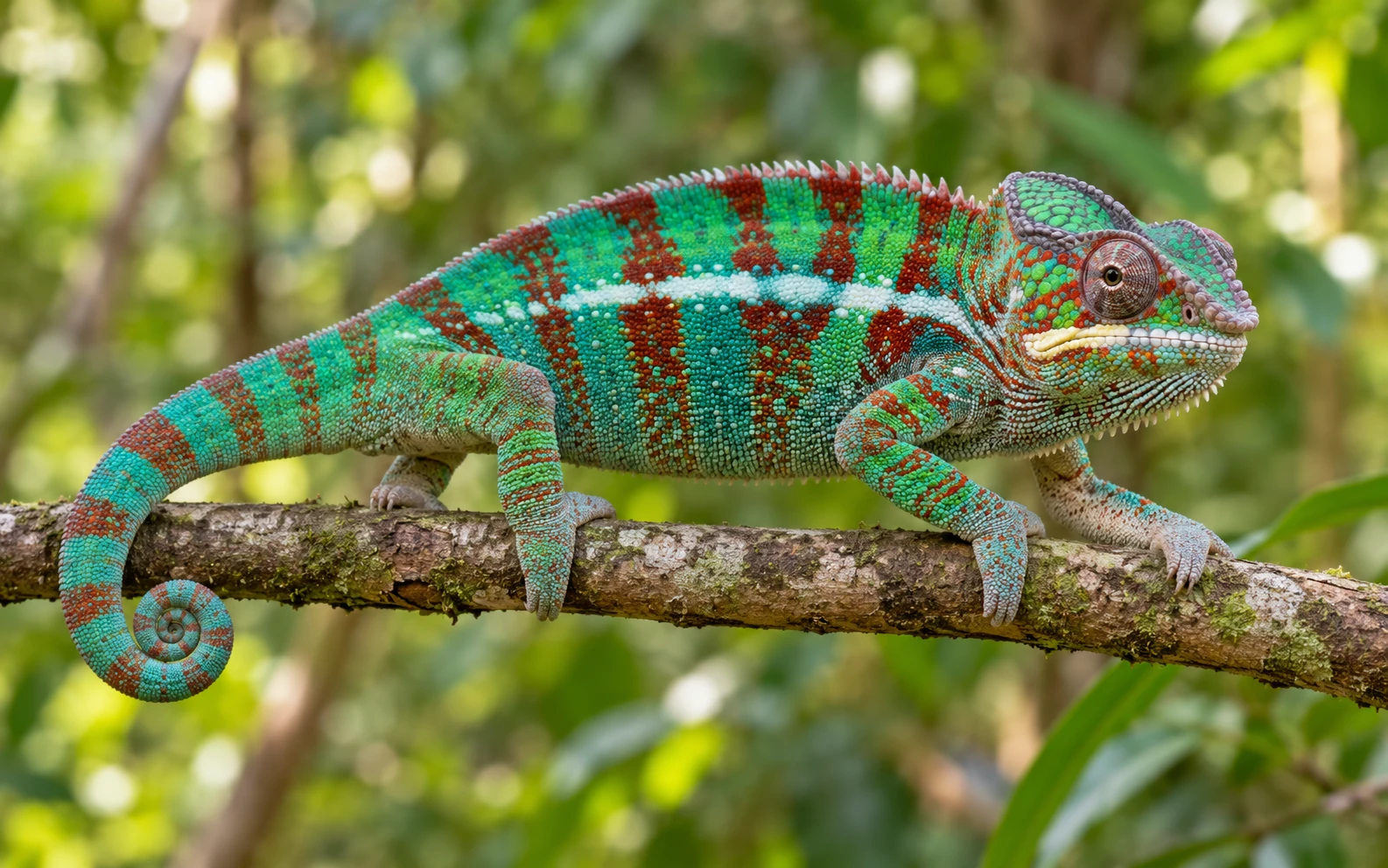
Meet the animal
Panther chameleons come from Madagascar and hunt insects during the day. Males are usually larger and more colourful than females. Locality names describe claimed ancestry and regional colour patterns; a photograph cannot prove origin or tell you which climate plan to use.
Before you choose one
RVC estimates four to seven years in captivity, with differences between individuals and sexes. Keep one chameleon, screened from the sight of others. Budget for lighting, water-system maintenance and a chameleon-experienced vet. A female can need egg-laying care even if you never intend to breed.
Set up its home
Plan at least about 61 × 61 × 122 cm for an adult, with more usable room preferred. Add many horizontal branches, leafy cover and hidden routes between warm and cool positions. Choose mesh or hybrid construction for your room, and leave space for drainage and a female’s laying area.
Temperature and safe heating
The sources disagree: Chameleon Academy describes daytime air around 24–26°C and local basking around 29°C; RVC gives about 35°C basking. Have an experienced specialist review one complete day-night plan before purchase. Do not average the figures. Control heat and measure at back height, including near any reachable roof or fitting.
Daylight, shade and UV
Provide bright days, darkness overnight and dense shade. Chameleon Academy suggests UVI around 3 at the exposed back; UVI means measured UV Index. Check exposure through the installed screen at every reachable height. Arrange light and heat together so the chameleon can warm up and still choose shelter.
Water, moisture and airflow
The specialist approach separates roughly 40–60% daytime humidity from much higher humidity during cool nights. Review this alongside the temperature plan. Provide clean drinking droplets through controlled misting or dripping, allow daytime surface drying and remove runoff. A humidity reading cannot confirm that your chameleon is drinking.
Food and nutrition
Offer varied cultured insects, fed nutritious food before use, and a coordinated calcium and vitamin plan. Growing juveniles need frequent small meals; adults need portions matched to condition and sex. Remove biting leftovers. Have a female’s diet reviewed rather than withholding essential food to try to prevent eggs.
Behaviour and handling
Give your chameleon control over exposure and contact. For an essential transfer, allow it to walk onto supported hands or a branch. Never pull gripping feet free. A still animal is not necessarily comfortable being handled, and colour alone cannot explain its health or mood.
Health and life stages
Provide a private digging area before a female shows laying signs. Straining, swelling, weakness or repeated falling need prompt veterinary help. Also seek advice for daytime eye closure, grip loss, abnormal breathing or sustained appetite decline. Bring records of heat, UV, water delivery, food and supplements.
Buying and keeping records
Choose documented captive-bred stock and retain identification and locality claims separately. Check current CITES and movement requirements before an import or export. Arrange a holiday keeper who understands the water system and daily checks, and quarantine new arrivals with separate equipment.
Your care routine
Before arrival, test the furnished enclosure and resolve the climate disagreement. Each day, observe the animal, drinking access and measured conditions. Remove waste, clean water-system parts and inspect drainage and branches. Check that plants still provide privacy without blocking essential access.
YOUR CHECKLIST
0 of 7 ticked
Panther chameleon — Furcifer pardalis
Care hub: wildformexotics.co.uk/animals/chameleons-animal-8/
Ticks are kept only while this page is open. Print or download a copy before leaving. Completing the checklist does not establish that an animal is well or an installation is safe.
Use these reminders alongside the full guide. Adjust feeding and maintenance to your animal’s condition and measured enclosure conditions.
Sources
- Panther chameleon care (Bill Strand / Chameleon Academy)
- Furcifer pardalis (Animal Diversity Web contributors / Animal Diversity Web, University of Michigan)
- Panther chameleon care, reviewed December 2024 (Royal Veterinary College, Beaumont Sainsbury Animal Hospital)
- How much UVB does my reptile need? The UV-Tool (Baines et al.; Journal of Zoo and Aquarium Research)
- Import or export endangered species: check if you need a CITES permit (GOV.UK / APHA and Defra)
- Guidance on section 14 of the Wildlife and Countryside Act (GOV.UK / Defra)
- Import of pet invertebrates, amphibians and reptiles: IIN (GOV.UK / APHA and Defra)
Equipment checklist
Equipment examples for Panther chameleon, grouped by care need. Read the checks before choosing. Shop links are Amazon affiliate links. Items without a verified Amazon match have no shop link.
Plan the whole setup: These examples cover only part of the setup. Meet every care need and test the finished enclosure before arrival. Suitable equipment you already own may meet the need; optional tools are labelled.
Check each item for your animal’s size and life stage, safe access, compatible controls and measured conditions. The list does not certify an installation.
Secure enclosure
Essential care need
Usable adult dimensions and escape-proof ventilation
Plan first: Verify inside measurements after décor and lamp guards; choose floor or climbing style for the species.
Zoo Med ReptiBreeze X-Large
Model: NT-13
Provide tall mesh housing to be assessed for the chameleon and the actual UK room.
Fit check: The manufacturer gives a size of 24 × 24 × 48 inches. Check conditions in your room and plan warmth, drinking water, foliage and drainage separately. Measure the usable interior after substrate, furnishings and lamp guards are fitted. Check room for your animal’s adult size, safe access, secure doors, vents and cable gaps, stable supports and any digging depth.
Temperature control and measurement
Essential care need
A thermostat for every heat source plus independent warm/cool readings
Plan first: Match dimming or on/off control to the heater, guard exposed lamps and put probes at animal level.
Exo Terra Digital Thermometer
Model: PT2472
Measure air temperature at animal height. Take independent warm and cool readings where the care plan needs a gradient.
Fit check: The remote probe measures air at one location. Keep it away from direct lamp heat, secure it safely and keep the display outside. Use separate probes for warm and cool areas where needed. Minimum/maximum readings help track changes; this device does not measure surfaces or control heating. Use a water-rated thermometer for submerged readings.
HabiStat Digital Dimming Thermostat Day/Night + Timer
Model: HTDD
Only for a compatible heater when extra heat is needed
Regulate a compatible heater using separate day and night settings. The thermostat does not produce heat.
Fit check: HTDD controls compatible heaters up to 600 W, with no minimum load and a 0–50°C setting range. Socket I regulates the heater; socket II switches a separately verified load on a timer without temperature control. Never connect UVB to the dimming heater socket; the 600 W rating does not confirm T5 ballast compatibility. Guard the heater, secure the probe as instructed without tape and keep electrics dry. Check warm and cool areas with independent thermometers. The controller cannot cool a hot enclosure.
Zoo Med ReptiTemp Digital Infrared Thermometer
Model: RT-1
Spot-check basking surfaces and other accessible surfaces; use an air probe for air temperature.
Fit check: Use this for surface temperatures, with air probes for air readings. Follow the distance and spot-size instructions, and account for reflective surfaces. It cannot measure internal body temperature.
Also plan for: Select the heat source, fitting and guard for this enclosure and room before buying the controller; no heater wattage is selected here.
Lighting and shade
Essential care need
A predictable day/night cycle and species-appropriate measured UV gradient
Plan first: Check the installed lamp, mesh, distance and animal-accessible basking position; preserve zero-UV shade.
Arcadia ProT5 Forest 6% UV-B Kit 24 W
Model: RARTP24F
Provide a measured UV gradient over the basking area, with sheltered routes away from it.
Fit check: RARTP24F is a 24 W, 570 mm UK 220–240 V fitting. Keep it away from water and spray; IP20 is not waterproof. Follow the manufacturer’s minimum animal clearance of 250 mm. This is a safety limit, not a recommended mounting height or UVI target. Check the complete fitting length, guards and reachable animal positions. Measure UV Index through the installed screen at each reachable height, with full shade available. Use a separately verified lighting circuit, never a heater’s dimming outlet.
Solarmeter Model 6.5R UV Index Meter
Model: 6.5R
Use your own meter or arrange an exposure check
Measure UV Index at the animal’s reachable basking and resting positions, with the fitted screen and guards in place.
Fit check: Use a 6.5 or 6.5R UV Index meter, rather than a UVB irradiance meter. Measure all reachable positions and shaded retreats through the fitted screen and guards. You can borrow a suitable meter or arrange a competent exposure check instead of buying one. Confirm UK supply if buying.
Also plan for: If a timer is needed, choose one confirmed as compatible with the actual lighting load, including the UVB ballast. A suitable existing timed socket may meet the need.
Water and hygiene
Essential care need
Accessible clean water and species-safe cleaning tools
Plan first: Choose a stable bowl/ledge sized for the animal and clean it when fouled.
Also plan for: Use clean dedicated tools and the foliage-drinking plan below. A standing reptile bowl is not a substitute for this chameleon’s drinking access.
Climbing and secure retreat
Essential care need
Connected branches, broad perches and multiple shaded hides
Plan first: Fix décor securely and leave access to cooler and more humid choices.
Exo Terra Jungle Vines Large
Model: PT3086
Add a securely fixed climbing route.
Fit check: PT3086 is about 182 cm long and 1.5 cm across. Check that the animal can grip it, secure it against movement and avoid trapping gaps or unsafe falls. Add broad resting cover where needed. It cannot replace food stems or a secure ceiling grip for moulting.
Alternative equipment
Zoo Med Natural Cork Round — select actual dimensions
Three natural small cork rounds; lengths, openings and shapes vary. One natural medium cork round; lengths, openings and shapes vary.
Choose actual dimensions and openings for this individual, support securely and avoid trapping or fall hazards. This is one component, not the complete set of retreats, broad resting surfaces or a grippable moult ceiling.
Select and, where appropriate, cut an actual piece to fit the animal and enclosure. Secure it without trapping gaps and keep hard pieces outside tarantula fall zones. Cork is a refuge or climbing component, not food substrate or a complete moulting ceiling.
Use only if the actual delivered opening and length fit the animal and leave its required usable enclosure space. Secure the piece and avoid hard fall zones. This option is not an automatic upgrade for a small spider enclosure.
Hydration delivery
Essential care need
Clean droplets on foliage followed by drying and drainage
Plan first: Confirm the animal can drink; a misting device is optional if manual delivery is reliable.
Alternative equipment
Exo Terra Mini Mister — 0.5 L
PT2489; 0.5 L hand spray bottle. The Amazon title uses 16 US fluid ounces; this is not the conflicting 1.5/2 L pressure sprayer.
Use an existing suitable fine sprayer if you have one. Follow the individual wet-dry cycle; do not spray the animal, soak every surface or substitute misting for drinking water.
A manual misting tool only where the individual care plan calls for it. Use clean water, keep the bottle hygienic and free of chemicals, and do not spray directly at the animal. Check substrate/refuge moisture and drying/airflow rather than misting to a universal schedule.