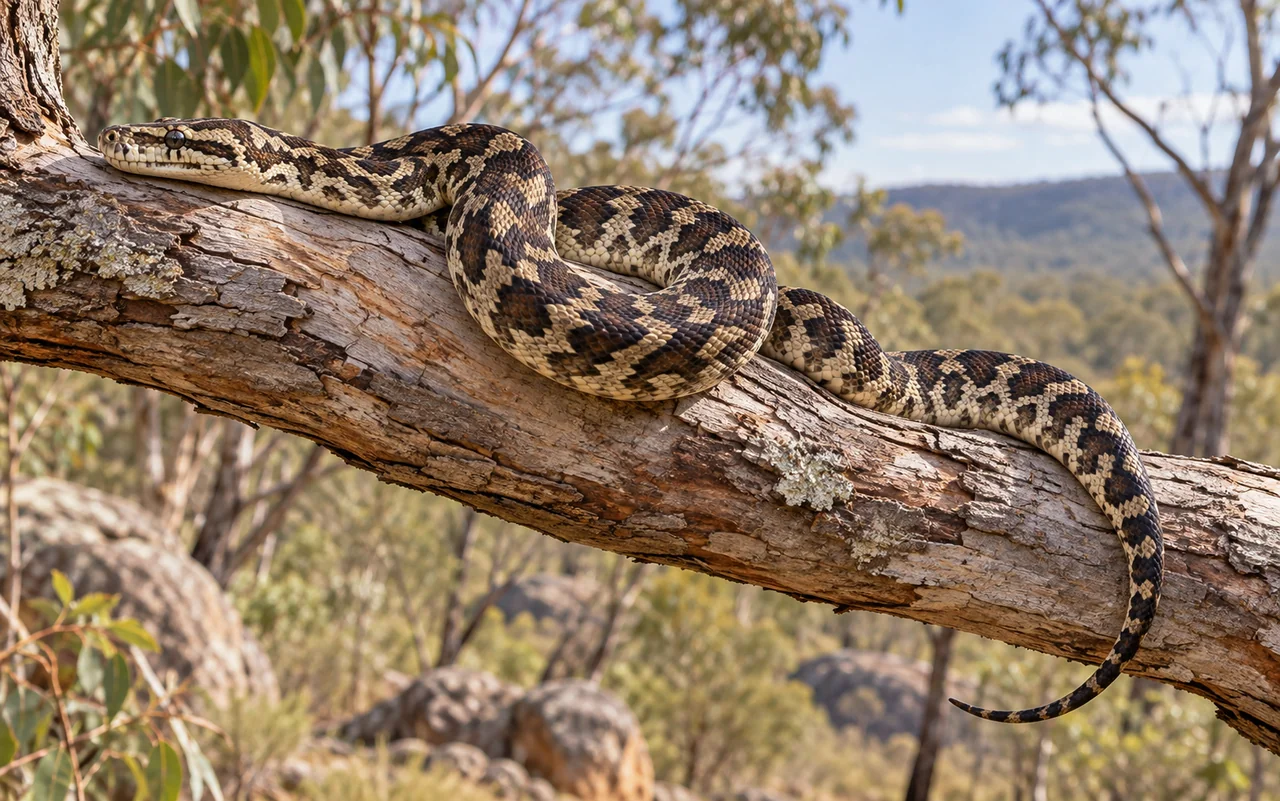
Meet the animal
Morelia spilota is a geographically varied semi-arboreal python. Record the actual form and parentage instead of treating every carpet or diamond python as interchangeable.
Confirm the actual geographic form; guidance for different forms is not interchangeable.
Before you choose one
Budget for substantial adult housing and load-bearing climbing furnishings.
Arrange dependable holiday care and keep money available for food, replacement equipment and appropriate veterinary help. Test the habitat before the animal arrives.
Set up its home
The retrieved guide proposes roughly 244 × 122 × 122 cm for many adults up to 2.4 m. Scale to full straightening and usable climbing, with strong fixed branches and concealed resting places.
Measure usable internal space after substrate, guards and furnishings. Check ventilation, cable holes and access against the smallest occupant. Fix heavy furnishings independently of loose substrate.
Check the adult structural and usable-space specification. No named enclosure here is confirmed to meet the whole adult requirement.
Equipment for this care need
SPECIFICATION TO MEET
Enclosure to the full adult specification
Enclosure to the full adult specification
The retrieved guide proposes roughly 244 × 122 × 122 cm for many adults up to 2.4 m. Scale to full straightening and usable climbing, with strong fixed branches and concealed resting places. No existing stock enclosure is selected as meeting the whole requirement.
Temperature and safe heating
The current ReptiFiles page proposes a 35–38°C basking surface, 24–26°C cool end and 22–25°C at night. These are different measurement locations. Confirm the geographic form and do not apply the surface number as enclosure air temperature. Seasonal cooling needs a separate individual plan.
Record the warm and cool locations, overnight minimum and daytime maximum. Air, surface and substrate readings are different measurements. Any added heater needs compatible thermostatic control and safe separation from the animal; assess summer cooling as well as winter heating.
Agree exact temperature targets and measurement positions for that form.
Equipment for this care need
Daylight, shade and UV
The current guide proposes basking UVI 2–3 with complete shade. Measure at the snake’s back on its actual accessible branch; the old PDF address now redirects to the current page.
Keep the night dark and provide retreat from daytime light. Lamp percentage, electrical wattage and a product name cannot establish the exposure reaching an animal. Check the finished installation after changes to mesh, branches or lamp position.
Equipment for this care need
SPECIFICATION TO MEET
Daylight, shelter and assessed UV provision
Daylight, shelter and assessed UV provision
Set the exact-species exposure plan before selecting a lamp; no one bulb is certified for this whole group. Keep a dark night.
Water, moisture and airflow
The guide describes 40–60% air humidity and a humid retreat. Mist only as needed to achieve the measured cycle; conflicting fixed misting instructions are not adopted.
Inspect the occupied refuge and substrate as well as the air reading. Adjust water provision and ventilation together, and clean contaminated drinking surfaces. A single humidity number cannot describe every microclimate.
Equipment for this care need
SPECIFICATION TO MEET
Accessible drinking provision
Accessible drinking provision
Size the usable basin and safe entry/exit for the actual animal. A small named reptile dish is not automatically a soaking basin.
Food and nutrition
The guide starts juveniles around 1–2 weeks and adults around 2–4 weeks between appropriate whole-prey meals, adjusted to body condition.
Record what is actually eaten and follow changes in growth and body condition. Food size, life stage and the full diet matter. Supplement products require an individual plan; do not combine calcium, vitamin D and multivitamins by guesswork.
Equipment for this care need
SPECIFICATION TO MEET
Appropriate feeding tools and prey hygiene
Appropriate feeding tools and prey hygiene
Choose soft-ended feeding tools long enough for the actual snake and a safe frozen-thawed prey routine. The catalogue’s short 28 cm tweezers are not selected for large boas or pythons. Keep prey preparation separate from human food preparation.
Behaviour and handling
Support the body, keep singly and avoid allowing a large python around the neck. Nervous youngsters need calm, brief necessary interaction.
Make necessary maintenance predictable and allow voluntary retreat. Prepare a secure transfer container before essential moves. Observation should not repeatedly interrupt feeding, rest or moulting.
Health and life stages
Track growth, sheds and breathing; rapid growth from excessive feeding is not the goal.
Keep dated observations of appetite, activity and condition. A sudden decline, injury, abnormal breathing or repeated failed moults needs appropriate professional assessment. This guide does not provide a diagnosis or medicine dose.
Buying and keeping records
Retain geographic form and provenance; a generated portrait is illustrative.
Ask for a dated source record, scientific identity, life stage and established care history. Keep new arrivals and their equipment separate while an appropriate quarantine plan is agreed. Check current official rules for the exact animal, route and transaction before importing or buying; this page does not establish legal clearance. Never release animals or viable eggs outdoors.
Your care routine
Check branch security, water and the warm/cool/night records. Review prey size and body condition, and inspect every load-bearing fixing. Keep a dated record of measurements and observations, and revisit the full advice when conditions or life stage change.
YOUR CHECKLIST
0 of 7 ticked
Carpet python — Morelia spilota
Ticks stay on this page while it is open. Completing a list does not certify welfare or an installation.
Equipment checklist
Check usable dimensions, compatibility and measured conditions for the individual setup. A product listing does not complete a setup or guarantee price or stock.
Plan the whole setup: Named items are conditional examples. Meet every care need and test the finished habitat before arrival. No price, availability or installation approval is claimed.
SPECIFICATION TO MEET
Enclosure to the full adult specification
Enclosure to the full adult specification
The retrieved guide proposes roughly 244 × 122 × 122 cm for many adults up to 2.4 m. Scale to full straightening and usable climbing, with strong fixed branches and concealed resting places. No existing stock enclosure is selected as meeting the whole requirement.
CONDITIONAL EXAMPLE
Independent temperature measurement
Exo Terra Digital Thermometer
Measure occupied warm/cool air or refuge locations and day/night extremes. This is a measuring probe, not a thermostat; protect wiring and follow the probe’s moisture rating.
Specification: Remote air probe and minimum/maximum memory; place away from direct lamp radiation.
CONDITIONAL EXAMPLE
Air humidity monitoring
Exo Terra Digital Hygrometer
Use representative air readings alongside actual substrate/refuge checks. Protect the sensor from direct spray; one reading does not prove the moisture gradient.
Specification: Remote humidity probe; readings describe air at the probe, not substrate moisture.
CONDITIONAL EXAMPLE
Compatible control for added heat
HabiStat Digital Dimming Thermostat Day/Night + Timer
Conditional on a suitable heater and its instructions. The HTDD has a 0–50°C setting range and 600 W maximum load. Confirm dimming compatibility and sensor position; the timer output is not another thermostatically controlled heat channel. Add guards. No cooling function is implied.
Specification: 600 W maximum, no minimum load; setting range 0–50°C. Socket II is timed; this model does not actively cool.
OPTIONAL TOOL
Surface-temperature spot checks
Zoo Med ReptiTemp Digital Infrared Thermometer
Optional cross-check of accessible surfaces. Account for emissivity and measurement area; it cannot replace occupied-air readings.
Specification: Measures surfaces, not air. Check distance/spot size and reflective-surface limitations.
OPTIONAL TOOL
Measure installed UV exposure
Solarmeter Model 6.5R UV Index Meter
An optional measuring tool, or arrange a competent measured installation check. Read at the animal’s accessible back/head height beneath the actual mesh and retain complete shade.
Specification: UV Index meter; take readings at accessible back height with screen and guards installed.
SPECIFICATION TO MEET
Daylight, shelter and assessed UV provision
Daylight, shelter and assessed UV provision
Set the exact-species exposure plan before selecting a lamp; no one bulb is certified for this whole group. Keep a dark night.
SPECIFICATION TO MEET
Appropriate feeding tools and prey hygiene
Appropriate feeding tools and prey hygiene
Choose soft-ended feeding tools long enough for the actual snake and a safe frozen-thawed prey routine. The catalogue’s short 28 cm tweezers are not selected for large boas or pythons. Keep prey preparation separate from human food preparation.
SPECIFICATION TO MEET
Accessible drinking provision
Accessible drinking provision
Size the usable basin and safe entry/exit for the actual animal. A small named reptile dish is not automatically a soaking basin.
Equipment notes: Temperature and safe heating
CONDITIONAL EXAMPLE
Independent temperature measurement
Exo Terra Digital Thermometer
Measure occupied warm/cool air or refuge locations and day/night extremes. This is a measuring probe, not a thermostat; protect wiring and follow the probe’s moisture rating.
Specification: Remote air probe and minimum/maximum memory; place away from direct lamp radiation.
CONDITIONAL EXAMPLE
Compatible control for added heat
HabiStat Digital Dimming Thermostat Day/Night + Timer
Conditional on a suitable heater and its instructions. The HTDD has a 0–50°C setting range and 600 W maximum load. Confirm dimming compatibility and sensor position; the timer output is not another thermostatically controlled heat channel. Add guards. No cooling function is implied.
Specification: 600 W maximum, no minimum load; setting range 0–50°C. Socket II is timed; this model does not actively cool.
OPTIONAL TOOL
Surface-temperature spot checks
Zoo Med ReptiTemp Digital Infrared Thermometer
Optional cross-check of accessible surfaces. Account for emissivity and measurement area; it cannot replace occupied-air readings.
Specification: Measures surfaces, not air. Check distance/spot size and reflective-surface limitations.
Equipment notes: Daylight, shade and UV
OPTIONAL TOOL
Measure installed UV exposure
Solarmeter Model 6.5R UV Index Meter
An optional measuring tool, or arrange a competent measured installation check. Read at the animal’s accessible back/head height beneath the actual mesh and retain complete shade.
Specification: UV Index meter; take readings at accessible back height with screen and guards installed.
Equipment notes: Water, moisture and airflow
CONDITIONAL EXAMPLE
Air humidity monitoring
Exo Terra Digital Hygrometer
Use representative air readings alongside actual substrate/refuge checks. Protect the sensor from direct spray; one reading does not prove the moisture gradient.
Specification: Remote humidity probe; readings describe air at the probe, not substrate moisture.