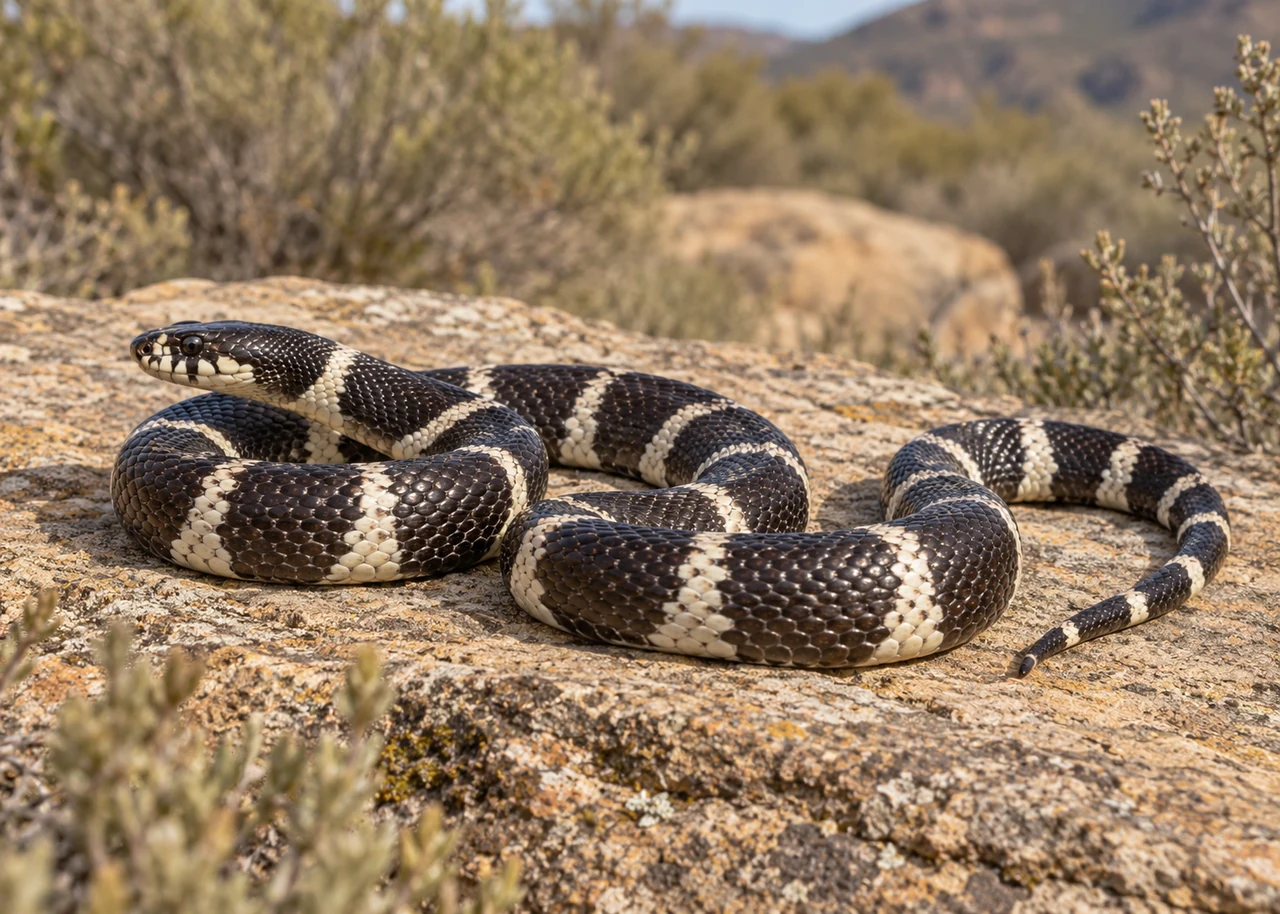
Meet the animal
Lampropeltis californiae comes from varied western North American habitats. Banded and striped forms occur, with further captive colour variations. Appearance alone does not prove locality or pedigree. Kingsnakes can eat other snakes, including their own kind.
Before you choose one
Budget for a lasting enclosure, frozen food, lighting and reptile-vet care. Ask for the individual’s length and feeding history. Keep one snake and arrange holiday care with written meal dates, control settings and locking instructions.
Set up its home
The 150 × 60 × 60 cm vivarium listed here may be an option, but its fit depends on your adult snake’s size. Measure usable internal length against the individual’s full straight-line length and check width and height too; published guides use different proportions. Nominal outside dimensions cannot establish usable space. Add snug warm and cool hides, a humid refuge, stable low branches and diggable substrate.
Temperature and safe heating
Have the complete day-night plan reviewed for the individual. RSPCA gives a 26–30°C basking zone and 21–24°C cool end; ReptiFiles describes a 29–32°C basking surface and 21–26°C cool side. The guides describe different measurements. Keep each recommendation with its source rather than combining the figures into one setting. Guard heat sources, use a compatible thermostat and check air and surfaces separately. Do not cool an unwell animal simply to copy a seasonal routine.
Daylight, shade and UV
Provide about 12 hours of daytime light, darkness overnight and shade. RSPCA describes basking UVI around 0.7; Royal Veterinary Center and ReptiFiles describe 2–3. These are conflicting recommendations, not a range to choose from or average. Have the individual’s target and measured installation reviewed, including any albino morph’s light sensitivity. Bulb percentage alone cannot establish UV Index.
Water, moisture and airflow
Measure humidity inside the vivarium at snake level with a hygrometer; a room reading cannot stand in for the air the snake occupies. RSPCA gives around 40–55%, while Royal Veterinary Center and ReptiFiles describe 40–60%. Keep these recommendations with their sources; they do not form one combined target. ReptiFiles places its probe centrally and notes differences between warm and cool areas and overnight. Record the location and time with each reading. Keep a separate humid refuge and fresh drinking water without soaking the whole floor. Poor sheds need an environmental and health review. Retained eye coverings need a reptile vet; do not pull them off.
Food and nutrition
Offer appropriately sized, fully thawed whole rodents with feeding tools. Royal Veterinary Center gives hatchlings about 5–7 days between meals, juveniles 7–10 and adults 10–14, adjusted for body condition. Use these age-based schedules as starting guidance and adjust them for your snake. A feeding response does not always mean it needs food. RSPCA says good-quality whole prey normally needs no supplements; do not add a dusting routine without an individual plan. Keep prey storage and preparation separate from human food.
Behaviour and handling
Allow settling before brief supported handling and leave at least 48 hours after a meal. Wash food scents from hands. Persistent escape attempts or a feeding response are reasons to check cover, conditions and cues, rather than assumptions about affection.
Health and life stages
Record feeding, sheds and weight. Wheezing, open-mouth breathing, burns, repeated regurgitation, mites or sustained weight loss need a reptile vet. Readily accepting meals does not rule out obesity. Quarantine separately with dedicated equipment and an individual testing plan.
Buying and keeping records
Choose documented captive-bred stock with exact identification and recent feeding records. Keep morph and locality claims separate from verified identity. Confirm current rules before a cross-border purchase and never introduce a second kingsnake as a companion.
Your care routine
Before arrival, confirm usable enclosure dimensions and the heat and UV plan. Each day, check the snake, fresh drinking water and controls, and record enclosure humidity with the probe location and time. Replace drinking water at least daily and promptly if fouled. Check the humid refuge separately rather than using its reading as the whole-enclosure value. Inspect doors, vents, cable entries and hides. Record meal dates and weight trends so a holiday keeper does not duplicate feeding.
YOUR CHECKLIST
0 of 9 ticked
California kingsnake — Lampropeltis californiae
Care hub: wildformexotics.co.uk/animals/california-kingsnake/
Ticks are kept only while this page is open. Print or download a copy before leaving. Completing the checklist does not establish that an animal is well or an installation is safe.
Use these reminders alongside the full guide. Adjust feeding and maintenance to your animal’s condition and measured enclosure conditions.
Sources
- California kingsnake identity (US Fish and Wildlife Service)
- Kingsnake welfare advice (RSPCA)
- California kingsnake care (Royal Veterinary Center)
- Kingsnake care sheet (ReptiFiles)
- UV-Tool: selecting appropriate UV lighting for reptiles and amphibians (2016) (Baines and colleagues, Journal of Zoo and Aquarium Research)
- CITES import and export guidance (APHA / GOV.UK)
- RSPCA kingsnake guidance
- ReptiFiles kingsnake guidance
- Exo Terra PT2477 EU manual (English, page 1)
- Guidance on section 14 of the Wildlife and Countryside Act (GOV.UK / Defra)
- Import of pet invertebrates, amphibians and reptiles: IIN (GOV.UK / APHA and Defra)
Other references
Sources: RSPCA kingsnake guidance · ReptiFiles kingsnake guidance · Exo Terra PT2477 EU manual (English, page 1) · Exo Terra Mister instructions
Equipment checklist
Equipment examples for California kingsnake, grouped by care need. Read the checks before choosing. Shop links are Amazon affiliate links. Items without a verified Amazon match have no shop link.
Plan the whole setup: These examples cover only part of the setup. Meet every care need and test the finished enclosure before arrival. Suitable equipment you already own may meet the need; optional tools are labelled.
Check each item for your animal’s size and life stage, safe access, compatible controls and measured conditions. The list does not certify an installation.
Adult enclosure, substrate and shelter
Read the care guidance for this need
Alternative equipment
Repti-Life 72 × 24 × 24 inch vivarium — black
Amazon-selected 72 × 24 × 24 inch black flat-pack; 18 mm MFC, 4 mm toughened glass, six vents. External/nominal sizing, not certified usable space.
Secure doors, cables and vents; check the smallest life stage and actual usable space. External dimensions are not usable internal space. Check actual individual size, access, secure gaps, load support, furnishing clearance and any substrate depth before choosing this example.
This is an 18 mm melamine-faced chipboard enclosure with glass doors. Check the delivered internal length, depth and height against the care requirement after substrate, guards and furnishings; the inch label is external/nominal and is not proof of usable dimensions. Fit a suitable lock, protect board edges and keep water in watertight containers. Do not use unprotected board for a wet substrate build. Choose larger housing if any usable dimension or full-body extension fails.
Also plan for: Add the substrate, hides, cover and secure supports described in the care guide. The enclosure alone does not provide them.
Temperature and safe heating
Read the care guidance for this need
Exo Terra Digital Thermometer
Model: PT2472
Records minimum and maximum air temperatures near a shelter your animal uses, to help you check the temperature plan.
Fit check: The remote probe measures air at one location. Keep it away from direct lamp heat, secure it safely and keep the display outside. Use separate probes for warm and cool areas where needed. Minimum/maximum readings help track changes; this device does not measure surfaces or control heating. Use a water-rated thermometer for submerged readings.
HabiStat Digital Dimming Thermostat Day/Night + Timer
Model: HTDD
Only for a compatible heater when extra heat is needed
Controls a compatible heater and allows separate day/night settings.
Fit check: HTDD controls compatible heaters up to 600 W, with no minimum load and a 0–50°C setting range. Socket I regulates the heater; socket II switches a separately verified load on a timer without temperature control. Never connect UVB to the dimming heater socket; the 600 W rating does not confirm T5 ballast compatibility. Guard the heater, secure the probe as instructed without tape and keep electrics dry. Check warm and cool areas with independent thermometers. The controller cannot cool a hot enclosure.
Zoo Med ReptiTemp Digital Infrared Thermometer
Model: RT-1
Checks basking and other occupied surface temperatures separately from air readings.
Fit check: Use this for surface temperatures, with air probes for air readings. Follow the distance and spot-size instructions, and account for reflective surfaces. It cannot measure internal body temperature.
Lighting, shade and UV
Read the care guidance for this need
Existing lighting may already provide a suitable day-night cycle. If you need extra lighting, use a switch or timer confirmed as compatible with its exact load, including any UVB ballast.
Solarmeter Model 6.5R UV Index Meter
Model: 6.5R
Use your own meter or arrange an exposure check
Measures UV Index at the animal’s reachable back height, with the screen and guards fitted.
Fit check: Use a 6.5 or 6.5R UV Index meter, rather than a UVB irradiance meter. Measure all reachable positions and shaded retreats through the fitted screen and guards. You can borrow a suitable meter or arrange a competent exposure check instead of buying one. Confirm UK supply if buying.
Also plan for: Agree a lighting and UV exposure plan for your animal before choosing a lamp. Keep a regular day-night cycle and accessible shade. No lamp model is selected here.
Water, humidity and ventilation
Read the care guidance for this need
Alternative equipment
Exo Terra Mini Mister — 0.5 L
PT2489; 0.5 L hand spray bottle. The Amazon title uses 16 US fluid ounces; this is not the conflicting 1.5/2 L pressure sprayer.
Adjust to the species: do not spray the animal directly, soak every surface or treat a mister as a substitute for drinking water. Use an existing suitable fine sprayer if you have one. Follow the individual wet-dry cycle; do not spray the animal, soak every surface or substitute misting for drinking water.
A manual misting tool only where the individual care plan calls for it. Use clean water, keep the bottle hygienic and free of chemicals, and do not spray directly at the animal. Check substrate/refuge moisture and drying/airflow rather than misting to a universal schedule.
Exo Terra Digital Hygrometer
Model: PT2477
Tracks the air humidity cycle near an occupied area.
Fit check: Place the remote humidity sensor inside the enclosure, away from direct heat. The reading describes air at that point, so record its position and check other areas where needed. Inspect the substrate and damp retreats directly, and keep ventilation clear. A humidity reading cannot show whether an animal has drinking water.
Also plan for: Provide the drinking water, damp retreats or safe water area described in the care guide. A sprayer and humidity gauge cannot provide these on their own.
Feeding and nutrition
Read the care guidance for this need
Also plan for: Offer appropriately sized, fully thawed whole rodents with feeding tools.
Equipment notes: Set up its home
Alternative equipment
Repti-Life 72 × 24 × 24 inch vivarium — black
Amazon-selected 72 × 24 × 24 inch black flat-pack; 18 mm MFC, 4 mm toughened glass, six vents. External/nominal sizing, not certified usable space.
Secure doors, cables and vents; check the smallest life stage and actual usable space. External dimensions are not usable internal space. Check actual individual size, access, secure gaps, load support, furnishing clearance and any substrate depth before choosing this example.
This is an 18 mm melamine-faced chipboard enclosure with glass doors. Check the delivered internal length, depth and height against the care requirement after substrate, guards and furnishings; the inch label is external/nominal and is not proof of usable dimensions. Fit a suitable lock, protect board edges and keep water in watertight containers. Do not use unprotected board for a wet substrate build. Choose larger housing if any usable dimension or full-body extension fails.
Equipment notes: Temperature and safe heating
EQUIPMENT TO CONSIDER
Exo Terra Digital Thermometer
Model PT2472 · Remote air probe and minimum/maximum memory; place away from direct lamp radiation. Check the supplier’s current price and availability, and confirm that the item suits your installation.
Records minimum and maximum air temperatures near a shelter your animal uses, to help you check the temperature plan.
Check before choosing: The remote probe measures air at one location. Keep it away from direct lamp heat, secure it safely and keep the display outside. Use separate probes for warm and cool areas where needed. Minimum/maximum readings help track changes; this device does not measure surfaces or control heating. Use a water-rated thermometer for submerged readings.
EQUIPMENT TO CONSIDER
HabiStat Digital Dimming Thermostat Day/Night + Timer
Only for a compatible heater when extra heat is needed
Model HTDD · 600 W maximum, no minimum load; setting range 0–50°C. Socket II is timed; this model does not actively cool. Check the supplier’s current price and availability, and confirm that the item suits your installation.
Controls a compatible heater and allows separate day/night settings.
Check before choosing: HTDD controls compatible heaters up to 600 W, with no minimum load and a 0–50°C setting range. Socket I regulates the heater; socket II switches a separately verified load on a timer without temperature control. Never connect UVB to the dimming heater socket; the 600 W rating does not confirm T5 ballast compatibility. Guard the heater, secure the probe as instructed without tape and keep electrics dry. Check warm and cool areas with independent thermometers. The controller cannot cool a hot enclosure.
EQUIPMENT TO CONSIDER
Zoo Med ReptiTemp Digital Infrared Thermometer
Model RT-1 · Measures surfaces, not air. Check distance/spot size and reflective-surface limitations. Check the supplier’s current price and availability, and confirm that the item suits your installation.
Checks basking and other occupied surface temperatures separately from air readings.
Check before choosing: Use this for surface temperatures, with air probes for air readings. Follow the distance and spot-size instructions, and account for reflective surfaces. It cannot measure internal body temperature.
Equipment notes: Daylight, shade and UV
EQUIPMENT TO CONSIDER
Solarmeter Model 6.5R UV Index Meter
Use your own meter or arrange an exposure check
Model 6.5R · UV Index meter; take readings at accessible back height with screen and guards installed. Check the supplier’s current price and availability, and confirm that the item suits your installation.
Measures UV Index at the animal’s reachable back height, with the screen and guards fitted.
Check before choosing: Use a 6.5 or 6.5R UV Index meter, rather than a UVB irradiance meter. Measure all reachable positions and shaded retreats through the fitted screen and guards. You can borrow a suitable meter or arrange a competent exposure check instead of buying one. Confirm UK supply if buying.
Equipment notes: Water, moisture and airflow
Alternative equipment
Exo Terra Mini Mister — 0.5 L
PT2489; 0.5 L hand spray bottle. The Amazon title uses 16 US fluid ounces; this is not the conflicting 1.5/2 L pressure sprayer.
Adjust to the species: do not spray the animal directly, soak every surface or treat a mister as a substitute for drinking water. Use an existing suitable fine sprayer if you have one. Follow the individual wet-dry cycle; do not spray the animal, soak every surface or substitute misting for drinking water.
A manual misting tool only where the individual care plan calls for it. Use clean water, keep the bottle hygienic and free of chemicals, and do not spray directly at the animal. Check substrate/refuge moisture and drying/airflow rather than misting to a universal schedule.
EQUIPMENT TO CONSIDER
Exo Terra Digital Hygrometer
Model PT2477 · Remote humidity probe; readings describe air at the probe, not substrate moisture. Check the supplier’s current price and availability, and confirm that the item suits your installation.
Tracks the air humidity cycle near an occupied area.
Check before choosing: Place the remote humidity sensor inside the enclosure, away from direct heat. The reading describes air at that point, so record its position and check other areas where needed. Inspect the substrate and damp retreats directly, and keep ventilation clear. A humidity reading cannot show whether an animal has drinking water.