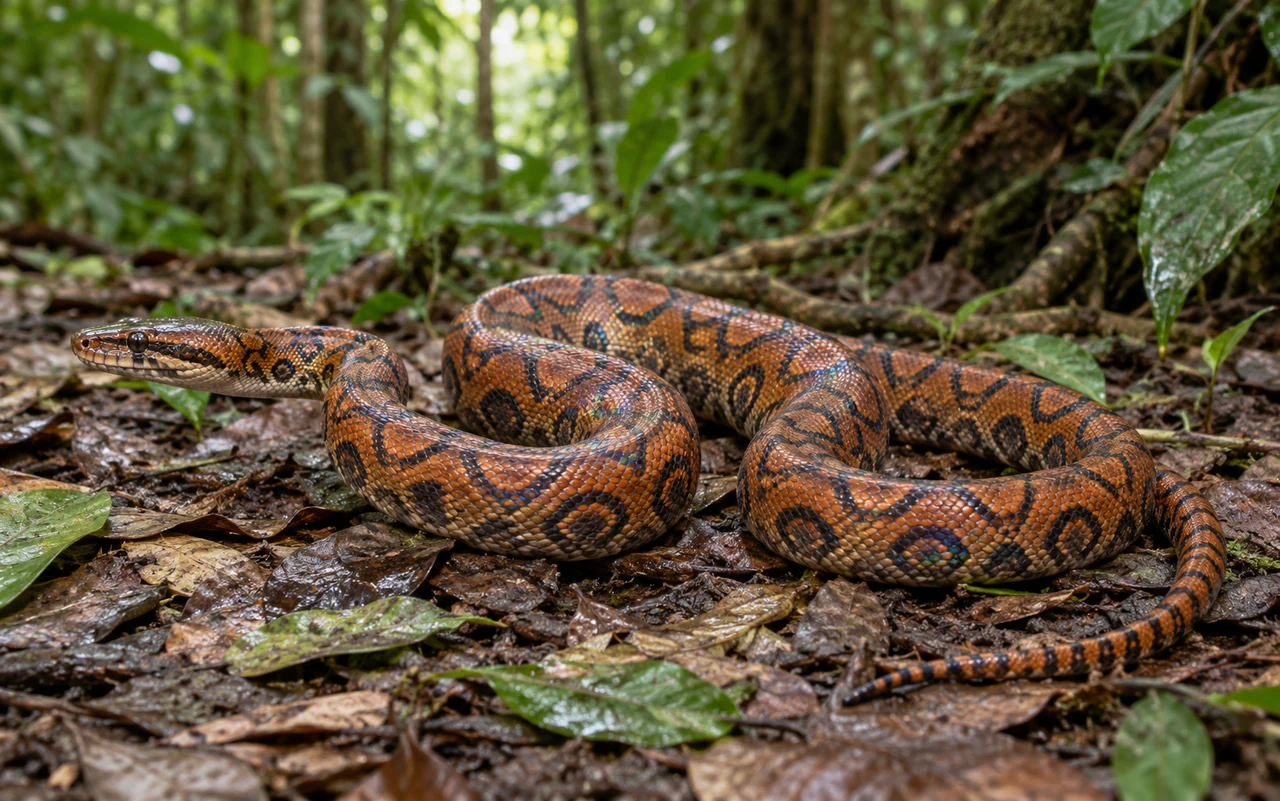
Meet the animal
Epicrates cenchria is a South American boa with ring-like markings and an iridescent sheen under suitable light. The sheen is not a permanent rainbow stripe. Confirm the species rather than applying this care to every animal called a rainbow boa.
Before you choose one
Plan for a large, strong animal and decades of care. Allow practical room for the proposed 210 cm enclosure and wet substrate load. First-year hydration needs closer management. Keep one boa and arrange experienced holiday cover and veterinary access.
Set up its home
The proposed adult layout is 210 × 90 × 90 cm, with usable internal length at least equal to the animal’s full length. Add strong branches, large warm and cool retreats, moisture-retaining substrate and a stable drinking or soaking basin. Seal joints as directed without removing ventilation.
Temperature and safe heating
Keeper guidance suggests a warm surface around 30–32°C, background air around 26–29°C and nights around 22–24°C. Have this plan checked for your individual animal. One source’s Fahrenheit conversion is wrong: 78–84°F is about 26–29°C. Check air and surfaces separately and control summer overheating.
Daylight, shade and UV
Provide daytime light, shaded branches and darkness overnight. The sources do not establish a settled species-specific UV target. Review measured exposure from a proposed low-output installation; iridescence and nocturnal activity cannot establish the required dose.
Water, moisture and airflow
Adult guidance often describes humidity around 70% by day with a night rise. Young boas need especially reliable damp refuges and hydration. Retain ventilation and drying contact surfaces: humid does not mean warm stagnant air or permanently wet skin. Keep drinking water clean and inspect refuges directly.
Food and nutrition
Offer suitable fully thawed whole rodents. Young boas may feed every one or two weeks; adults often need two to four weeks according to meal size and condition. Use a feeding tool with adequate reach for a large snake, and keep food preparation separate from handling.
Behaviour and handling
Expect evening activity, strong climbing and sheltered rest. Handle only after settling, outside the 48-hour post-meal period, with full body support and experienced help when necessary. Do not pull coils from branches. Rehearse maintenance rather than improvising restraint.
Health and life stages
Respiratory signs, burns, repeated regurgitation, dehydration or falling condition need a reptile vet. Record meals, weight, sheds, water use and minimum and maximum temperatures. Do not blindly increase both heat and misting when a problem appears.
Buying and keeping records
Choose documented captive-bred E. cenchria with age-specific feeding and care records. Retain origin documents and check current import or export controls. Household suitability depends on practical space and climate management as well as availability.
Your care routine
Before arrival, test refuges, moisture, air and surfaces and agree a heatwave response. Each day, check the boa, water and controls. Clean water facilities and inspect substrate and branches. Leave meal dates and clear moisture and cooling instructions for holiday cover.
YOUR CHECKLIST
0 of 8 ticked
Brazilian rainbow boa — Epicrates cenchria
Care hub: wildformexotics.co.uk/animals/brazilian-rainbow-boa/
Ticks are kept only while this page is open. Print or download a copy before leaving. Completing the checklist does not establish that an animal is well or an installation is safe.
Use these reminders alongside the full guide. Adjust feeding and maintenance to your animal’s condition and measured enclosure conditions.
Sources
- Brazilian rainbow boa care sheet (ReptiFiles)
- Reptile management and husbandry (Merck Veterinary Manual)
- UV-Tool: selecting appropriate UV lighting for reptiles and amphibians (2016) (Baines and colleagues, Journal of Zoo and Aquarium Research)
- Brazilian rainbow boa: exact UK species listing (Exotic-Pets.co.uk)
- CITES import and export guidance (APHA / GOV.UK)
- Guidance on section 14 of the Wildlife and Countryside Act (GOV.UK / Defra)
- Import of pet invertebrates, amphibians and reptiles: IIN (GOV.UK / APHA and Defra)
Equipment checklist
Equipment examples for Brazilian rainbow boa, grouped by care need. Read the checks before choosing. Shop links are Amazon affiliate links. Items without a verified Amazon match have no shop link.
Plan the whole setup: These examples cover only part of the setup. Meet every care need and test the finished enclosure before arrival. Suitable equipment you already own may meet the need; optional tools are labelled.
Check each item for your animal’s size and life stage, safe access, compatible controls and measured conditions. The list does not certify an installation.
Adult enclosure, substrate and shelter
Read the care guidance for this need
Also plan for: Add the substrate, hides, cover and secure supports described in the care guide. The enclosure alone does not provide them.
Temperature and safe heating
Read the care guidance for this need
Exo Terra Digital Thermometer
Model: PT2472
Records minimum and maximum air temperatures near a shelter your animal uses, to help you check the temperature plan.
Fit check: The remote probe measures air at one location. Keep it away from direct lamp heat, secure it safely and keep the display outside. Use separate probes for warm and cool areas where needed. Minimum/maximum readings help track changes; this device does not measure surfaces or control heating. Use a water-rated thermometer for submerged readings.
HabiStat Digital Dimming Thermostat Day/Night + Timer
Model: HTDD
Only for a compatible heater when extra heat is needed
Controls a compatible heater and allows separate day/night settings.
Fit check: HTDD controls compatible heaters up to 600 W, with no minimum load and a 0–50°C setting range. Socket I regulates the heater; socket II switches a separately verified load on a timer without temperature control. Never connect UVB to the dimming heater socket; the 600 W rating does not confirm T5 ballast compatibility. Guard the heater, secure the probe as instructed without tape and keep electrics dry. Check warm and cool areas with independent thermometers. The controller cannot cool a hot enclosure.
Zoo Med ReptiTemp Digital Infrared Thermometer
Model: RT-1
Checks basking and other occupied surface temperatures separately from air readings.
Fit check: Use this for surface temperatures, with air probes for air readings. Follow the distance and spot-size instructions, and account for reflective surfaces. It cannot measure internal body temperature.
Lighting, shade and UV
Read the care guidance for this need
Existing lighting may already provide a suitable day-night cycle. If you need extra lighting, use a switch or timer confirmed as compatible with its exact load, including any UVB ballast.
Solarmeter Model 6.5R UV Index Meter
Model: 6.5R
Use your own meter or arrange an exposure check
Measures UV Index at the animal’s reachable back height, with the screen and guards fitted.
Fit check: Use a 6.5 or 6.5R UV Index meter, rather than a UVB irradiance meter. Measure all reachable positions and shaded retreats through the fitted screen and guards. You can borrow a suitable meter or arrange a competent exposure check instead of buying one. Confirm UK supply if buying.
Also plan for: Agree a lighting and UV exposure plan for your animal before choosing a lamp. Keep a regular day-night cycle and accessible shade. No lamp model is selected here.
Water, humidity and ventilation
Read the care guidance for this need
Alternative equipment
Exo Terra Mini Mister — 0.5 L
PT2489; 0.5 L hand spray bottle. The Amazon title uses 16 US fluid ounces; this is not the conflicting 1.5/2 L pressure sprayer.
Adjust to the species: do not spray the animal directly, soak every surface or treat a mister as a substitute for drinking water. Use an existing suitable fine sprayer if you have one. Follow the individual wet-dry cycle; do not spray the animal, soak every surface or substitute misting for drinking water.
A manual misting tool only where the individual care plan calls for it. Use clean water, keep the bottle hygienic and free of chemicals, and do not spray directly at the animal. Check substrate/refuge moisture and drying/airflow rather than misting to a universal schedule.
Exo Terra Digital Hygrometer
Model: PT2477
Tracks the air humidity cycle near an occupied area.
Fit check: Place the remote humidity sensor inside the enclosure, away from direct heat. The reading describes air at that point, so record its position and check other areas where needed. Inspect the substrate and damp retreats directly, and keep ventilation clear. A humidity reading cannot show whether an animal has drinking water.
Also plan for: Provide the drinking water, damp retreats or safe water area described in the care guide. A sprayer and humidity gauge cannot provide these on their own.
Feeding and nutrition
Read the care guidance for this need
Also plan for: Offer suitable fully thawed whole rodents.
Equipment notes: Temperature and safe heating
EQUIPMENT TO CONSIDER
Exo Terra Digital Thermometer
Model PT2472 · Remote air probe and minimum/maximum memory; place away from direct lamp radiation. Check the supplier’s current price and availability, and confirm that the item suits your installation.
Records minimum and maximum air temperatures near a shelter your animal uses, to help you check the temperature plan.
Check before choosing: The remote probe measures air at one location. Keep it away from direct lamp heat, secure it safely and keep the display outside. Use separate probes for warm and cool areas where needed. Minimum/maximum readings help track changes; this device does not measure surfaces or control heating. Use a water-rated thermometer for submerged readings.
EQUIPMENT TO CONSIDER
HabiStat Digital Dimming Thermostat Day/Night + Timer
Only for a compatible heater when extra heat is needed
Model HTDD · 600 W maximum, no minimum load; setting range 0–50°C. Socket II is timed; this model does not actively cool. Check the supplier’s current price and availability, and confirm that the item suits your installation.
Controls a compatible heater and allows separate day/night settings.
Check before choosing: HTDD controls compatible heaters up to 600 W, with no minimum load and a 0–50°C setting range. Socket I regulates the heater; socket II switches a separately verified load on a timer without temperature control. Never connect UVB to the dimming heater socket; the 600 W rating does not confirm T5 ballast compatibility. Guard the heater, secure the probe as instructed without tape and keep electrics dry. Check warm and cool areas with independent thermometers. The controller cannot cool a hot enclosure.
EQUIPMENT TO CONSIDER
Zoo Med ReptiTemp Digital Infrared Thermometer
Model RT-1 · Measures surfaces, not air. Check distance/spot size and reflective-surface limitations. Check the supplier’s current price and availability, and confirm that the item suits your installation.
Checks basking and other occupied surface temperatures separately from air readings.
Check before choosing: Use this for surface temperatures, with air probes for air readings. Follow the distance and spot-size instructions, and account for reflective surfaces. It cannot measure internal body temperature.
Equipment notes: Daylight, shade and UV
EQUIPMENT TO CONSIDER
Solarmeter Model 6.5R UV Index Meter
Use your own meter or arrange an exposure check
Model 6.5R · UV Index meter; take readings at accessible back height with screen and guards installed. Check the supplier’s current price and availability, and confirm that the item suits your installation.
Measures UV Index at the animal’s reachable back height, with the screen and guards fitted.
Check before choosing: Use a 6.5 or 6.5R UV Index meter, rather than a UVB irradiance meter. Measure all reachable positions and shaded retreats through the fitted screen and guards. You can borrow a suitable meter or arrange a competent exposure check instead of buying one. Confirm UK supply if buying.
Equipment notes: Water, moisture and airflow
Alternative equipment
Exo Terra Mini Mister — 0.5 L
PT2489; 0.5 L hand spray bottle. The Amazon title uses 16 US fluid ounces; this is not the conflicting 1.5/2 L pressure sprayer.
Adjust to the species: do not spray the animal directly, soak every surface or treat a mister as a substitute for drinking water. Use an existing suitable fine sprayer if you have one. Follow the individual wet-dry cycle; do not spray the animal, soak every surface or substitute misting for drinking water.
A manual misting tool only where the individual care plan calls for it. Use clean water, keep the bottle hygienic and free of chemicals, and do not spray directly at the animal. Check substrate/refuge moisture and drying/airflow rather than misting to a universal schedule.
EQUIPMENT TO CONSIDER
Exo Terra Digital Hygrometer
Model PT2477 · Remote humidity probe; readings describe air at the probe, not substrate moisture. Check the supplier’s current price and availability, and confirm that the item suits your installation.
Tracks the air humidity cycle near an occupied area.
Check before choosing: Place the remote humidity sensor inside the enclosure, away from direct heat. The reading describes air at that point, so record its position and check other areas where needed. Inspect the substrate and damp retreats directly, and keep ventilation clear. A humidity reading cannot show whether an animal has drinking water.