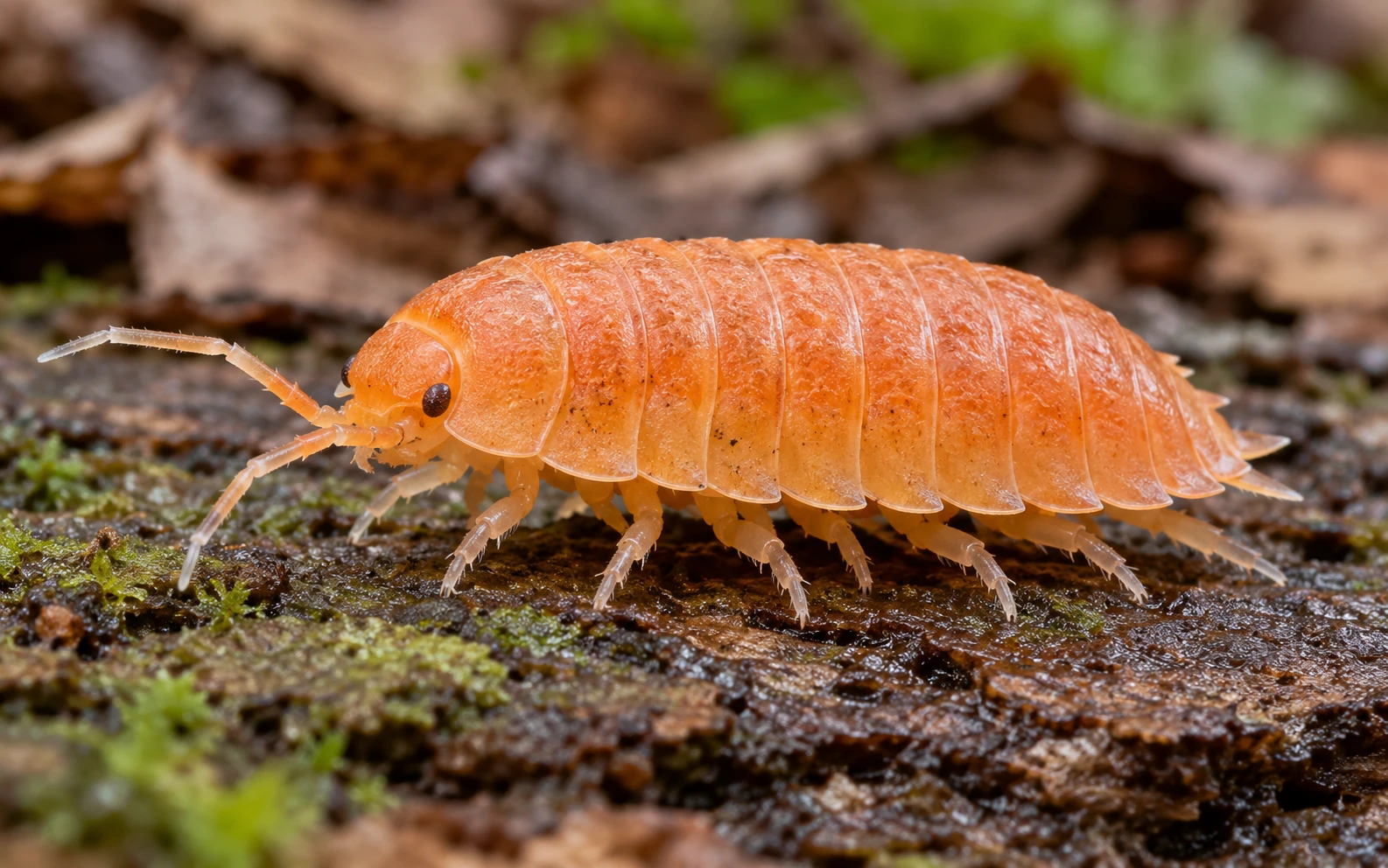
Meet the animal
Powder orange is a trade colour-line name for Porcellionides pruinosus, not a separate species. The usual appearance is powdery blue-grey, and colour alone cannot verify identity. Keep the supplier’s scientific name and colony history. British records often associate this woodlouse with compost and decomposing material; untreated compost is not automatically safe enclosure material.
Before you choose one
One published estimate gives individual lives of two to three years, while the colony can continue through many generations. Plan for population growth, spare space and holiday checks. Their speed and small size make watching under a shelter more practical than regular handling.
Set up its home
Provide escape-resistant ventilation, soil, leaf litter and low bark cover. About 5 cm of substrate is one published culture method, with enough floor area to separate damp shelter from less damp litter. Retain juveniles as well as adults with suitable ventilation gaps. Expand the container before the growing population exhausts its usable habitat.
Temperature and safe heating
The Minibeast guide suggests around 18–26°C as practical husbandry guidance, not a tested optimum. Measure your culture and avoid abrupt changes, sunlit windowsills and uncontrolled heating. A warm organic refuge in nature does not mean every corner of a pet container should be heated.
Daylight, shade and UV
Ordinary room daylight provides a useful day-night cycle. Keep shaded bark and leaf cover available. No quantified species-specific UVB requirement is established in this review, so additional reptile UV lighting is not a default culture need.
Water, moisture and airflow
Inspect the soil beneath the damp refuge, keeping it moist without making the whole container wet. Misting the lid does not restore a dry refuge below. Leave less damp areas and clear ventilation so animals can choose. Check these conditions when appetite or activity changes.
Food and nutrition
Keep decaying leaves available as the main food, with calcium and small supplementary portions. Check consumption before adding more and remove spoiled extras. A rapidly growing colony may need more litter and space, not a larger pile of rich food. If used in a bioactive enclosure, it does not remove your duty to clean waste.
Behaviour and handling
Expect many animals to remain sheltered. Use one inspection point and transfer gently on bark or with established substrate. Newly moulted animals and tiny offspring are easy to injure, so avoid shaking them loose or handling them with fingers.
Health and life stages
Females carry developing young in a brood pouch. Preserve sheltered spaces and plan for continuing population growth. Repeated deaths should prompt a check of recent food, water, substrate and new additions with an experienced keeper. Do not apply pest treatments or reptile medicines to the culture.
Buying and keeping records
Keep records of species, colour line, supplier and transfers. Do not merge uncertain stock just because it looks orange. Keep animals and substrate out of gardens and natural waters. Isopods are crustaceans and excluded from the ordinary pet-invertebrate import note; ask APHA about an intended import before ordering.
Your care routine
Establish the habitat and a spare culture before relying on the animals in another enclosure. Check damp shelter, food use and unusual losses regularly; replenish litter and remove spoiled supplements. Record additions and transfers so a problem can be traced without disturbing every colony.
YOUR CHECKLIST
0 of 6 ticked
Powder orange isopods — Porcellionides pruinosus
Care hub: wildformexotics.co.uk/animals/bioactive-animal-6/
Ticks are kept only while this page is open. Print or download a copy before leaving. Completing the checklist does not establish that an animal is well or an installation is safe.
Use these reminders alongside the full guide. Adjust feeding and maintenance to your animal’s condition and measured enclosure conditions.
Sources
- Porcellionides pruinosus (British Myriapod and Isopod Group)
- Plum slater care guide (Minibeast Wildlife)
- Isopod care information (Springtails US)
- Effects of moisture decrease on behavioural and life history traits in three terrestrial isopods (European Zoological Journal (2023))
- Importing non-native animals (GOV.UK / APHA and Defra)
- Import of pet invertebrates, amphibians and reptiles: IIN (GOV.UK / APHA and Defra)
- Guidance on section 14 of the Wildlife and Countryside Act (GOV.UK / Defra)
- Import or export endangered species: check if you need a CITES permit (GOV.UK / APHA and Defra)
Equipment checklist
Equipment examples for Powder orange isopods, grouped by care need. Read the checks before choosing. Shop links are Amazon affiliate links. Items without a verified Amazon match have no shop link.
Plan the whole setup: These examples cover only part of the setup. Meet every care need and test the finished enclosure before arrival. Suitable equipment you already own may meet the need; optional tools are labelled.
Check each item for your animal’s size and life stage, safe access, compatible controls and measured conditions. The list does not certify an installation.
Contained habitat
Essential care need
Secure ventilation and gaps smaller than the animal or nymph
Plan first: Check escape points and whether the animal needs height, floor area or substrate depth.
Also plan for: Choose a ventilated colony vessel that retains the smallest young as well as adults. Preserve a damp/drier substrate gradient and edible leaves; ordinary drilled vents may need secured breathable barriers.
Moisture and monitoring
Essential care need
A species-specific damp refuge or drinking access with airflow
Plan first: Check the places your animal uses and how they dry between wettings. A single humidity reading cannot describe the whole enclosure.
Alternative equipment
Exo Terra Mini Mister — 0.5 L
PT2489; 0.5 L hand spray bottle. The Amazon title uses 16 US fluid ounces; this is not the conflicting 1.5/2 L pressure sprayer.
Use an existing suitable fine sprayer if you have one. Follow the individual wet-dry cycle; do not spray the animal, soak every surface or substitute misting for drinking water.
A manual misting tool only where the individual care plan calls for it. Use clean water, keep the bottle hygienic and free of chemicals, and do not spray directly at the animal. Check substrate/refuge moisture and drying/airflow rather than misting to a universal schedule.
Exo Terra Digital Thermometer
Model: PT2472
Measure air temperature at animal height. Take independent warm and cool readings where the care plan needs a gradient.
Fit check: The remote probe measures air at one location. Keep it away from direct lamp heat, secure it safely and keep the display outside. Use separate probes for warm and cool areas where needed. Minimum/maximum readings help track changes; this device does not measure surfaces or control heating. Use a water-rated thermometer for submerged readings.
Food and maintenance
Essential care need
Clean continuing food supply and a way to remove spoilage
Plan first: Select tools and food for the exact species and life stage; do not substitute generic reptile supplements.
Alternative equipment
Zoo Med Turtle Bone — two-pack
TB-1; two natural cuttlebones, not a 100 g pack. Manufacturer lists cuttlebone as the sole ingredient.
Use only in the species-specific substrate/food plan. Prepare safely, keep free of contaminants and verify depth and moisture. This product alone does not provide the complete diet or habitat.
A plain supplemental calcium component for the listed detritivore plan. Check the delivered label and remove any packaging or holder. It does not replace decayed leaves, decomposed wood or a complete species-appropriate food substrate.
Also plan for: Provide the edible leaves and supplementary food your species needs. Wood and cuttlebone are only part of the diet.
Colony substrate and cover
Essential care need
Clean organic substrate, leaf litter, bark and a moisture gradient
Plan first: Avoid pesticides, standing water, full substrate changes and release of captive material.
Alternative equipment
Zoo Med Natural Cork Round — select actual dimensions
Three natural small cork rounds; lengths, openings and shapes vary. One natural medium cork round; lengths, openings and shapes vary.
Choose actual dimensions and openings for this individual, support securely and avoid trapping or fall hazards. This is one component, not the complete set of retreats, broad resting surfaces or a grippable moult ceiling.
Select and, where appropriate, cut an actual piece to fit the animal and enclosure. Secure it without trapping gaps and keep hard pieces outside tarantula fall zones. Cork is a refuge or climbing component, not food substrate or a complete moulting ceiling.
Use only if the actual delivered opening and length fit the animal and leave its required usable enclosure space. Secure the piece and avoid hard fall zones. This option is not an automatic upgrade for a small spider enclosure.