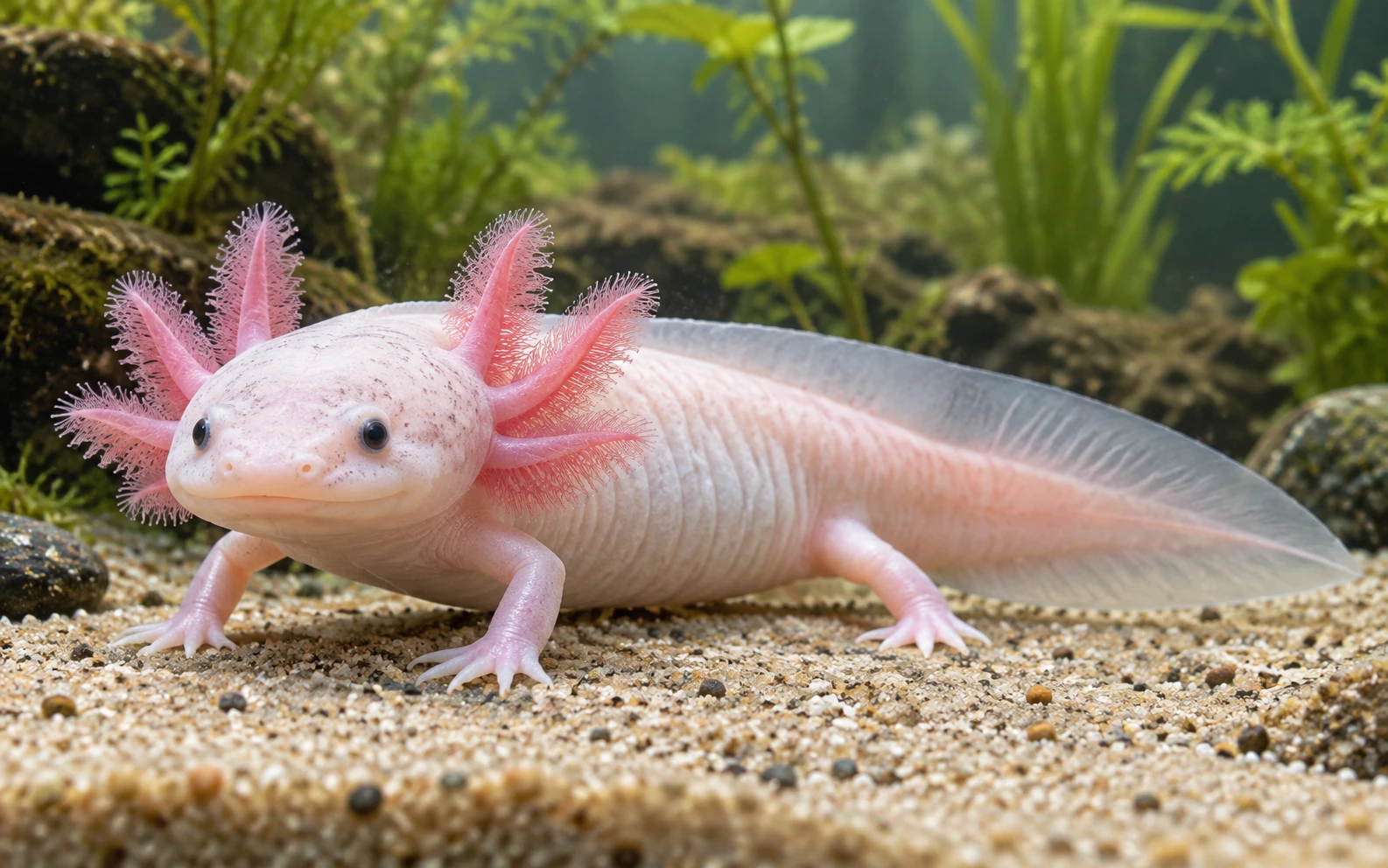
Meet the animal
Ambystoma mexicanum is a salamander from the lake system around Mexico City. Adults normally keep external gills and remain aquatic. Domestic colours do not prove wild ancestry or conservation value. Regeneration does not protect an animal from injury or infection.
Before you choose one
Plan for a 25–30 cm adult and a decade or more of care. Keep one animal for observation, with daily checks, water-testing supplies and an amphibian vet. Arrange holiday care and a workable hot-weather plan in advance.
Set up its home
Plan around the larger published adult aquarium size of about 110 litres, with more floor area where possible. Another veterinary guide lists 78 litres. Account for the actual water left after furnishings. Use smooth hides and a secure lid. A bare base helps quarantine monitoring. Avoid swallowable gravel, sharp objects and fish companions.
Temperature and safe heating
University and veterinary guidance overlap around 16–18°C water as a planning band. Measure the aquarium through summer afternoons. Sustained warming towards 22°C needs prompt correction. Choose cooling before a heatwave and avoid sudden improvised changes. Diffuse the filter outlet so the animal can rest without strong current.
Daylight, shade and UV
Provide a day-night rhythm and shaded shelters. Avoid a brightly lit, exposed display. The reviewed sources do not establish a pet axolotl UVI target; do not improvise a reptile basking lamp above the aquarium.
Water, moisture and airflow
Cycle the biological filter before arrival and confirm it by testing. Aim for no measurable ammonia or nitrite and keep nitrate low, using around 20 mg/L as a practical working ceiling. Test replacement water, treat chlorine and chloramine, and avoid distilled water alone. Very low nitrate in a planted tank does not itself mean the cycle failed.
Food and nutrition
Offer suitably sized earthworms and a nutritionally suitable complete axolotl pellet. Bloodworms alone are not a complete adult diet. Young animals commonly need daily small meals; adults often start at two or three meals weekly or every other day. Adjust to condition and remove leftovers promptly.
Behaviour and handling
Leave the axolotl in water during ordinary care. For necessary transfers, use a smooth container instead of gripping delicate gills and limbs. Keep animals separately to avoid biting and unintended mating. Watching resting, feeding and movement is more useful than handling.
Health and life stages
Gill deterioration, persistent abnormal floating, wounds, swelling or sustained appetite loss need water tests and prompt amphibian-veterinary advice. Bring chemistry and temperature records. Do not try fish medicines, salt baths, refrigeration or forced metamorphosis as home remedies. Eggs and larvae need a separate specialist plan.
Buying and keeping records
Choose documented captive-bred stock and retain identification and seller records. Check current CITES and movement requirements before any import or export. Never release animals, eggs or aquarium material into natural waters.
Your care routine
Verify filtration, safe housing, water treatment and cooling before arrival. Each day, observe the animal and remove waste and food remains. Use test results to guide partial water changes. Preserve mature filter media and clean it gently in removed aquarium water when needed, rather than disinfecting or replacing all of it.
YOUR CHECKLIST
0 of 6 ticked
Axolotl — Ambystoma mexicanum
Care hub: wildformexotics.co.uk/animals/axolotl/
Ticks are kept only while this page is open. Print or download a copy before leaving. Completing the checklist does not establish that an animal is well or an installation is safe.
Use these reminders alongside the full guide. Adjust feeding and maintenance to your animal’s condition and measured enclosure conditions.
Sources
- Axolotl care sheet (2025) (The Unusual Pet Vets)
- Guide to axolotl husbandry (Ambystoma Genetic Stock Center / University of Kentucky)
- Caring for Your Axolotl (Canobie Lake Veterinary Hospital)
- How to look after axolotls and aquatic frogs (OATA)
- Axolotl Guide (2024) (Ambystoma Genetic Stock Center / University of Kentucky)
- The import of live amphibians of the order Caudata (Cefas / GOV.UK)
- Import or export endangered species: check if you need a CITES permit (GOV.UK / APHA and Defra)
- Guidance on section 14 of the Wildlife and Countryside Act (GOV.UK / Defra)
- Import of pet invertebrates, amphibians and reptiles: IIN (GOV.UK / APHA and Defra)
Equipment checklist
Equipment examples for Axolotl, grouped by care need. Read the checks before choosing. Shop links are Amazon affiliate links. Items without a verified Amazon match have no shop link.
Plan the whole setup: These examples cover only part of the setup. Meet every care need and test the finished enclosure before arrival. Suitable equipment you already own may meet the need; optional tools are labelled.
Check each item for your animal’s size and life stage, safe access, compatible controls and measured conditions. The list does not certify an installation.
Aquarium and secure lid
Essential care need
Broad adult swimming floor with a fitted, escape-proof lid
Plan first: Support the filled aquarium safely; measure the warmest water zone and keep the tank away from sunlight.
Alternative equipment
Diversa aquarium with LED lid — nominal 200 L
Selected 200 L / 100 × 40 × 50 cm tank variant; retailer lists 100 × 40 × 56 cm including hood and 8 mm glass. Tank and LED lid only; no filter, heater, stand or cooling package is claimed.
Check actual usable floor area and water volume after furnishings against the axolotl care plan. Support the filled tank on a suitable stand and secure the lid and all cable openings. Provide smooth hides, shade and a safe bare or otherwise approved base; avoid swallowable gravel. The included viewing LED can remain off. Specify and cycle a gentle-flow filter separately, protect its intake and plan summer cooling; a lid and nominal volume do not complete the habitat.
Water filtration and testing
Essential care need
Gentle established filtration and a complete water test kit
Plan first: Protect intakes, avoid strong current and verify water quality before and after maintenance.
API Freshwater Master Test Kit
Check pH, ammonia, nitrite and nitrate while establishing and maintaining the aquarium’s biological cycle.
Fit check: Tests pH, high-range pH, ammonia, nitrite and nitrate. Follow reagent instructions and expiry dates; hardness tests are separate when required by the water plan.
Cooling and temperature checks
Essential care need
Stable cool-water plan suitable for the room’s warmest season
Plan first: Use an independent thermometer; do not rely on frozen bottles or heater dials as measured control.
JBL Aquarium Thermometer Slim
Model: 6140700
Read the aquarium’s water temperature directly, including during warm weather.
Fit check: 15 cm glass aquarium thermometer with suction holder, range 0–50°C. Fix securely where the reading represents the water the animal occupies, inspect for damage and cross-check uncertain readings. This measures temperature; it does not cool the aquarium. Confirm a UK supplier for this exact model.
Also plan for: Choose a cooling system for the room’s summer conditions and the actual water volume. The thermometer below measures water temperature but cannot provide cooling; heater dials and frozen bottles do not fulfil this need.
Smooth cover and substrate
Essential care need
Stable hides and no swallowable loose stones
Plan first: Check that decor has no sharp edges, trapping gaps or unstable stacks.
Also plan for: Use a smooth aquatic-safe hide the animal can enter and leave freely, with the source-linked base/substrate plan. No terrestrial cave, gravel or swallowable décor is selected.
Aquatic food and cleaning
Essential care need
Species-appropriate food, feeding tools and waste removal
Plan first: Use food from traceable sources and remove leftovers without disrupting biological filtration.
Exo Terra Bamboo Tweezers Small 28 cm
Model: PT2076
Optional food-placement or maintenance tool
Place or remove small food items without gripping the animal.
Fit check: Use for placing food or removing leftovers, never for gripping the animal, forcing a bite or striking its mouth. Keep tools separate between quarantine groups. Choose food and supplements separately for the species. This does not replace the axolotl’s aquatic cleaning equipment.
Seachem Prime 100 ml
Treat replacement water for chlorine and chloramine before use.
Fit check: Use only when new water needs chlorine or chloramine treatment. Prepare suitable replacement water in a separate container at the current label dose, and confirm the amphibian plan with a vet. Conditioner cannot replace cycling, water tests, changes or a safe basin. Do not use emergency overdoses or treat it as medicine.