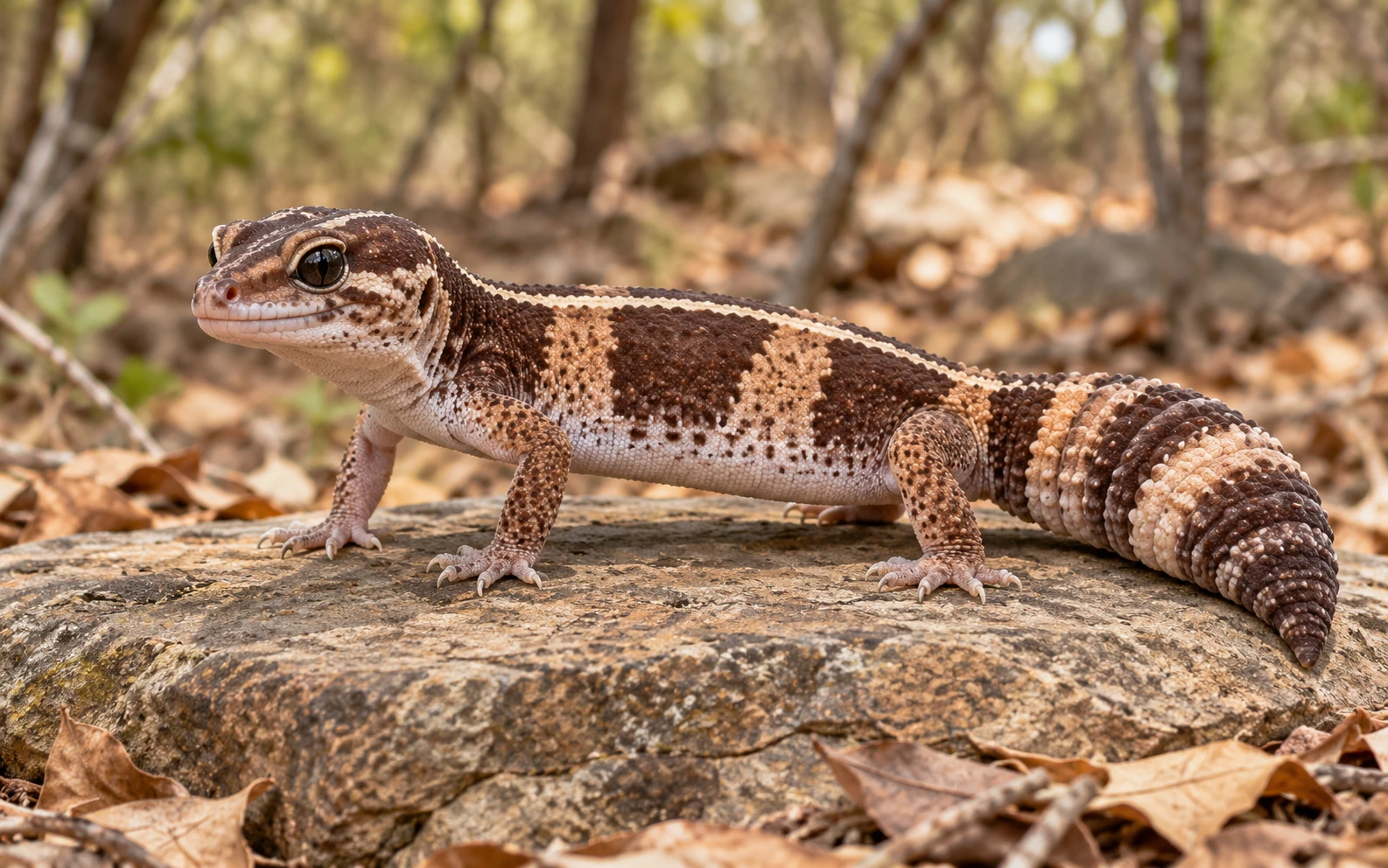
Meet the animal
Hemitheconyx caudicinctus is a ground-dwelling West African gecko with movable eyelids and a substantial tail. Savanna and woodland habitats include sheltered moisture. Captive colours and patterns do not identify a separate species or prove locality.
Before you choose one
Plan a long-term commitment and keep one gecko. Published size and longevity estimates vary, so ask about the individual’s age, feeding and health records. Budget for live insects, replacement lighting and a reptile vet.
Set up its home
Specialist guidance starts at about 91 × 46 × 46 cm for an adult; more usable space is welcome. Provide snug warm and cool hides, a damp retreat, low climbing and clean water. A soil-based digging layer around 10 cm is one practical example; paper can help quarantine but cannot replace damp shelter.
Temperature and safe heating
ReptiFiles describes a warm-season hide around 32–34°C and cooler areas around 22–25°C. Maintain a measured warm-to-cool choice and thermostat-controlled heat. Its separate seasonal programme is not an instruction to chill every pet. Have cooling reviewed individually, especially for young or unwell animals.
Daylight, shade and UV
Provide a day-night rhythm and darkness overnight. Specialist guidance suggests UVI 1–2 with shade. Check this measured UV Index at reachable positions through the fitted screen and coordinate supplements with the installation. Exact species-wide optima remain uncertain.
Water, moisture and airflow
Keep a reliably moist hide, drinking water and a substrate moisture gradient. The specialist source distinguishes wet and dry seasons, so one constant percentage would misrepresent its plan. Inspect damp material, retain airflow and avoid standing water. Review seasonal changes before applying them.
Food and nutrition
Offer varied cultured insects, gut-loaded before use, with coordinated calcium and vitamins. Young geckos need frequent small meals; adults usually need fewer feeding days. Follow weight and condition rather than tail size alone. Remove biting leftovers and avoid a diet made entirely of rich larvae.
Behaviour and handling
Expect much activity around darkness. Let the gecko step onto support and keep contact brief and low. Never restrain it by the tail. Give it hiding and digging choices inside the enclosure rather than relying on handling for activity.
Health and life stages
Check toes after shedding. Retained skin, weakness, abnormal limbs, wounds, diarrhoea or progressive weight loss need a reptile vet. Females need suitable digging access around egg production. Do not peel skin, force-feed or copy breeding manipulation into ordinary care.
Buying and keeping records
Choose documented captive-bred stock and clarify the seller’s existing food and conditions. Keep identification and origin records and check current rules before importing. Quarantine separately and keep cleaning tools away from kitchens and other animals’ equipment.
Your care routine
Test warm, cool and damp choices before arrival. Each day, check the gecko, water and controls. Remove waste and prey and inspect damp hides for fouling. A bioactive enclosure still needs drainage checks and a plan to isolate an unwell animal.
YOUR CHECKLIST
0 of 7 ticked
African fat-tailed gecko — Hemitheconyx caudicinctus
Care hub: wildformexotics.co.uk/animals/african-fat-tailed-gecko/
Ticks are kept only while this page is open. Print or download a copy before leaving. Completing the checklist does not establish that an animal is well or an installation is safe.
Use these reminders alongside the full guide. Adjust feeding and maintenance to your animal’s condition and measured enclosure conditions.
Sources
- Hemitheconyx caudicinctus (The Reptile Database)
- Hemitheconyx caudicinctus (Animal Diversity Web / University of Michigan)
- African fat-tailed gecko care sheet (ReptiFiles)
- Leopard geckos and African fat-tails (Winter Park Veterinary Hospital)
- Importing non-native animals (GOV.UK / APHA and Defra)
- Import or export endangered species: check if you need a CITES permit (GOV.UK / APHA and Defra)
- Guidance on section 14 of the Wildlife and Countryside Act (GOV.UK / Defra)
- Import of pet invertebrates, amphibians and reptiles: IIN (GOV.UK / APHA and Defra)
Equipment checklist
Equipment examples for African fat-tailed gecko, grouped by care need. Read the checks before choosing. Shop links are Amazon affiliate links. Items without a verified Amazon match have no shop link.
Plan the whole setup: These examples cover only part of the setup. Meet every care need and test the finished enclosure before arrival. Suitable equipment you already own may meet the need; optional tools are labelled.
Check each item for your animal’s size and life stage, safe access, compatible controls and measured conditions. The list does not certify an installation.
Secure enclosure
Essential care need
Usable adult dimensions and escape-proof ventilation
Plan first: Verify inside measurements after décor and lamp guards; choose floor or climbing style for the species.
Alternative equipment
Repti-Life 72 × 24 × 24 inch vivarium — black
Amazon-selected 72 × 24 × 24 inch black flat-pack; 18 mm MFC, 4 mm toughened glass, six vents. External/nominal sizing, not certified usable space.
External dimensions are not usable internal space. Check actual individual size, access, secure gaps, load support, furnishing clearance and any substrate depth before choosing this example.
This is an 18 mm melamine-faced chipboard enclosure with glass doors. Check the delivered internal length, depth and height against the care requirement after substrate, guards and furnishings; the inch label is external/nominal and is not proof of usable dimensions. Fit a suitable lock, protect board edges and keep water in watertight containers. Do not use unprotected board for a wet substrate build. Choose larger housing if any usable dimension or full-body extension fails.
Temperature control and measurement
Essential care need
A thermostat for every heat source plus independent warm/cool readings
Plan first: Match dimming or on/off control to the heater, guard exposed lamps and put probes at animal level.
Exo Terra Digital Thermometer
Model: PT2472
Measure air temperature at animal height. Take independent warm and cool readings where the care plan needs a gradient.
Fit check: The remote probe measures air at one location. Keep it away from direct lamp heat, secure it safely and keep the display outside. Use separate probes for warm and cool areas where needed. Minimum/maximum readings help track changes; this device does not measure surfaces or control heating. Use a water-rated thermometer for submerged readings.
HabiStat Digital Dimming Thermostat Day/Night + Timer
Model: HTDD
Only for a compatible heater when extra heat is needed
Regulate a compatible heater using separate day and night settings. The thermostat does not produce heat.
Fit check: HTDD controls compatible heaters up to 600 W, with no minimum load and a 0–50°C setting range. Socket I regulates the heater; socket II switches a separately verified load on a timer without temperature control. Never connect UVB to the dimming heater socket; the 600 W rating does not confirm T5 ballast compatibility. Guard the heater, secure the probe as instructed without tape and keep electrics dry. Check warm and cool areas with independent thermometers. The controller cannot cool a hot enclosure.
Zoo Med ReptiTemp Digital Infrared Thermometer
Model: RT-1
Spot-check basking surfaces and other accessible surfaces; use an air probe for air temperature.
Fit check: Use this for surface temperatures, with air probes for air readings. Follow the distance and spot-size instructions, and account for reflective surfaces. It cannot measure internal body temperature.
Also plan for: Select the heat source, fitting and guard for this enclosure and room before buying the controller; no heater wattage is selected here.
Lighting and shade
Essential care need
A predictable day/night cycle and species-appropriate measured UV gradient
Plan first: Check the installed lamp, mesh, distance and animal-accessible basking position; preserve zero-UV shade.
Arcadia ShadeDwellerPro 8 W 7% UV-B Kit
Model: RARTP8S
Provide a measured UV option alongside warm and cool opaque retreats.
Fit check: RARTP8S is a 8 W, 315 mm UK 220–240 V fitting. Keep it away from water and spray; IP20 is not waterproof. Follow the manufacturer’s minimum animal clearance of 250 mm. This is a safety limit, not a recommended mounting height or UVI target. Check the complete fitting length, guards and reachable animal positions. Measure UV Index through the installed screen at each reachable height, with full shade available. Use a separately verified lighting circuit, never a heater’s dimming outlet. Allow for pigmentation and keep opaque warm and cool retreats.
Solarmeter Model 6.5R UV Index Meter
Model: 6.5R
Use your own meter or arrange an exposure check
Measure UV Index at the animal’s reachable basking and resting positions, with the fitted screen and guards in place.
Fit check: Use a 6.5 or 6.5R UV Index meter, rather than a UVB irradiance meter. Measure all reachable positions and shaded retreats through the fitted screen and guards. You can borrow a suitable meter or arrange a competent exposure check instead of buying one. Confirm UK supply if buying.
Also plan for: If a timer is needed, choose one confirmed as compatible with the actual lighting load, including the UVB ballast. A suitable existing timed socket may meet the need.
Water and hygiene
Essential care need
Accessible clean water and species-safe cleaning tools
Plan first: Choose a stable bowl/ledge sized for the animal and clean it when fouled.
Exo Terra Water Dish Small
Model: PT2801
Provide accessible drinking water in a small, clean dish.
Fit check: PT2801 measures 5.5 × 6.5 × 3 cm externally. Check the usable basin, stability, safe water depth and easy entry and exit for your animal. Outside measurements do not establish a soaking fit. Clean and refresh water at least daily and whenever soiled. This is a small drinking dish, not an adult snake, dragon, frog or tortoise basin. Tiny spiderlings may need a smaller receptacle.
Ground cover and hides
Essential care need
Secure warm/cool retreats and a substrate matched to age and health
Plan first: Avoid sharp material and collapse risks; use a separate clean humid hide when required.
Also plan for: Select and fit separate warm and cool retreats and a suitable substrate for this individual. One medium cave is only a component; its external dimensions do not prove that the animal fits.
Humid retreat
Essential care need
A clean hide with a locally moist substrate
Plan first: Keep a moist refuge alongside ventilation and a drier choice; inspect during shedding.
Alternative equipment
Exo Terra Mini Mister — 0.5 L
PT2489; 0.5 L hand spray bottle. The Amazon title uses 16 US fluid ounces; this is not the conflicting 1.5/2 L pressure sprayer.
Use an existing suitable fine sprayer if you have one. Follow the individual wet-dry cycle; do not spray the animal, soak every surface or substitute misting for drinking water.
A manual misting tool only where the individual care plan calls for it. Use clean water, keep the bottle hygienic and free of chemicals, and do not spray directly at the animal. Check substrate/refuge moisture and drying/airflow rather than misting to a universal schedule.
Also plan for: Select and prepare the actual humid hide and its locally moist material. The sprayer alone does not provide a sheltered humid retreat.
Feeder insect care
Essential care need
Secure feeder storage and appropriately sized prey
Plan first: Gut-load feeders and remove uneaten insects; coordinate supplements with UV exposure.
Exo Terra Bamboo Tweezers Small 28 cm
Model: PT2076
Optional food-placement or maintenance tool
Place or remove small food items without gripping the animal.
Fit check: Use for placing food or removing leftovers, never for gripping the animal, forcing a bite or striking its mouth. Keep tools separate between quarantine groups. Choose food and supplements separately for the species.
Also plan for: Provide secure feeder housing, manageable gut-loaded prey and the species-specific supplement plan. The optional tweezers do not provide food or feeder storage.